Showing posts with label St. Louis Rams. Show all posts

Thursday, February 3, 2011

2002: Patriots Stun Rams to Win Super Bowl XXXVI


Super Bowl XXXVI on February 3, 2002 looked to be a blowout in the making. The St. Louis Rams, with a 14-2 record and seeking to win two titles in three years, were up against the 11-5 New England Patriots, who had come from nowhere and were not considered to be of the same caliber.

The Rams, under Head Coach Mike Martz, entered the 2001 season expecting to contend for a title. They boasted the NFL’s most explosive offense, led by QB Kurt Warner, the league leader in passing (101.4 rating), passing yards (4830), touchdowns (36), completions (375), yards per attempt (8.8), and completion percentage (68.7) as well as league MVP choice of the Associated Press and NEA. Wide receivers Isaac Bruce and Torry Holt were both Pro Bowl performers. RB Marshall Faulk, who ran for 1382 yards and gained another 765 on 83 catches, garnered the other MVP trophies (Pro Football Writers Association and Bert Bell Award). The unheralded defense benefited from the addition of 33-year-old CB Aeneas Williams. Having won the NFC West with the league’s best record, St. Louis routed the Packers in the Divisional playoff and then got past the Eagles to win the conference title.

In 2000, the first year under Head Coach Bill Belichick, the Patriots finished at the bottom of the AFC East with a 5-11 tally, and not much more was anticipated in ’01. It certainly didn’t appear that the team was anything special when it fell to 5-5 following a loss to the Rams in November. But from that point, New England didn’t lose again, winning the last six regular season games. They barely defeated the Raiders in a snowy Divisional round contest and got past Pittsburgh for the AFC Championship. Coaching, starting with Belichick, certainly played a role, as did the coming together of a defense that didn’t allow more than 17 points in any of those eight wins. But the emergence of QB Tom Brady (pictured above), who took over for injured veteran QB Drew Bledsoe in September, paid huge dividends as he displayed outstanding game-management skills and great ability in clutch situations. Still, the Patriots came into the Super Bowl as two-touchdown underdogs.

There was a crowd of 72,922 at the Louisiana Superdome in New Orleans and the Patriots broke with tradition by eschewing the usual player introductions to be introduced en masse as a team, emphasizing the club’s cohesiveness. The clubs traded punts to start off the game. On their second possession, the Rams drove 48 yards in ten plays with Warner completing six of seven passes. Jeff Wilkins kicked a 50-yard field goal to give St. Louis the early lead.

After the Patriots went three-and-out, the Rams again drove into New England territory, the highlight being a 29-yard pass completion from Warner to WR Az-Zahir Hakim on the second play of the second quarter. But after penetrating to the 34 yard line, Wilkins was wide to the left on a 52-yard field goal attempt.
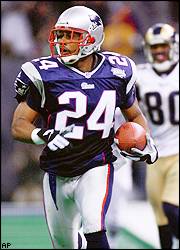

New England held onto the ball for seven plays but again had to punt. However, on the third play of the next St. Louis possession, CB Ty Law intercepted a Warner pass that was intended for Bruce and returned it 47 yards for a touchdown (pictured at right). In stunning fashion, the Patriots were in front at 7-3.

With under two minutes remaining in the first half, Warner threw to WR Ricky Proehl for a 15-yard gain to the New England 40, but safety Antwan Harris forced a fumble and CB Terrell Buckley recovered for the Patriots. Brady hit on passes to WR Troy Brown for 16 yards and eight yards to TE Jermaine Wiggins to get to the St. Louis 24. Following an eight-yard carry by RB Kevin Faulk, Brady threw to WR David Patten for an eight-yard TD and the Patriots went into halftime with an improbable 14-3 lead.

Coach Belichick had learned from the loss to St. Louis during the regular season, when he had tried to key on blitzing Warner. This time, he sought to keep Marshall Faulk in check and loaded up with as many as six or seven defensive backs on each play. The strategy was having the desired effect, as Warner’s rhythm was disrupted and the fleet wide receivers were kept in check.

The teams went back to trading punts in the third quarter, battling for field position. Late in the period, after the Rams had advanced to the New England 45, Warner was intercepted again, this time by CB Otis Smith, who returned the pickoff 30 yards to the St. Louis 33. Five plays later, Adam Vinatieri kicked a 37-yard field goal to make the score 17-3.

With the game moving into the fourth quarter, the Rams began to come alive as Warner hit on short passes, completing six in a row to reach the New England three. Following two incompletions and facing a fourth-and-three situation, Warner ran and fumbled when hit by LB Roman Phifer. Patriots FS Tebucky Jones picked up the ball and took off for an apparent 97-yard touchdown, but the play was nullified by a defensive holding penalty on DE Willie McGinest. Gaining a huge reprieve, Warner ran for a two-yard touchdown shortly thereafter and New England’s margin was cut to 17-10.

The teams again traded punts, and the Patriots had consecutive three-and-out possessions. After the second one, and with under two minutes remaining, the Rams took over at their 45 yard line. Warner threw to Hakim for 18 yards, WR Yo Murphy for 11, and then the slow-but-steady Proehl for a 26-yard touchdown. With the extra point, the game was tied at 17-17 and it appeared likely that the contest would go into overtime.

New England’s offense took over at its own 17 with 1:21 now on the clock and no timeouts remaining. Brady threw two passes to RB J.R. Redmond that covered 13 yards. After an incompletion, he went to Redmond again for another 11 yards to his own 41. A 23-yard pass to Brown took the ball into Rams territory at the 36 and a throw to Wiggins added another six yards. With seven seconds now remaining, Brady spiked the ball to stop the clock and Vinatieri, who was rapidly becoming recognized as an outstanding clutch kicker, booted a game-winning 48-yard field goal (pictured below). In an amazing upset, the Patriots won their first championship by a score of 20-17.


The Rams won the statistical battle, outdistancing New England in total yards (427 to 267), first downs (26 to 15), and time of possession (33:30 to 26:30). But the Patriots didn’t turn the ball over, while taking advantage of three St. Louis turnovers to score 17 points.

Tom Brady was the game’s MVP as he completed 16 of 27 passes for 145 yards and a touchdown and showed great poise in directing the game-winning drive. Troy Brown (pictured below) led New England’s receivers with 6 catches for 89 yards. RB Antowain Smith rushed for 92 yards on 18 carries.


The strategy of keying on Marshall Faulk held the Rams’ running game to 90 yards, with Faulk gaining 76 of that total on 17 attempts and catching four passes for 54 yards – ordinary by his standards. Kurt Warner was successful on 28 of 44 passes for 365 yards, but with just one TD against two interceptions. Az-Zahir Hakim, Isaac Bruce, and Torry Holt all caught five passes apiece, with Hakim gaining the most yards (90; Bruce and Holt gained 56 and 49 yards, respectively).

“When Adam hit it, it was so true,” said Bill Belichick of Vinatieri’s game-winning field goal. “It was so high and so far. If you want a guy to make a play at the end of the game, he's the one.”

Of the Rams, Ty Law said, “I don't think they looked past us, but at the same time, I don't think they were expecting this type of fight.”

“I don't think we were overconfident,” a disappointed Kurt Warner stated from the St. Louis perspective. “We played hard, but those few turnovers, those few mistakes we made, they turned them into points. Some days they don't turn into anything, but they turned them into 17 points and a world championship. That's what's so hard about this loss. It was the fact our mistakes did us in today.”

The championship for the Patriots proved to not be a fluke as the club won two more over the next three years and consistently contended beyond that. St. Louis, in the meantime, moved in the opposite direction. Warner suffered through two injury-marred seasons in 2002-03 and was let go – he would eventually revive his career in Arizona. The team dropped to 7-9 in ’02, and after rebounding to 12-4 in 2003, fell into mediocrity thereafter.

Friday, January 7, 2011

1990: Quick-Striking Rams Beat Giants in OT of Divisional Playoff Game


The NFC Divisional playoff game on January 7, 1990 at Giants Stadium in the New Jersey Meadowlands featured the host Giants, champions of the NFC East with a 12-4 record, against the visiting Los Angeles Rams, second place finishers in the NFC West at 11-5. It was truly a contrast in styles.

New York, coached by Bill Parcells, was a conservative club and most of its games in 1989 were close. The Giants had a sturdy defense that featured linebackers Lawrence Taylor and Carl Banks, DE Leonard Marshall, and CB Mark Collins. Injury-plagued QB Phil Simms guided the offense that benefited from the play of RB Ottis Anderson (1023 yards), who was 32 and hadn’t been anywhere near 1000 yards in a season in five years. But the loss of star TE Mark Bavaro to a midseason injury had been detrimental. Moreover, New York, after winning the Super Bowl following the ’86 season, had missed the playoffs in 1987 and ’88 and had trouble against playoff teams during the regular season, despite their impressive record.

The Rams were coached by John Robinson and were as exciting and pass-oriented offensively as the Giants weren’t. QB Jim Everett set a new team record with 4310 passing yards and had outstanding receivers to throw to in Henry Ellard (70 catches, 1382 yards) and Willie “Flipper” Anderson (44 catches, 1146 yards, a 26.0 average per reception). Los Angeles could run the ball, too, as RB Greg Bell gained 1137 yards and scored 15 touchdowns. However, while the defense boasted some stellar performers such as pass rushing LB Kevin Greene and CB Jerry Gray, it tended to give up far too many points. LA, after finishing behind the 49ers in the division, easily defeated the Eagles in wintry weather at Philadelphia in the Wild Card playoff game.

There were 76,325 fans at Giants Stadium, and the home team largely dominated the first half. On the first LA possession, Lawrence Taylor, sacking Everett for the first of two times, forced a fumble at the New York 11 that LB Gary Reasons recovered. Placekicker Raul Allegre, who had just been activated after six games following an injury, kicked two field goals in the first quarter, of 35 and 41 yards. The Rams had trouble moving the ball on offense and defensively had difficulty containing Ottis Anderson (pictured below). However, the Giants couldn’t get into the end zone, allowing Los Angeles to stay in the game.


Late in the second quarter, the second turnover of the game occurred when LA’s Jerry Gray tipped a Simms pass that was intercepted by safety Michael Stewart, who grabbed the ball near midfield and returned it 29 yards. On the next play, Everett threw a 20-yard touchdown pass to Willie Anderson that made the score 7-6 with 17 seconds left in the half.

On the first drive of the second half, Everett was intercepted in the end zone by Collins. The ensuing New York drive ended in a punt, but Sean Landeta’s 49-yard kick was fielded by CB Darryl Henley for the Rams, who lost 11 yards trying to return it. LA had to punt it back, and the Giants proceeded to drive 82 yards in 14 plays capped by Ottis Anderson’s two-yard run for a TD with just under two minutes remaining in the third quarter. Anderson had six rushes for 28 yards on the drive while Simms completed passes of 11 yards to rookie RB Dave Meggett to the Rams’ 40 and to TE Zeke Mowatt for 23 yards to the nine yard line. New York was back in front by 13-7.

The Rams responded with a 69-yard drive that led to a 31-yard Lansford field goal less than three minutes into the fourth quarter. Everett threw to Ellard for gains of 23 and 16 yards along the way, and Bell ran for 16 yards on a draw play. The Giants’ lead was narrowed to 13-10.

The Rams drove to the tying field goal on a 75-yard possession in which Everett was successful on six of seven passes for 44 yards. The quarterback also had a 13-yard run to the New York 12. Lansford kicked a 22-yard field goal to tie the game with 3:01 left on the clock and send it into overtime.

LA won the toss to gain first possession in the sudden death period. The Rams advanced from their 23 to the 48 on a 12-yard pass to TE Pete Holohan and 13-yard completion to Ellard. Giants CB Sheldon White then drew an interference call on Willie Anderson that resulted in a 27-yard advance into New York territory. On the next play, following a five-yard penalty for a false start, Anderson beat Collins for a 30-yard touchdown in the right corner of the end zone (pictured at top) and kept right on running into the tunnel leading to the locker rooms as the home crowd sat stunned. The contest went just 1:06 into overtime and was won by the Rams, 19-13.

While the Giants had dominated the first half, overall Los Angeles ended up with more total yards (448 to 344) and first downs (26 to 20). The Rams gave up two turnovers, but after the two early sacks by Lawrence Taylor, Everett wasn’t thrown for a loss again.


Jim Everett threw 44 passes and completed 25 of them for 315 yards with two touchdowns and an interception. Henry Ellard (pictured at left) caught 8 passes for 125 yards while “Flipper” Anderson scored on both of his two receptions that covered 50 yards. Greg Bell ran for 87 yards on 19 attempts.

For the Giants, Ottis Anderson was the star with 120 rushing yards on 24 carries, including a TD. Phil Simms completed 14 of 29 passes for 180 yards and had one picked off. Dave Meggett caught four passes out of the backfield for 52 yards and Zeke Mowatt also gained 52 yards, on three receptions.

“We were being outplayed most of the half and we went in with a lead,” Jim Everett (pictured below) said regarding the impact of the late first half touchdown. “That kind of told us we might have some breaks.”

The Giants were unhappy with the interference call on Sheldon White, claiming the ball was not catchable. Field judge Bernie Kukar explained his call by saying, “The defensive man did not play the ball, he played the man. He wrapped the receiver while the ball was still catchable.”

“This game is more than one play,” concluded Bill Parcells. “I'm proud of my guys, they played their hearts out."

It was the third straight win on the east coast for the Rams, who won at New England in the season finale to clinch the wild card slot and then won at Philadelphia in the first round before coming to Giants Stadium.

But while the Rams were glad to get another shot at the division-rival 49ers in the NFC Championship game, a club they had split with in the season series, it was San Francisco handily winning the conference title by a 30-3 score.

Monday, December 27, 2010

1969: Kapp Brings Vikings From Behind to Beat Rams in Western Playoff


The Minnesota Vikings had made it to the postseason for the first time in 1968 and were stronger in ’69. On December 27, 1969 they hosted the Los Angeles Rams at Metropolitan Stadium for the NFL Western Conference title.

The Vikings had topped the Central Division with a league-best 12-2 record. Under Head Coach Bud Grant, they featured a strong defense, in particular the line of ends Jim Marshall and Carl Eller and tackles Alan Page and Gary Larsen. The offense was conservative and directed by QB Joe Kapp (pictured above) - like Grant, a product of the Canadian Football League. Kapp had his critics, for his technique (especially when passing the ball) was unpolished, but he was a tough and fiery leader who found ways to win, which included running the ball himself (and not shying from contact when doing so).

As was typical of teams coached by George Allen, Los Angeles relied heavily on veteran players, was conservative and run-oriented offensively, and defensively solid. QB Roman Gabriel was the consensus league MVP and kept the turnovers low (he tossed 24 TD passes and only 7 interceptions). The excellent offensive line allowed just 17 sacks. The Rams had won their first 11 games, but lost the last three to finish atop the Coastal Division with an 11-3 record.

There were 47,900 fans present on a 25 degree day in Minnesota. The Rams got the first couple of breaks. After Kapp passed to WR John Henderson for a 12-yard gain, FB Bill Brown fumbled and safety Richie Petitbon recovered for the Rams at the Minnesota 45. On LA’s first play, Gabriel was hit by LB Roy Winston while passing and Eller grabbed the pass for an apparent interception and return for a touchdown, but an offside penalty nullified the play. The Rams, benefiting from the reprieve, drove to a score. RB Larry Smith ran three times up the middle for 19 yards, Gabriel passed to WR Wendell Tucker for eight yards, and FB Les Josephson added five yards on three runs. On a third-and-three play, Gabriel rolled out and passed to TE Bob Klein for a touchdown.

The Vikings came back with a 10-play, 75-yard scoring drive of their own. Kapp completed four straight passes, including three to WR Gene Washington that totaled 49 yards; the last was for 27 yards to the LA four yard line. HB Dave Osborn leaped over Petitbon and into the end zone for a TD with 3:29 remaining in the first quarter.

The Rams put together another drive, but failed to score when Bruce Gossett was wide on a 38-yard field goal attempt. However, they were more successful on their next possession that consumed 12 minutes of the second quarter. The drive featured screen passes as well as good ground-gaining by the backs, and Gabriel kept it going with a 13-yard run to the Minnesota 47 on a third-down play. This time Gossett was successful on a 20-yard field goal to break the tie with 4:30 left in the half.


Following another punt by the Vikings, Gabriel completed passes of 16 and 18 yards to TE Billy Truax (pictured at left), the second putting the Rams at the Minnesota 22 yard line. Smith and Josephson then ran the ball down to the two. The 13-play, 65-yard possession ended with a Gabriel pass to Truax for a two-yard touchdown. Los Angeles had scored on three of four first half possessions and led at halftime by 17-7.

Minnesota came out fired up for the second half. Still, the Rams looked strong as they took the second half kickoff and Smith ran 12 yards to near midfield, but the drive stalled and they had to punt for the first time.

Kapp completed a 41-yard pass to Washington that put the ball on the LA 12, and a piling-on penalty moved the ball to the six. Kapp scrambled to the one and Osborn dove in for a touchdown that cut the Rams’ lead to 17-14.

The Minnesota defense was playing more aggressively and was stopping the LA attack that had been so effective in the first half. However, the Rams then got a couple of breaks on defense.

First, on a drive deep into Los Angeles territory, FS Ed Meador intercepted a Kapp pass at the four yard line. He returned it to the 19 and fumbled, but the Rams maintained possession. However, LA couldn’t move and had to punt again. But Kapp was intercepted a second time, by Petitbon, to give the Rams excellent field position at the Minnesota 36.

It seemed as though Los Angeles might be able to add another touchdown, but a pass to Truax at the five fell incomplete, thus forcing the Rams to go for three rather than adding a crucial seven points. Gossett was good from 27 yards to make the score 20-14 in the fourth quarter.

The Vikings put together a 65-yard drive as Kapp completed three straight passes for 40 yards to the LA 19, two of them to Brown out of the backfield, and eventually scoring a touchdown himself on a two-yard bootleg with 8:24 left to play.


Now with a one-point lead at 21-20, the fired-up Vikings stopped CB Ron Smith on the 12 yard line on the ensuing kickoff return. On the next play, Eller (pictured at right) went around All-Pro OT Bob Brown to hit Gabriel, fading back from his 12 yard line. Catching him at the two, Eller drove him into the end zone and tackled him for a safety. Minnesota’s lead was now three points.

The Rams got one more possession after the safety and, starting at their 15, advanced to the Minnesota 44 before Page intercepted a Gabriel pass to nail down the 23-20 win with 31 seconds remaining.

The statistics indicated the closeness of the contest as the Vikings outgained the Rams by just 275 yards to 255 while LA had the edge in first downs by just 19 to 18.

Joe Kapp completed 12 of 19 passes for 196 yards with no touchdowns and two interceptions, and ran for 42 yards (all in the second half). He had set up all three Minnesota touchdowns with outstanding passing and, beyond the statistics, displayed outstanding leadership in bringing the Vikings from behind. Gene Washington caught four passes for 90 yards and John Henderson also caught four, adding another 68 yards. While Kapp was the team’s leading rusher, Dave Osborn had 30 yards on 13 attempts to top the running backs.


In defeat, Roman Gabriel (pictured at left) completed 22 of 32 passes for 150 yards with two TDs and one interception. Larry Smith, playing with a broken nose for much of the game, led the running attack with 60 yards on 11 carries and caught 6 passes for an additional 36 yards. Les Josephson had 7 receptions for 41 yards while Billy Truax gained a team-leading 47 yards on 5 catches that included a touchdown.

“We lost because the Vikings were better than we were in the second half,” a disappointed Coach George Allen said. “I have never seen a team come so ready to play as we were and lose. It's hard to believe.”

The Vikings went on to easily beat the Browns for the NFL Championship, but they were upset in the last pre-merger Super Bowl by the AFL-champion Kansas City Chiefs. In the next 13 seasons under Bud Grant, Minnesota made it to the postseason 10 times. By the time the Rams next appeared in the playoffs, in 1973, both Allen and Gabriel had moved on.

Tuesday, December 21, 2010

1952: Pat Harder Spurs Lions to Win Over Rams in Conference Playoff


The 1952 NFL season ended with both the Detroit Lions and Los Angeles Rams tied atop the National Conference with 9-3 records, necessitating a playoff game. The clubs met at Detroit’s Briggs Stadium on December 21 to determine who would represent the conference against the Cleveland Browns for the league championship.

The Rams were the defending league champions and had made it to the title game three consecutive years as either the Western Division champ (1949) or champion of the renamed National Conference (1950 and ’51). There had nevertheless been organizational turmoil early in the season as Joe Stydahar, the head coach since 1950, resigned after a bad loss in the opening game and assistant Hamp Pool (with whom Stydahar had been feuding) was elevated to the top job. After getting off to a sluggish 1-3 start, LA won eight straight games. The Rams still boasted the league’s most explosive offense that included quarterbacks Norm Van Brocklin and Bob Waterfield, receivers Tom Fears and Elroy “Crazylegs” Hirsch, and the NFL’s leading rusher, FB Dan Towler.


Detroit, meanwhile, was a team on the rise under second-year Head Coach Buddy Parker. The offense was led by QB Bobby Layne, who had been obtained in 1950 and proved to be an excellent fit with his passing and leadership abilities. Star all-purpose HB Doak Walker missed time due to injury, but HB Bob “Hunchy” Hoernschemeyer (pictured at left) ranked fifth in the NFL in rushing (457 yards). 30-year-old veteran FB Pat Harder (pictured at top) had been obtained from the Cardinals, with respectable results, although more due to his blocking than running. End Cloyce Box led the league in touchdowns with 15. The defense was especially tough, with a backfield that was perhaps the best in the NFL.

There were 47,645 fans present on a cold, foggy day in Detroit. The Lions scored on their first possession, following an uncharacteristically poor punt by Van Brocklin. The Rams were double-teaming Box, as well as Walker out of the backfield, so Layne threw passes down the middle to big (262-pound) end Leon Hart that gained, first, 22 yards and then 13. Harder capped the 52-yard drive with a 12-yard touchdown run and successfully kicked the extra point to make it 7-0.

There was no further scoring in the opening period, but, following a miss by Waterfield on a 34-yard field goal attempt in the second quarter, Detroit put together a six-play, 80-yard drive that ended with Harder running for a four-yard TD. The possession was highlighted by two passes to Walker, one from Layne for a 50-yard gain and the other an option pass by Hoernschemeyer that went for 24 yards and put the Lions in scoring position. The Rams finally got on the board near the end of the half when Van Brocklin tossed a 15-yard touchdown pass to Fears that capped a seven-play drive following an interception and made it 14-7.

Early in the third quarter, Van Brocklin threw a pass to end Bob Carey at the Detroit 40 that looked to be a big play in the making, but Carey fumbled and safety Yale Lary recovered for the Lions. Detroit made the most of the break as Walker threw a halfback option pass to Hart in the end zone for a 24-yard TD. Shortly thereafter, a 43-yard field goal by Harder (who had kicked all of the extra points as well) increased Detroit’s margin to 24-7.

The Rams fought back with an 80-yard drive deep into Lions territory, highlighted by a 47-yard run by HB Skeets Quinlan, but after getting a first down on the six yard line, four straight runs into the line by Towler were stopped and LA was forced to turn the ball over on downs at the Detroit one.

However, in the fourth quarter Los Angeles got a break when Layne went to the air deep in his own territory and was intercepted by middle guard Stan West, who returned it to the Detroit 20. Waterfield replaced Van Brocklin at quarterback and shortly thereafter Towler scored from five yards out to cut the Lions’ margin to 24-14. It was a three-point game when LA’s Verda “Vitamin T” Smith returned a punt 56 yards for another TD.

With the game coming down to the last minute, the Rams had the ball at their own 11 but a pass from Waterfield, intended for Hirsch, was instead intercepted by LB LaVern Torgeson at the LA 30. Hoernschemeyer scored a nine-yard clinching touchdown and the Lions won the game and division title by a score of 31-21.


Detroit outgained the Rams by 365 yards to 307 and had the edge in first downs with 18 to LA’s 15. While the Lions gave up more turnovers (four to three), the two fumbles and the last-minute interception were more costly to Los Angeles.

Pat Harder was the player of the game for Detroit as he ran for 72 yards on 8 carries, including two touchdowns, and caught a pass for six more yards. Adding up the two TDs, one field goal, and four extra points, he accounted for 19 points.

Doak Walker (pictured above right) ran for 29 yards on 7 attempts, caught two passes for 75 more yards, and threw a touchdown pass. Bob Hoernschemeyer gained 49 yards on 11 rushes, including a TD.

Bobby Layne (pictured below) completed 9 of 21 passes for 144 yards and was intercepted four times. The Lions made good use of their two halfback option passes that totaled 48 yards and directly scored one touchdown while setting up another. Leon Hart was the leading pass receiver for the Lions with 5 catches for 86 yards and a TD.


For the Rams, Norm Van Brocklin completed 15 of 19 passes for 166 yards with a touchdown and none intercepted while Bob Waterfield added 3 of 9 for 13 yards and was picked off once. Tom Fears led the receivers with 7 catches for 76 yards and a TD while Crazylegs Hirsch had 5 receptions for 45 yards. “Deacon Dan” Towler ran for 54 yards on 13 carries and had one touchdown.

The game truly marked a changing of the guard in the West (the conferences would be renamed Western and Eastern in 1953). The Lions went on to defeat the Browns for the NFL Championship in ’52 and won the Western Conference again in 1953 and ’54 (in all instances they faced Cleveland in the title game, winning again in ’53 but losing in 1954). The Rams did not return to the postseason until 1955.

Pat Harder played one more season in 1953. While a good fullback, his kicking made him significant to two championship teams (the 1947 Cardinals as well as ’52 Lions) and he was the NFL’s scoring leader in three consecutive seasons (1947 to ’49). Harder retired with 531 career points that included 38 touchdowns, 35 field goals, and 198 extra points.

The playoff game against the Lions was the last for Bob Waterfield (pictured below). The quarterback who led the Rams to their first championship in 1945 while the franchise was still in Cleveland, he had also been a good defensive back during the single-platoon era and was one of the league’s best kickers as well. Waterfield was inducted into the Pro Football Hall of Fame in 1965.

Saturday, December 11, 2010

1960: Unitas’ 47-Game TD Pass Streak Comes to End as Colts Lose to Rams


The Baltimore Colts had won back-to-back NFL championships in 1958 and ’59, and seemed a good bet to win three straight when they got off to a 6-2 start in 1960. However, Head Coach Weeb Ewbank’s club sputtered at that point. Age and injuries began to catch up to the Colts, most significantly a torn Achilles tendon suffered by FB Alan Ameche that proved to be career-ending.

Of course, the Colts still had their star quarterback, Johnny Unitas (pictured above), who was playing with a bad back but was still effective. The running game was not nearly as productive without Ameche, though, and defenses were adjusting to concentrate on stopping the passing attack.

Baltimore had lost two straight games, including a stunning, last-minute 20-15 defeat at the hands of the Lions (one of the contenders chasing the Colts in the Western Conference) the previous week. They were now 6-4 and in trouble as they traveled to Los Angeles to take on the Rams on December 11.

Los Angeles had a new head coach in ’60, former star quarterback Bob Waterfield. The club lost its first four games (including one at Baltimore), but was 3-6-1 by the time the Colts arrived. Some younger players were getting opportunities to play, among them Frank Ryan at quarterback in place of veteran Bill Wade.

There were 75,461 fans at the Memorial Coliseum, and they saw a low-scoring defensive battle. The Colts looked impressive initially, taking up most of the first quarter with a 17-play, 80-yard drive that ended with a nine-yard field goal by Steve Myhra. But that was it as Baltimore held on to a miniscule 3-0 lead at halftime.

Ryan started at quarterback for the Rams but left with a shoulder injury, bringing Wade into the game. Del Shofner, normally a split end, saw action in the defensive backfield and was also the team’s punter until he went down with a leg injury. FB Joe Marconi took over the punting and had an excellent game, kicking six times for a 47.8 average and thus keeping the Colts from starting drives in good field position.

Wade made the biggest play of the game in the third quarter when he rolled out to his left and proceeded to run 66 yards for the only touchdown. He got a good block from Marconi and eluded CB Milt Davis at the 10 yard line on the way to putting the Rams ahead by 7-3.

Danny Villanueva added a 32-yard field goal for LA in the fourth quarter. In the closing minutes, Unitas moved the Colts from their own three yard line to the Rams’ 20, but a fumbled handoff to HB Alex Hawkins was recovered by Los Angeles DT George Strugar, nailing down the 10-3 win for the Rams.

While the Colts outgained LA by 272 yards to 248, they were held to 91 yards on the ground. They also fumbled five times, losing two of them. HB Lenny Moore gained 44 yards on 18 carries (by far his most attempts of the year) while the replacement for Alan Ameche, FB Billy Pricer, ran the ball 8 times and accumulated only 11 yards.

Stars on defense for the Rams included MLB Les Richter, DE Lou Michaels, DE Gene Brito, and DT John Baker. Michaels and the 35-year-old Brito were playing hurt, making their contributions all the more significant.

But the biggest story was that Johnny Unitas failed to complete a touchdown pass, breaking a string of 47 consecutive games stretching back to the eighth contest of the 1956 season (ironically, against the Rams at the same venue). As remarkable as the streak was at the time, it has grown in luster over the intervening years.

The streak occurred at a time when teams were not as prone to passing, and prior to rules changes (most notably in the 1970s) that opened up the aerial game and encouraged teams to throw the ball far more often. The closest any quarterback since has come to the 47-game streak is 36 by Green Bay’s Brett Favre from 2002-04. Dan Marino ranks third, with a 30-game streak in 1985-87.

Along the way, Unitas threw for multiple touchdowns in 33 of the 47 contests (including every game in 1959 and the six leading up to the contest against the Rams), with a high of four that he reached on seven occasions (three times in ’60). The Colts went 31-16 during the 47 games (Unitas missed two complete games to injury in 1958. The streak does not include the two NFL Championship games, in both of which Unitas threw TD passes).

The third straight defeat for the Colts effectively knocked them out of title contention and they ended up losing a fourth to close out the 1960 season with a record of 6-6, placing them fourth in the Western Conference. The Rams were farther behind in sixth place at 4-7-1.

While his touchdown passing streak ended and the team failed to remain on top in the NFL, the 27-year-old Unitas still was among league’s best passers. He set a new record for passing yards with 3099 (he in fact broke Sammy Baugh’s previous record of 2938 in the Rams game) and led the league in pass attempts (378), completions (190), and touchdowns (25). However, he also was second in interceptions thrown (24) due to defenses hanging back to stop the pass once they no longer feared the Colts’ running game (12 of the pickoffs occurred during the last four losing games of the year, including one by the Rams).

Thursday, December 9, 2010

1967: Blocked Punt Sets Up Winning TD as Rams Defeat Packers


The December 9, 1967 contest at the Los Angeles Memorial Coliseum featured the Green Bay Packers, two-time defending NFL champions, against the Rams, a team on the rise and in a tough battle for a division title. In this first season in which the Eastern and Western conferences were split into two four-team divisions apiece, Green Bay was 9-2-1 and had already clinched the Central Division, while Los Angeles had a 9-1-2 record, putting the Rams just behind the 10-0-2 Baltimore Colts in the Coastal Division.

While Head Coach Vince Lombardi’s Packers had won four titles in six seasons, the team was beginning to show its age and injuries had added to the challenge of keeping the run going. 33-year-old QB Bart Starr had been playing hurt at the beginning of the year, and running backs Elijah Pitts and Jim Grabowski were lost to injury, forcing the club to bring in journeymen replacements in Ben Wilson and Chuck Mercein. Still, after a slow start, Green Bay was rolling and rode a four-game winning streak into LA.

The Rams had strung together seven consecutive losing seasons prior to the arrival of George Allen as head coach in 1966. His impact had been immediate, as the team went 8-6 in his first year, and now it had become a title contender. The offense played conservatively, with QB Roman Gabriel (pictured above) and a solid group of running backs led by HB Les Josephson and FB Dick Bass. The defense was outstanding, starting with the line that was known as “The Fearsome Foursome” and included ends Deacon Jones and Lamar Lundy and tackles Merlin Olsen and Roger Brown (acquired from Detroit in the preseason after Roosevelt Grier was lost for the year with a knee injury).

There were 76,837 fans on hand under sunny skies for the Saturday contest. Both teams failed on field goal attempts before Green Bay scored first, late in the first quarter, on a 30-yard touchdown pass from Starr to flanker Carroll Dale. The Rams came back to tie the game early in the second quarter with a 73-yard drive that concluded with Gabriel throwing to split end Jack Snow for a 16-yard TD. Following an interception by Green Bay safety Willie Wood, the Packers scored on a 32-yard Don Chandler field goal just before the half to take a 10-7 lead into the intermission.


In the third quarter, LA regained the lead when Gabriel again tossed a scoring pass to Snow, this one covering 11 yards. It was 17-10 later in the period when Bruce Gossett kicked a 23-yard field goal. But instead of squib-kicking the ensuing kickoff, as they had been doing to keep the ball away from Green Bay’s sensational kick returner, rookie HB Travis Williams (pictured at left), Gossett kicked away. Williams fielded the kick four yards deep in his end zone and proceeded to sprint 104 yards for a touchdown – his record fourth such return of the year. From a seven-point Rams lead, the game was now tied at 17-17.

Early in the fourth quarter, CB Clancy Williams intercepted a pass for LA and the Rams capitalized with a 16-yard Gossett field goal to retake the lead. But the Packers took advantage of a turnover when Bass fumbled and they drove 43 yards to a four-yard touchdown run by Mercein. With 2:19 left on the clock, Green Bay led by 24-20.

It looked good for the Packers when the defense stifled the Rams, who had to punt after three plays. But Green Bay was unable to penetrate the LA defense for a game-clinching first down and was forced to kick the ball back.

With the ball at the Packers’ 27 yard line, Donny Anderson, the team’s punter as well as the heir apparent to the departed Paul Hornung at halfback, prepared to punt with 54 seconds now remaining to play. But before Anderson could get off the kick, Rams reserve LB Tony Guillory ran untouched through the line and blocked it. DB Claude Crabb picked up the loose football and ran 20 yards before being pulled down at the five by Anderson.

Gabriel had to throw the ball away on the first play, but on the second, after a play-action fake to HB Tommy Mason, he threw the ball into the end zone where it was caught by flanker Bernie Casey for a touchdown. Gossett’s conversion was good, and the Rams came away with a big 27-24 win.


Los Angeles outgained the Packers (324 yards to 218) and had more first downs (20 to 12), although they also gave up three turnovers to Green Bay’s two. Roman Gabriel completed 20 of 36 passes for 227 yards with three touchdowns and two interceptions. Les Josephson led the ground game with 73 yards on 19 carries and also caught 5 passes for 51 yards. Bernie Casey caught 6 passes for 97 yards, including the winning TD. Jack Snow (pictured at right) had two touchdowns among his four receptions for 48 yards.

For the Packers, Bart Starr was successful on 10 of 20 passes for 138 yards with a touchdown and two picked off. Boyd Dowler led the club by catching four of those passes for 71 yards. The Rams managed to hold the normally potent Green Bay running game to 98 yards on 32 attempts, with Travis Williams the leading rusher with 26 yards on 12 attempts.

The Rams thrashed the Colts 34-10 the next week in the climactic battle for the division crown, and finished 11-1-2. For the first time in NFL history, a division title was determined by tiebreaker (as opposed to playing an extra game), and due to LA’s better point differential in head-to-head contests, they finished ahead of Baltimore. Green Bay lost its season finale to complete the regular season at 9-4-1, but in the Western Conference Championship game, won the rematch with the Rams by a convincing 28-7. The Packers went on to win a third straight NFL title by beating Dallas and capped it all with a Super Bowl triumph over the AFL champion Oakland Raiders.

Roman Gabriel threw a career-high 25 touchdown passes and his 2779 passing yards were his most with the Rams (his career high was 3219 with the Eagles in 1973). By the passer rating system in use at the time, he placed fourth in the league, although by the current rating system he was third (85.2). Gabriel was named to the Pro Bowl for the first of three straight years.

Bart Starr’s numbers dropped off significantly from 1966, when he was the NFL’s top passer (105.0 rating by current system). He threw a career-high 17 interceptions and only nine TD passes. Yet his 8.7 yards per attempt and 15.9 yards per completion were both league-leading figures and, along with the Packers finishing on top once again, attested to his continued effectiveness.

In addition to scoring four touchdowns on kickoff returns, Travis Williams set a record for kick return average of 41.1 on 18 returns. While Cecil Turner of the Bears also returned four kickoffs for TDs in 1970, the average per return still remains the best to date.

Sunday, December 5, 2010

1971: Willie Ellison Runs for 247 Yards as Rams Beat Saints


Prior to the December 5, 1971 game between the Los Angeles Rams and New Orleans Saints, halfback Willie Ellison had largely labored in obscurity. In his fifth year out of Texas Southern, as part of a stable of good backs in LA he had only occasionally started; in his best season, 1968, he gained 616 yards, but had a combined total of 521 in the other three years. At 6’2” and 210 pounds, he had good speed but was stuck behind bigger backs more to the liking of Head Coach George Allen such as Les Josephson and Larry Smith.

1971 was a year of transition for the Rams, as Allen had been let go following the ’70 season and replaced by Tommy Prothro, a career college coach who had been at UCLA. One of the changes the new head coach made was to utilize Ellison more, and it would lead to his not only achieving a career high in rushing but a place in the record book as well.

Los Angeles was 6-4-1 coming into the game against the Saints at the Memorial Coliseum, a half-game behind the 49ers (7-4) in the NFC West. New Orleans, under Head Coach J.D. Roberts, was struggling at 4-5-2, although the Saints were coming off of a win the week before at Green Bay and had beaten the Rams in the first game of the season. However, rookie QB Archie Manning, who had starred in that opening-day contest, was injured against the Packers and out for the rematch with LA – third-year backup Edd Hargett started in his place.

There were 73,610 fans present at the huge stadium, and they didn’t have to wait long for the Rams to get on the board. On the third play from scrimmage, Ellison ran around end for an 80-yard touchdown. Sprung thanks to a block by perennial Pro Bowl guard Tom Mack on New Orleans FS D’Artagnan Martin, Ellison had clear sailing until he reached the Saints’ 20 and dodged the strong safety, Hugo Hollas, to continue on to the end zone.

The next score was set up when New Orleans punter Julian Fagan, after fielding a bad snap that had gone over his head, launched a punt that went just four yards. LA took over on the New Orleans 33 and capitalized when QB Roman Gabriel completed a 37-yard TD pass to WR Jack Snow.

The Saints then capped an eight-play drive at 9:38 into the opening period as Hargett completed a 25-yard touchdown pass to WR Dan Abramowicz. But no sooner had they cut LA’s lead to seven points when RB Travis Williams returned the ensuing kickoff 105 yards for a TD. The Rams led by 21-7 after one quarter of play.

On LA’s first series of the second quarter, Ellison broke loose for a 48-yard run to the New Orleans 12, but David Ray ended up missing a 15-yard field goal attempt to make it all for naught. However, when the Saints were forced to punt again, WR Lance Rentzel returned it 24 yards to the New Orleans 37. In a drive assisted by a roughing-the-passer penalty on DT Dave Long, Larry Smith ran the final five yards for a TD.

In the final seconds of the second quarter, Gabriel threw an eight-yard touchdown pass to Rentzel that capped a drive of 69 yards in 13 plays which included three runs for 33 yards by Ellison. After one half, Los Angeles was comfortably leading 35-7 and Ellison had gained 186 yards rushing on 13 carries.

After building the big first half lead, the Rams played poorly in the third quarter. A series of penalties kept them in bad field position - one was an unsportsmanlike conduct penalty on Prothro, who stormed onto the field after Gabriel was called for intentional grounding.

New Orleans took advantage of LA’s miscues to score twice. After a 17-yard punt by Pat Studstill from his two yard line, the Saints had excellent field position at the LA 19 and HB Bob Gresham scored from a yard out. Then Ellison fumbled after taking a hard hit and the ball was recovered by Saints LB Jim Flanigan. New Orleans drove 60 yards in seven plays that resulted in a short TD carry by Hargett.

The score was 35-21 after three quarters, putting the Saints in striking distance, but early in the fourth quarter, Gabriel connected with Rentzel for a 39-yard touchdown to cap a 10-play, 65-yard drive that got the Rams back on track. Hargett followed by throwing a desperation pass while pressured by DT Merlin Olsen that was intercepted by CB Jim Nettles at the New Orleans 45. While the Saints scored once more on a second short, one-yard run by Gresham, the outcome was essentially decided.

The only drama remaining pertained to Ellison as he closed in on the single-game rushing record. The existing NFL record had been 237, twice achieved by Cleveland’s Jim Brown, but with the adopting of the American Football League’s records following the merger in 1970, the target was now the 243 yards gained by Cookie Gilchrist of the Bills against the Jets in 1963.

A ten-yard gain put Ellison even with Gilchrist at 243 yards, but then Prothro pulled the halfback for a breather with two minutes left to play, much to the displeasure of the crowd. He returned, to cheers, and broke the record with a two-yard run off left tackle. Ellison added another two-yard run for good measure, bringing his new record total to 247 yards, and left the field to a standing ovation.

The result of the game was almost an afterthought, as Ray kicked a 12-yard field goal to make the final score 45-28.

The Rams easily outgained the Saints, by 421 yards to 263, although they gave up 119 yards as a result of 14 penalties (New Orleans was flagged six times). Willie Ellison’s 247 rushing yards came on 26 carries for a 9.5-yard average gain and included the one long touchdown.

Roman Gabriel completed 10 of 18 passes for 137 yards with three TDs and no interceptions. Lance Rentzel caught 5 passes for 65 yards and two scores to lead the receivers.

For the Saints, Edd Hargett threw 36 passes and was successful on 19 of them for 213 yards with a touchdown and one picked off. Dan Abramowicz and TE Dave Parks both caught five passes, with Abramowicz gaining 91 yards (and scoring a TD) to 46 for the veteran tight end. New Orleans gained just 56 yards on the ground, on 23 carries, and FB Jim Strong led with 33 yards on 7 attempts. While Bob Gresham scored the two short TDs, he averaged less than a yard a carry with 9 yards on 11 attempts.

“Yes, they made me aware of the records (at halftime),” said Ellison afterward. “I knew I needed something like 60 yards to break the NFL mark. But really, I didn't let it concern me. I felt whatever comes will come.”

“Willie Ellison ran like hell all day,” said Saints Coach North. “He has a little bit of everything – including blocking.”

“You need 11 guys to block,” added veteran Rams G Joe Scibelli. “But you also need a guy who knows how to hit the hole. Personally I feel honored to be a part of Willie Ellison's record.”

The record-setting performance (it was broken by Buffalo’s O.J. Simpson in the first week of the 1973 season) gave Willie Ellison 929 yards in 12 games, on his way to an even 1000 yards on 211 carries (4.7 avg.). He also caught 32 passes for 238 yards, but all four of his touchdowns came on the ground. Ellison led the team with 764 yards in ’72, but by the following year he was playing fullback in Kansas City, where his career ended in 1974 (returning to the obscurity from whence he had come).

The Rams ended up with an 8-5-1 record to again finish second to San Francisco in the NFC West; following a losing season in 1972, Prothro would be out as coach. New Orleans lost its last two games to conclude with a 4-8-2 tally, once again at the bottom of the division (the Saints would not escape the NFC West cellar until 1974).

Thursday, November 25, 2010

1990: Division Rivals Knock Giants & 49ers From Ranks of Unbeaten


Ten games into the 1990 NFL season, both the defending-champion San Francisco 49ers and New York Giants were sporting perfect 10-0 records. With the teams scheduled to meet in San Francisco the next week, speculation was rampant that it could be a showdown of unbeaten teams for supremacy in the NFC. But first they each had to face fierce division rivals on November 25.

In the case of the Giants, coached by Bill Parcells, it meant traveling to Philadelphia’s Veterans Stadium to take on Buddy Ryan’s Eagles. The Giants had been successful with a conservative offense that rarely turned the ball over, in combination with a solid defense. The Eagles played in the style of the brash Ryan, aggressive on defense while dependent upon the flashy skills of QB Randall Cunningham (pictured above) on offense. They had gotten off to a slow start in ’90, going 1-3 to begin the season (including an opening-game loss to New York at Giants Stadium), but had won their last four games prior to hosting the Giants and were 6-4 overall.

The first half was closely fought. New York scored initially on a 15-yard pass from QB Phil Simms to WR Mark Ingram and the Eagles responded as Cunningham connected with WR Fred Barnett for a 49-yard TD. In the second quarter, Cunningham capped a drive of over nine minutes by leaping into the end zone for a touchdown from a yard out. TE Mark Bavaro caught a four-yard scoring pass from Simms, but the extra point was missed and the Eagles led by the slender margin of 14-13 at halftime.

Roger Ruzek kicked a 39-yard field goal to extend Philadelphia’s lead to 17-13 in the third quarter, but in a span of 22 seconds in the fourth quarter the Eagles essentially put the game away. First, Cunningham passed to WR Calvin Williams for a six-yard touchdown. Then, LB Seth Joyner deflected a Simms pass that was intercepted by MLB Byron Evans, who ran untouched for a 23-yard TD. That provided the final score of 31-13 as the Eagles toppled the Giants.

The Eagles controlled the ball for over 38 minutes and rolled up the most yards against the Giants thus far with 405. The Giants, who typically ran the ball 60 percent of the time, were forced to throw 40 passes. Phil Simms, who had only been intercepted twice in the previous ten games, was picked off twice by the Eagles and completed only 17 of his passes.

Randall Cunningham passed for 229 yards and two touchdowns, with no interceptions, and ran for 66 yards on 9 carries with a TD. He was named NFC Offensive Player of the Week for his efforts. RB Keith Byars caught 8 passes for 128 yards.

It was the first regular season loss for the Giants in 14 games dating back to December 1989, and the Eagles had beaten them then. It also delayed the Giants from clinching the NFC East title.

Meanwhile, at San Francisco’s Candlestick Park, the 49ers ran into trouble against the Los Angeles Rams. The Rams, under Head Coach John Robinson, were having a poor season and came into the game at 3-7 and hardly seemed a match for the two-time defending league champions that had won a record-tying 18 straight games. Under Head Coach George Seifert, the 49ers were known for their passing offense, led by QB Joe Montana and WR Jerry Rice.

However, in the wind and rain at Candlestick Park, the Rams forced four turnovers in the first half and took a 21-7 lead. RB Cleveland Gary accounted for the first two TDs of the game, first on a 22-yard option pass from FB Buford McGee and then on a 10-yard run in the second quarter. The 49ers scored on a five-yard pass from Montana to WR John Taylor, but McGee ran for a six-yard touchdown to provide the 14-point margin at the half.

It appeared that the 49ers might pull off a successful comeback in the third quarter. Montana threw a screen pass to RB Harry Sydney that was good for a 23-yard touchdown. Mike Cofer booted a 42-yard field goal before the period was over that pulled the Niners to within 21-17.

But on San Francisco’s next possession, Montana was intercepted by Rams SS Vince Newsome and LA went 90 yards in 17 plays to score a game-clinching touchdown as Gary ran in from a yard out. The final score was 28-17.

The Rams outgained the 49ers, 350 yards to 291, and turned the ball over twice, as compared to a total of six times by the Niners. Joe Montana threw for 235 yards and two touchdowns, but was intercepted three times. Jerry Rice caught 7 passes for 72 yards, but gave up one of the fumbles.


Meanwhile, WR Willie “Flipper” Anderson caught 8 passes for 149 yards and Cleveland Gary (pictured at left) ran for 68 yards on 24 carries and caught three passes for 27 yards while scoring three touchdowns. QB Jim Everett was successful on 16 of 27 passes for 224 yards with one picked off.

The 49ers won the showdown against the Giants the next week, stripped of the glamour of being a battle of unbeatens, by a low score of 7-3. San Francisco lost once more in the regular season to finish atop the NFC West at 14-2. New York ended up winning the NFC East at 13-3. The two teams met in the NFC Championship game, where the Giants prevailed and went on to win the Super Bowl over Buffalo.

The Eagles lost their next two games after upsetting the Giants, and ended up in second place in the NFC East at 10-6. They qualified for the playoffs as a wild card team, but lost to the Redskins in the first round, costing Ryan his job. For the Rams, the upset of the 49ers was the high point of an otherwise dismal year. They defeated the Browns the next week, but lost their last four games to finish at 5-11 for third place in the NFC West.

Wednesday, November 24, 2010

1974: James Harris Rallies Rams to Win Over Vikings


The Los Angeles Rams were coming off of a division title-winning season in 1973, their first under Head Coach Chuck Knox, and were leading the NFC West again with a 7-3 record as they faced the Minnesota Vikings on November 24, 1974 at the Memorial Coliseum. The team featured a conservative offense with an effective ground game that was led by RB Lawrence McCutcheon and a solid defense.

What was surprising was the change at quarterback six games into the season. 34-year-old veteran John Hadl, who had been obtained from the Chargers prior to the ’73 season and proceeded to put together a Pro Bowl performance, started the year but, in an astonishing move, was traded to Green Bay for five draft picks in October. His replacement was James Harris (pictured above), a castoff from the Buffalo Bills.

The 6’4”, 210-pound Harris had started a total of three games in three years with the Bills before being waived in 1972. Signed by the Rams for ’73, he sat on the bench backing up Hadl, but now he was being handed the starting job for a contending team in midseason. If the inexperience factor was not enough, the fact that the Grambling product was at that point the only African-American starting quarterback in the NFL added to the pressure. Thus far, he had risen to the challenge, as the club had gone 4-1 with him leading the offense.

The Vikings, under eighth-year Head Coach Bud Grant, were the defending NFC champions. They were still known for their defense, although age was beginning to creep into the picture. The offense featured QB Fran Tarkenton, a 14th-year veteran, and versatile RB Chuck Foreman. Minnesota was also 7-3 and leading the NFC Central division. Moreover, the Rams had lost to the Vikings in each of their last five meetings.

There was a huge crowd of 90,266 fans at the cavernous Memorial Coliseum, the most to watch a Rams game since 1959. It was an unseasonably hot day in which the temperature rose to 90 degrees at field level.

There was no scoring in the first quarter, but Fred Cox put the Vikings on the board in the second quarter with a 36-yard field goal. Minnesota followed with a 96-yard drive in five plays that was highlighted by Tarkenton passes of 48 yards to WR Jim Lash and 45 yards to WR John Gilliam. Foreman ran for a one-yard touchdown that made the score 10-0.

The Rams came back as Harris led them on a 63-yard, 10-play drive for their first score. Harris capped the drive himself as he dove for a TD from a yard out, but David Ray’s extra point attempt hit the right upright and was unsuccessful – even though the Vikings had only 10 players on the field – and Minnesota maintained a four-point advantage at 10-6.

The Vikings came back on their next possession that started with just 48 seconds left in the half, moving 65 yards in seven plays, five of which were passes. Foreman’s second TD occurred on the last of those throws from Tarkenton, from 12 yards out. Minnesota held a 17-6 lead at the half.

LA had been dogged by mistakes and penalties in the first half. In particular, a 60-yard punt return for an apparent TD by RB Cullen Bryant was called back due to a clip. The large and restless crowd had been doing its share of booing.

In the first possession of the third quarter, Harris injured his ankle on a 10-yard scramble and was forced to miss a series. In relief, rookie Ron Jaworski completed his first regular season NFL pass, of 19 yards to WR Lance Rentzel, although a second, to TE Bob Klein down to the Minnesota one yard line, was called back due to clipping. 15 more yards were tacked on when Coach Knox was penalized for arguing the call.

With his ankle re-taped, Harris came back into the game. Another scoring opportunity was missed when rookie RB John Cappelletti fumbled after catching a Harris pass at the Vikings’ 20, with Minnesota recovering. In the meantime, the Vikings offense had turned conservative and no points were scored in the period.

However, the Rams offense came alive in the fourth quarter. The Vikings had been pinned down deep in their own territory following an excellent punt by LA’s Mike Burke that went out at the Minnesota six (Burke had a great day, and greatly helped in the battle for field position, as he dropped five punts inside the 20 and four of those inside the 10). Following a sack of Tarkenton by DT Larry Brooks, the Rams were able to get good field position on the ensuing punt (and despite a penalty on the return) at the Vikings’ 43.

Harris threw to WR Jack Snow for a 24-yard gain, and followed up with passes to Cappelletti for five yards and McCutcheon for 13 down to the one yard line. From there, Harris again gained the last yard, diving into the end zone for a touchdown. Getting the PAT this time, the Rams were now behind by 17-13.

The Vikings got the ball back with eight minutes remaining and again faced inspired play by the Los Angeles defense. The defensive line of ends Fred Dryer and Jack Youngblood and tackles Merlin Olsen and Larry Brooks was especially effective in throttling the Vikings. They were forced to punt again, with the Rams taking over at their 31 yard line with just under four minutes on the clock.

Harris was once again able to find holes in Minnesota’s five-deep coverage. He first threw to WR Harold Jackson, who made a diving catch at the sideline for a 15-yard gain. Then he hit Cappelletti for eight yards and Klein for 17 down to the Vikings’ 23. Following the two-minute warning, Harris tossed to Cappelletti once again for six yards and then to McCutcheon, who gained nine yards to the eight yard line. With 1:14 remaining to play, Harris lobbed a pass into the end zone over substitute CB Jackie Wallace that Snow pulled in for the go-ahead touchdown.

Minnesota had time for one last shot, but Tarkenton was intercepted by LB Ken Geddes to nail down the 20-17 win for the Rams.

Los Angeles outgained the Vikings, with 380 yards to 301, and had the edge in first downs with 25 to 18. Each team turned the ball over once, although the six LA penalties had been costly.


James Harris completed his last ten passes and was successful on 24 of 37 overall for 249 yards with a touchdown and no interceptions. Lawrence McCutcheon gained 64 yards rushing on 15 carries and added 7 pass receptions for 58 yards. Jack Snow (pictured at left) also caught 7 passes, including the game-winning TD, and gained 91 receiving yards.

For the Vikings, Fran Tarkenton connected on 19 of 35 passes for 217 yards with a touchdown and an interception. Chuck Foreman was the leading receiver, with 9 catches for 88 yards and a TD, as well as leading ground gainer with 49 yards on 12 attempts, including a score.

Chuck Knox called the second half comeback “the best half of our season. We made it hard on ourselves, but I'm real proud of the way our guys hung in there.”

“I give more of the credit to the offensive line,” said Harris. “Minnesota had us pretty well covered and I had to look for secondary receivers. They gave me time to do that.”

“The play was a quick go,” said Snow of the winning TD. “Wallace came up to bump me at the start. I made a little quick move and got past him. James laid it right out there. No man could drop a pass so perfectly placed. There was no way I was going to flub it. This moment has been a long time coming.”

The Rams were able to clinch the NFC West following the next night’s win by the Steelers over New Orleans. They ended up at 10-4 and beat the Redskins in the Divisional round of the playoffs before meeting up once again with Minnesota in the NFC Championship game and losing this time, 14-10. The Vikings had gone on to win the NFC Central for the sixth time in seven years, also with a 10-4 tally, and handily defeated the Cardinals to get to the conference championship game. They lost to Pittsburgh in the Super Bowl.

James Harris surprised the skeptics, ranking second in the NFC in passing (85.1 rating). His overall numbers were modest, due to the nature of the offense and his not starting for the whole season, as he passed for 1544 yards with 11 touchdowns and 6 interceptions. But he topped NFC passers in yards per attempt (7.8) and yards per completion (14.6) and the club went 7-2 in his starts. Harris was selected to the Pro Bowl and was named MVP of the game.

Saturday, October 30, 2010

1978: Mazzetti’s 5 Field Goals Lead Falcons Past Rams


Just three weeks prior to the October 30, 1978 contest between the Atlanta Falcons and Los Angeles Rams, 23-year-old Tim Mazzetti had been tending bar at Smokey Joe’s in Philadelphia. The University of Pennsylvania grad had failed to catch on with the Eagles, Cowboys, and Patriots and wondered if he would get another opportunity. But Atlanta’s placekicker, Fred Steinfort, had gotten off to a dreadful start and when the Falcons held a tryout to find a replacement, Mazzetti beat out two others to get the job. It didn’t take long for him to make a positive impression - he kicked a game-winning field goal in the final seconds to beat the 49ers in his second game. Now he would have the opportunity to kick before a Monday Night Football audience.

The Falcons were in their second season under the new organizational structure that most prominently included GM Eddie LeBaron, the former undersized star quarterback for the Redskins and Cowboys, and Head Coach Leeman Bennett. In 1977, they had gone 7-7 thanks to a dominating defense that allowed only 129 points all season while the offense was hindered by the frequent injuries to young QB Steve Bartkowski. Atlanta lost four of its first six games but had won the last two to be even at 4-4 going into the game against the Rams.

Los Angeles had been the dominant team in the NFC West for the past five seasons, but failed to make it to the Super Bowl. The head coach during that period, Chuck Knox, had run afoul of owner Carroll Rosenbloom and left for Buffalo, initially to be replaced by George Allen, who had been in LA from 1966 to ’70 before departing for Washington. However, Allen failed to last through the preseason and Ray Malavasi was now coaching the club. Despite the tumult in the front office, the team was off to an outstanding start on the field at 7-1 (including a shutout of the Falcons in LA); they had lost for the first time the previous week.

The crowd of 57,250 at Atlanta-Fulton County Stadium was fired up and the Falcons defense responded in kind. However, it was the Rams threatening in the first quarter as they drove to the Atlanta five. They were helped along by a 12-yard pass from QB Pat Haden to WR Willie Miller (with a roughing-the-passer penalty tacked on) and 17-yard run by RB Lawrence McCutcheon. But LA came up empty when TE Terry Nelson fumbled at the two and it was recovered by Falcons CB Rick Byas.

The Rams got another shot when FS Bill Simpson intercepted a Bartkowski pass and returned it 24 yards. Haden threw a 10-yard TD pass to WR Ron Jessie on the first play of the second quarter to give Los Angeles a 7-0 lead.

To further complicate things for Atlanta, Bartkowski was lost to a shoulder separation later in the second quarter and replaced by backup June Jones. But the special teams made a big play when Falcons defensive lineman Edgar Fields blocked a punt at the LA 23. It set up Mazzetti’s first field goal of the night, from 21 yards.

The Atlanta defense came through with another big play when Byas intercepted a Haden pass at the Los Angeles 33 to set up another field goal attempt of 37 yards into a stiff cross wind with 32 seconds left in the half. Mazzetti was again successful and the Falcons went into halftime down by just a point at 7-6.

At the start of the third quarter, the Rams drove to the Atlanta 32, but Frank Corral missed a 49-yard field goal attempt. They were still leading late in the period when they tried to convert a fourth-and-one situation at the 50 and RB Cullen Bryant was stopped for a loss of a yard. It proved to be the turning point of the game.

The Falcons made the most of the opportunity, and Mazzetti put them ahead 9-7 with a 33-yard field goal to start the fourth quarter. Shortly thereafter, CB Rolland Lawrence intercepted his second pass of the game and Atlanta drove 64 yards in 10 plays capped by Mazzetti’s fourth field goal, of 26 yards, for a 12-7 lead with 6:44 left to play.

Atlanta continued to take advantage of LA turnovers. Rams DB Jackie Wallace fumbled a Falcons punt and RB Mike Esposito recovered at the Rams 25 yard line. Just before the two-minute warning, Mazzetti kicked a 37-yard field goal - his fifth of the contest.

Rams Coach Malavasi had replaced Haden with backup QB Vince Ferragamo to try and ignite the offense, but it was to no avail. When Corral missed a 43-yard field goal attempt in the last minute, LA’s fate was sealed and the Falcons came away with a 15-7 win.

Los Angeles outgained Atlanta, 234 yards to 185, and had the edge in first downs, 14 to 9. However, the Rams gave up a crucial five turnovers, to two by the Falcons, and Atlanta’s defense had five sacks.

June Jones played well in relief of Steve Bartkowski, completing 7 of 11 passes for 87 yards with none intercepted (Bartkowski threw one). Neither team was able to run effectively on the other, and RB Haskel Stanback led the Falcons with 51 yards on 21 carries; FB Bubba Bean added another 44 yards on 15 attempts. WR Alfred Jackson was the most productive of the team’s receivers, gaining 40 yards on two catches.

For the Rams, Pat Haden completed 13 of 23 passes for 130 yards with one TD but also three interceptions (two of them by Rolland Lawrence); Vince Ferragamo was two of four for 50 yards in relief. Lawrence McCutcheon was the team’s top rusher with 50 yards on 12 carries, while Ron Jessie caught four passes for 44 yards and WR Billy Waddy gained 50 yards on three catches.

“We moved the ball pretty well at first and had good field position and then started making mistakes. In fact we made too many mistakes, mainly fumbles and interceptions," said Rams Coach Malavasi.

Atlanta’s Leeman Bennett took note of his defense’s strong performance, in particular the momentum-changing stop on fourth down in the third quarter. “That was a big play,” he said. “It knocked the wind out of their sails when they didn't make it.”

The win was one of five straight for the Falcons, who went on to finish at 9-7 and in second place in the NFC West. They qualified for the playoffs as a wild card team – the franchise’s first postseason appearance – and in the first NFC Wild Card game defeated the Eagles. They succumbed to Dallas in the Divisional round, although in a tight 27-20 contest. The Rams, who went on to finish first once again in the division at 12-4, won in the Divisional round but lost the NFC Championship game to the Cowboys.

Tim Mazzetti tied the existing club record with his five field goals (since broken by Norm Johnson in 1994) on his way to leading the NFC in field goal accuracy (13 of 16, 81.3 %). It was an outstanding performance, especially for a kicker who started the season as a bartender. Mazzetti played for three seasons in the NFL and also kicked for three in the USFL.

Thursday, October 28, 2010

2001: Saints Come From 18 Points Behind to Beat Rams


The New Orleans Saints were coming off of a 10-6 year in 2000 under first-year Head Coach Jim Haslett and were 3-2 in ’01 as they faced the St. Louis Rams, the team they had beaten out for the NFC West title and then defeated in the Wild Card playoff (the first playoff win in franchise history), at the Dome at America’s Center on October 28, 2001. The Rams, under second-year Head Coach Mike Martz, were a perfect 6-0 thus far and seemed almost invincible.

St. Louis, with its outstanding passing offense, struck quickly on the second play from scrimmage. WR Az-Zahir Hakim took the handoff on a reverse and the former high school quarterback proceeded to fire a pass to WR Isaac Bruce for a 51-yard touchdown. The Saints then fumbled the ball away on their first possession, as TE Cam Cleeland was stripped by St. Louis LB Don Davis after catching a short pass from QB Aaron Brooks. CB Aeneas Williams recovered for the Rams and five plays later, following pass completions by QB Kurt Warner of 25 yards to WR Torry Holt and 13 yards to TE Ernie Conwell, Conwell ran for a two-yard touchdown. St. Louis was ahead by 14-0 and the game was barely four minutes old.

New Orleans got on the board thanks to a 33-yard John Carney field goal, and the score was 14-3 after one quarter. But the Rams scored again early in the second quarter. A pass interference call on Saints CB Kevin Mathis gave St. Louis a 38-yard gain to the New Orleans 36 yard line, and then Warner connected on passes of 13 yards to RB Trung Canidate (filling in for injured star RB Marshall Faulk) and 19 to Bruce to set up Canidate’s one-yard touchdown run.

The Saints drove 66 yards in 12 plays for another field goal by Carney, this time of 44 yards. But Jeff Wilkins responded with a 54-yard field goal late in the period that gave the Rams a halftime lead of 24-6 (Wilkins had missed an attempt earlier that broke a string of 30 consecutive successful field goal attempts).

Down by 18 points, New Orleans came back in stunning fashion in the third quarter. First, rookie RB Deuce McAllister returned the opening kickoff of the second half 46 yards to the St. Louis 48. Two plays later, Brooks connected with WR Joe Horn for a 46-yard touchdown.

On the ensuing St. Louis possession, Saints safety Sammy Knight roared into the backfield on a safety blitz, batted Warner’s pass and intercepted it. His 13-yard return ended up at the Rams’ 16 yard line. New Orleans lost yardage on the possession, however, and settled for a 44-yard field goal by Carney.

St. Louis CB Dre’ Bly fumbled the kickoff and it was recovered for the Saints by RB Fred McAfee at the Rams 16. Five plays later Brooks rolled out and tossed a six-yard pass to Horn for a touchdown. An attempted two-point conversion failed when RB Ricky Williams was stopped short of the end zone, but the Saints were now only two points behind at 24-22.

The Rams went three-and-out on their next possession and had to punt. It took just two plays for New Orleans to take the lead when Brooks went deep down the sideline to WR Willie Jackson and connected for a 49-yard touchdown. Once again, the attempted two-point conversion failed, but the Saints were now ahead by 28-24.

The Saints onslaught continued when DE Darren Howard intercepted a short Warner pass and returned it 37 yards to the St. Louis 23. The resulting possession lasted five plays and ended with Carney hitting on a 23-yard field goal. The third quarter ended with the Saints in the lead at 31-24, having put up 25 points in the course of the period.

St. Louis finally got on the board again in the fourth quarter following a 12-play, 87-yard drive that ended with an eight-yard touchdown pass from Warner to Holt. With the score now tied at 31-31 and the clock winding down to under five minutes, it seemed as though the Rams would yet pull the game out. But at the New Orleans 23, Canidate, who had caught a screen pass, fumbled and safety Chris Oldham recovered for the Saints and ran 43 yards before being pushed out of bounds at the St. Louis 36.

A 14-yard run by Ricky Williams got the ball to the 22, but it seemed that the Rams had dodged a bullet four plays later when they blocked Carney’s 30-yard field goal attempt. However, Bly was penalized for being offsides, giving New Orleans a first down. They ran three times to run the clock down and Carney’s fifth field goal of the day, from 27 yards, gave the Saints a 34-31 win.


St. Louis outgained the Saints, 474 yards to 320, and had 25 first downs to New Orleans’ 15. But they also turned the ball over eight times, including the four that fueled the New Orleans third quarter comeback.

Aaron Brooks (pictured at top) completed 20 of 31 passes for 254 yards with three touchdowns and no interceptions. Joe Horn caught 8 passes for 121 yards and two of the TDs. Ricky Williams led the running game with 77 yards on 17 carries.

For the Rams, Kurt Warner went to the air 47 times with 29 completed for 385 yards; however, while he threw for one TD, he also surrendered four interceptions (two by Sammy Knight, pictured above left). Isaac Bruce was the most productive receiver, catching 7 passes for 179 yards and a touchdown, but while Trung Canidate caught 10 passes for 107 yards, he only gained 19 yards rushing on 12 carries in relief of Faulk, including the one short TD. Az-Zahir Hakim, who contributed a touchdown pass, was the team’s leading rusher with 20 yards on two runs.

“They're not robots, they can be beaten,” said Joe Horn afterward. “I think we proved that today and we look forward to meeting them again.” The result was very different when the clubs met for the rematch in New Orleans – the Rams won, 34-21. Indeed, St. Louis lost only once more the rest of the regular season in posting a 14-2 record and re-taking the NFC West. However, they were stunned by the underdog New England Patriots in the Super Bowl. New Orleans failed to generate any momentum from the come-from-behind win, going 3-7 and losing the last four games of the year. The Saints finished in third place in the division at 7-9.

Kurt Warner (pictured below) was the NFL’s leading passer (101.4 rating) and also led the league in completion percentage (68.7), passing yards (4830), touchdown passes (36), yards per attempt (8.8), yards per completion (12.9), and percentage of TD passes (6.6).

Aaron Brooks, in his first full season as the starting quarterback, ranked fourth in the NFL with a career-high 3832 yards and tossed 26 touchdown passes, although he was also among the league leaders with 22 interceptions.

Sunday, October 24, 2010

1993: Rubley Rallies Rams, But Lions Prevail in Final Seconds

(NOTE TO READERS: Today's post marks the first anniversary of the launch of Today in Pro Football History. For regular readers, thank you, I hope you have enjoyed it and will continue to do so. For newcomers, I encourage you to take a look at the archived material. Feedback and suggestions are always welcome - there is an e-mail link on my profile page. And now, back to the game...)


The Los Angeles Rams were off to a 2-4 start as they hosted the Detroit Lions (4-2) at Anaheim Stadium on October 24, 1993. The Rams had fallen on hard times since going 11-5 in 1989 and making it to the NFC Championship game. In the intervening three seasons they were a combined 14-34. Nine-year Head Coach John Robinson had been replaced by Chuck Knox in ’92 – it was a second stint in LA for the coach who had led the club to a 57-20-1 mark and five division titles from 1973-77. A 6-10 tally in 1992 had been considered progress.

Los Angeles added quality with first round draft choices DT Sean Gilbert in 1992 and RB Jerome Bettis in ’93. But while Gilbert was putting together a Pro Bowl season and Bettis had gained 187 yards in the previous two games, eighth-year veteran QB Jim Everett was still in a prolonged slump and had thrown 9 interceptions as opposed to 7 touchdowns.

The Lions, under Head Coach Wayne Fontes, relied most heavily on star RB Barry Sanders. With an improved defense under the guidance of defensive coordinator Hank Bullough, Detroit had held its opponents to 20 or fewer points in five of the six games thus far.

The first quarter was scoreless. Detroit’s offense drove to the LA 28 yard line on its second possession, with QB Rodney Peete connecting with WR Herman Moore on passes that covered 15 and 18 yards, but Jason Hanson missed a 45-yard field goal attempt.

The Rams got a break in the second quarter when CB Todd Lyght intercepted a Peete pass at midfield. But a drive to the Detroit 23 ended with Everett being intercepted by CB Tim McKyer. In the last two minutes of the half, another Rams drive ended when Everett fumbled at the Detroit 44 and NT Lawrence Pete recovered for the Lions. Eight plays later, Hanson was successful on a 25-yard field goal attempt as time ran out and the Lions went into halftime with a 3-0 lead.

Bettis had run well for the Rams, gaining 85 yards on 16 carries, but Everett was a dismal two of nine for 12 yards passing. Sanders gained 50 yards on 15 attempts for the Lions.

The third quarter promised more futility for the Rams as they went three-and-out on their first possession, which ended with Everett being sacked. But following a 12-play drive by the Lions that resulted in another Hanson field goal, this time from 24 yards, Knox benched the ineffective veteran quarterback and replaced him with second-year backup T.J. Rubley (pictured at top).

Rubley had been selected by the Rams in the ninth round of the 1992 draft out of Tulsa. He had played well in the preseason but saw no action during his rookie year and was making his regular season NFL debut against the Lions.

In his first series, Rubley largely kept the ball on the ground, handing off to Bettis five times for 25 yards. He took off on a six-yard run himself and completed one of three passes before the Rams were forced to punt.

Taking over on the last play of the third quarter, Detroit’s offense methodically drove down the field. The big play was a 40-yard pass completion from Peete to WR Aubrey Matthews to get to the LA 25 yard line. Six plays later, Sanders ran around end for a five-yard touchdown and the Lions had what appeared to be a safe 13-0 lead.

However, Rubley completed five of six passes on the next possession, took off on an 11-yard run along the way, and with the last completion hit WR Ernie Jones for a four-yard touchdown.

The Lions went three-and-out on their next possession and Rubley and the Rams took over at their own 32 with 3:39 left to play. The young quarterback tossed two completions to veteran WR Henry Ellard that totaled 17 yards and then found WR Todd Kinchen for 24 to the Detroit 21 yard line. Two plays later, and just after the two-minute warning, Rubley connected with Jones once again for a 21-yard touchdown. While Tony Zendejas missed the extra point attempt, the score was now tied at 13-13.

There would be no storybook ending for LA on this day, however. Peete completed two passes, including a key 25-yard completion to TE Rodney Holman that set up an 18-yard field goal by Hanson and the Lions prevailed, 16-13.


In relief of Everett, T.J. Rubley completed 12 of 17 passes for 151 yards with two touchdowns and none intercepted. Jerome Bettis had another outstanding day as he gained 113 yards on 23 carries. Todd Kinchen was the leading receiver with four catches for 60 yards (Henry Ellard also caught four passes, for 32 yards).

For Detroit, Barry Sanders ran for 91 yards on 26 carries, including the one TD. Rodney Peete was successful on 15 of 25 pass attempts for 249 yards and an interception. Herman Moore gained 120 yards on 6 pass receptions.

Rubley’s magic wore off over the remainder of the season. While he led Los Angeles to two wins, overall the team went 5-11 to finish at the bottom of the NFC West. Rubley completed 57.1 % of his passes for 1338 yards with eight touchdowns and six interceptions. In the offseason, Everett was dealt to New Orleans but Chris Miller was obtained from Atlanta to take over the starting role, and another veteran, Chris Chandler, arrived to be the backup. Rubley became an afterthought.

More lasting success came to Jerome Bettis, who ranked second in the NFL with 1429 yards rushing on 294 carries. He outrushed Barry Sanders, who gained 1115 yards on 243 carries for the Lions. Detroit went 10-6 and won the NFC Central but fell to the Packers in the Wild Card playoff round.

As a footnote, T.J. Rubley’s NFL career came to a bad – and abrupt – end. After seeing no action with the Rams in 1994, he moved on to become the number three quarterback in Green Bay in ’95. In a game against Minnesota, both starter Brett Favre and primary backup Ty Detmer were injured and Rubley entered with the score tied at 38-38. On a third-and-one play, Head Coach Mike Holmgren called for a quarterback sneak, but Rubley audibled and passed instead. The throw was bad and the Vikings intercepted and drove to the winning score. Holmgren cut Rubley the following week, and while he saw action with the World League of American Football and Canadian Football League, he was done in the NFL.