Showing posts with label New Orleans Saints. Show all posts

Monday, February 7, 2011

2010: Saints Finally Reach the Top, Defeat Colts in Super Bowl XLIV


The New Orleans Saints had endured a long road to respectability after joining the NFL as an expansion team in 1967. They didn’t have so much as a .500 season until 1979 and didn’t post a winning record or appear in the playoffs until 1987. The Saints spent a year on the road in 2005 after heavy damage from Hurricane Katrina forced them to abandon their home stadium while it underwent repair and raised questions as to the franchise’s future in New Orleans. But they bounced back in ’06 to advance to the NFC Championship game, losing to the Bears. After dipping to 8-8 in 2008, they rebounded strongly in ’09 and, on February 7, 2010, reached the highest point of all as they met the Indianapolis Colts in Super Bowl XLIV.

The Saints, in their fourth season under Head Coach Sean Payton, featured an explosive offense led by QB Drew Brees (pictured above), who led the NFL with a 109.6 passer rating, a record 70.6 completion percentage, and 34 touchdown passes while throwing for 4388 yards and giving up only 12 interceptions. The receiving corps was a very talented one, led by 6’4”, 225-pound WR Marques Colston and including deep threats Robert Meachem and Devery Henderson. The running game consisted of a committee of backs led by RB Pierre Thomas. The defense, long a problem area, responded to the leadership of defensive coordinator Gregg Williams and featured DE Will Smith, MLB Jonathan Vilma, CB Tracy Porter, and FS Darren Sharper.

New Orleans won its first 13 games of the 2009 regular season before finally succumbing to the Cowboys and ended up losing the last three contests to finish at 13-3. Having won the NFC South, if on something of a down note, the Saints crushed Arizona in the Divisional playoff and then got past the Vikings in overtime to win the NFC Championship.

Indianapolis, led by first-year Head Coach Jim Caldwell, was in the postseason for the eighth straight year and had won the Super Bowl following the 2006 season. As had been the case throughout, the key player was QB Peyton Manning, who threw for 4500 yards and 33 touchdowns, and was selected to the Pro Bowl for the tenth time. WR Reggie Wayne and TE Dallas Clark both caught 100 passes and were Pro Bowl choices as well. RB Joseph Addai led a decent, if not spectacular, group of runners. The aggressive defense contained ends Dwight Freeney and Robert Mathis, MLB Gary Brackett, and FS Antoine Bethea.

Like the Saints, the Colts started off strong with 14 wins in ’09 before losing the last two to top the AFC South at 14-2. They defeated the Ravens in the Divisional round and outdistanced the spirited New York Jets in the AFC Championship game.

There was a crowd of 74,059 at Sun Life Stadium in Miami as New Orleans received the opening kickoff but went three-and-out in the first series. The Colts came out fast, utilizing a no-huddle offense through much of their initial drive. Manning started off with an 18-yard completion to Clark and was successful on a total of six short passes as Indianapolis went 53 yards in 11 plays, ending with a 38-yard field goal by Matt Stover to take the early lead.

The Saints got to midfield on their next possession and Thomas Morstead’s punt seemingly pinned the Colts down at their four yard line. But once again Indianapolis put together a solid drive, going 96 yards in 11 plays to score. In addition to Manning’s passes, Addai ran effectively, with 53 yards on just three carries. WR Pierre Garcon hauled in a Manning pass for a 19-yard touchdown and the Colts led by 10-0 after one quarter of play.

New Orleans drove into Indianapolis territory, helped by a 15-yard unnecessary roughness penalty, but after reaching the 22 yard line, Brees was sacked by Freeney for a seven-yard loss on a third-and-three play. The Saints settled for a 46-yard field goal by Garrett Hartley.

Following a short possession by the Colts, New Orleans again mounted a long drive. Brees hit on six straight passes, including 21 yards to WR Lance Moore and 27 yards to Colston, to get down to the Indianapolis three. Following a pass to Moore that gained nothing, a false start penalty moved the Saints back five yards, but they regained all of that and more when Thomas ran seven yards to the one. However, runs by RB Mike Bell on third down and Thomas on fourth down failed to penetrate into the end zone, and the Colts took over on downs.

Indianapolis was only able to get out to the ten yard line and punted. Brees fired a pass to Henderson for a 19-yard gain and two more completions got the ball down to the Colts’ 26. Hartley kicked a 44-yard field goal as the half ended, and the score stood at 10-6.

Kicking off to start the second half, the Saints surprised the Colts with Morstead executing an onside kick that bounced off the hands of Indianapolis WR Hank Baskett and was recovered by New Orleans safety Chris Reis. Starting at their own 42, the Saints made the most of the gamble and scored in six plays. Five of those plays were completions by Brees, including a 16-yard touchdown on a screen pass to Thomas (pictured below) that put New Orleans ahead, 13-10.


The Colts came right back, however, again going into a no-huddle offense and driving 76 yards in ten plays, converting a fourth-and-two situation along the way. Manning completed five passes, the longest of 27 yards to Clark, and Addai ran the final four yards for a TD that put Indianapolis back in front at 17-13.

The Saints responded with another scoring drive, with Hartley connecting for his third field goal, this time from 47 yards out. The third quarter ended with the Colts in front by a point.

Indianapolis again drove into New Orleans territory to begin the fourth quarter, but after reaching the 33 yard line, Stover missed a 51-yard field goal attempt. The Saints moved methodically down the field, with Brees hitting on seven consecutive short passes that included a two-yard touchdown to TE Jeremy Shockey. An attempted two-point conversion failed, but New Orleans was once more in front at 24-17 with just under six minutes left to play.

Starting at their own 30, the Colts again went into a no-huddle offense and Manning was successful on four of six passes to get to the New Orleans 31. But in a third-and-five situation, Manning threw a pass intended for Wayne that was instead intercepted by CB Tracy Porter, who returned it 74 yards for a touchdown (pictured below). The game was effectively over.


The Colts drove to the New Orleans five, but a fourth-and-goal pass was incomplete with 34 seconds left. The Saints, for so long a NFL doormat, were champions by a score of 31-17.

Indianapolis held the edge in total yards (432 to 332) and first downs (23 to 20). However, they suffered the only turnover of the game on the interception, and it was a huge one.

The game’s MVP, Drew Brees, completed 32 of 39 passes for 288 yards and two TDs. Marques Colston caught 7 passes for 83 yards and Devery Henderson also had 7 receptions, for 63 yards. Pierre Thomas, who led a rushing attack that accumulated just 51 yards, gained 30 yards in nine carries and also pulled in 6 passes for 51 yards and a TD.

For the Colts, Peyton Manning went to the air 45 times with 31 completions for 333 yards that included a TD and the interception. Dallas Clark caught 7 passes for 86 yards and Joseph Addai added 7 receptions for 58 yards in addition to pacing the running attack with 77 yards and a touchdown on 13 attempts.

“Four years ago, who ever thought this would be happening when 85 percent of the city was under water?” said Drew Brees afterward. “Most people left not knowing if New Orleans would ever come back, or if the organization would ever come back. We just all looked at one another and said, ‘We are going to rebuild together. We are going to lean on each other.’ This is the culmination in all that belief.”

It was a great moment for the franchise and its fans, and for the quarterback who had signed with New Orleans as a free agent in the wake of the dreadful ’05 season.

While both clubs struggled at times in 2010, they returned to the postseason. However, they both were eliminated early, losing in the Wild Card playoff round.

Monday, December 6, 2010

1987: Saints Beat Bucs, Qualify for Playoffs for First Time


Prior to the 1987 NFL season, the New Orleans Saints had symbolized pro football futility. Since the franchise first took the field in 1967, the club had not only never qualified for the postseason in its first 20 seasons, but had never finished with a winning record (the Saints had gone 8-8 in 1979 and 1983).

However, the arrival of Jim Mora (pictured at right) as head coach in 1986 marked a significant change in the team’s direction. After a successful stint coaching the Philadelphia/Baltimore Stars to two USFL championships, he was hired by the Saints (after a flirtation with the Eagles, who went with the brash Buddy Ryan instead). They had gone 7-9 in ’86, which was an improvement, and one they built upon. Coming into the December 6, 1987 game against the Tampa Bay Buccaneers, the Saints were 8-3 and close to locking up a playoff spot.

The team’s strength was its defense, in particular the linebacker corps of Vaughan Johnson, Rickey Jackson, Pat Swilling, and Sam Mills (who had played for Mora with the Stars). They were at their best stopping the run and ended up leading the league in takeaways (30 interceptions, 18 recovered fumbles). The offense was conservative and run-oriented, featuring RB Rueben Mayes and QB Bobby Hebert, another former USFL star.

Tampa Bay, under the guidance of Head Coach Ray Perkins, was a dismal 4-7 and had lost four straight games coming into the contest at the Louisiana Superdome (two of the wins came while replacement players were in use during the month-long strike by the players’ union; the New Orleans replacement team also went 2-1). The season was a lost cause, but there was some anticipation as rookie QB Vinny Testaverde, the overall first draft choice and Heisman Trophy winner out of the University of Miami, was making his first start for the Buccaneers.

The game started out well for the Saints, playing before a home crowd of 66,471. On the third play from scrimmage, Testaverde fumbled and DE Bruce Clark recovered at the Tampa Bay 19 yard line. Four plays later, Hebert threw an eight-yard touchdown pass to TE John Tice.

No sooner did the Bucs get the ball back, following a 40-yard kickoff return by DB Bobby Futrell, and Testaverde again fumbled the ball away. Swilling recovered for the Saints at the Tampa Bay 38, and the resulting possession again ended in a Hebert to Tice TD pass, this time from six yards out. Barely six minutes into the game, New Orleans had a 14-0 lead.

Two possessions later, the Buccaneers went 48 yards in seven plays to get on the board. Testaverde completed passes to RB James Wilder and WR Bruce Hill along the way that converted third downs (a 17-yard pass interference call on the Saints also helped) and capped the drive himself by running the final yard for a touchdown. The first quarter ended with the Saints leading by 14-7.

New Orleans responded with a 10-play possession that covered 77 yards and was highlighted by a Hebert pass to WR Mark Pattison that covered 36 yards to the Tampa Bay 29. Mayes swept around end for a seven-yard touchdown and the lead was extended to 21-7.

The Bucs were forced to punt and the star kick returner for the Saints, RB Mel Gray (another USFL refugee), fielded the kick at his 16 and ran it back 80 yards to the Tampa Bay four yard line. In short order, RB Dalton Hilliard ran three yards for a TD that put New Orleans up by 21 points.

The Buccaneers managed to put together a long, 14-play drive that resulted in a 37-yard field goal by Donald Igwebuike and the score at halftime was 28-10.

New Orleans started off the third quarter by driving for a 40-yard field goal by the dependable Morten Andersen, and essentially had the game in hand. The Bucs fought back and Testaverde threw touchdown passes of 37 yards to WR Mark Carrier in the third quarter and 12 yards to Hill in the final period. Igwebuike also kicked a 43-yard field goal and RB Bobby Howard ran for a two-yard touchdown.

But the Saints added points on a two-yard run by Mayes and Andersen field goals of 24 and 32 yards. New Orleans won by a final score of 44-34 and clinched a postseason berth for the first time.

Going to the air often in attempting to catch up, Tampa Bay actually outgained the Saints (449 yards to 365) and had more first downs (27 to 19). However, they turned the ball over four times (to once by New Orleans) and the two early fumbles that led to touchdowns put the Bucs in a hole they were unable to dig out of.

Vinny Testaverde made up for the early miscues by setting a new rookie passing yardage record with 369 while completing 22 of 47 passes with two touchdowns and two interceptions apiece. Mark Carrier set a franchise record with 212 receiving yards on 8 catches, including one TD. The Buccaneers gained 97 yards on the ground, with RB Jeff Smith leading the way at 31 yards on 8 carries and James Wilder following close behind at 30 yards on six attempts.


In winning, Bobby Hebert (pictured at left) completed 16 of 24 passes for 255 yards with two touchdowns and none intercepted. WR Eric Martin gained 101 yards on just two catches thanks to a 67-yard reception, and WR Lonzell Hill caught three passes to lead the club (he gained 27 yards). Dalton Hilliard and Rueben Mayes ground out 117 rushing yards between them, with Hilliard gaining 62 yards on 16 carries, including one TD, and Mayes contributing 55 yards on 21 attempts with two scores.

“You bet we’re a playoff team,” said an exultant Coach Mora afterward. “Our guys are happy, but their attitude is they’re not done yet. They want more.”

The Saints kept winning, ending up with nine straight victories to close out the season with a 12-3 tally. Coming in second in the NFC West to the 49ers, they claimed a wild card spot and hosted Minnesota in the first round of the postseason. Their first playoff game proved to be a great disappointment as the Vikings rolled over them, 44-10. Meanwhile, Tampa Bay kept losing and finished at 4-11, tied with Detroit at the bottom of the NFC Central division.

Bobby Hebert, who had been experiencing difficulty in transferring his USFL success to the NFL, showed marked improvement as he threw for 2119 yards with 15 touchdowns against 9 interceptions. His 12.9 yards per completion ranked fourth in the NFC.

Rueben Mayes was selected for the Pro Bowl for the second time as he ranked second in the NFC (fifth in the league) with 917 yards on 243 carries (3.8 avg.) and five touchdowns. Injuries would steadily erode his production thereafter, and he didn’t start a game after 1990.


Mel Gray’s 80-yard punt return was no anomaly as he led the NFL with a 14.7-yard average on 24 returns. He would go on to be a highly-productive kick returner for the next decade, although his greatest notoriety would come as a member of the Detroit Lions.

In the first of 21 up-and-down seasons, Vinny Testaverde (pictured at right) completed 43 % of his passes for 1081 yards and five TDs along with six interceptions. Fellow rookie Mark Carrier caught 26 passes and accounted for half of his 423 receiving yards in the game against the Saints. He would go on to a productive 12-year career.

Sunday, December 5, 2010

1971: Willie Ellison Runs for 247 Yards as Rams Beat Saints


Prior to the December 5, 1971 game between the Los Angeles Rams and New Orleans Saints, halfback Willie Ellison had largely labored in obscurity. In his fifth year out of Texas Southern, as part of a stable of good backs in LA he had only occasionally started; in his best season, 1968, he gained 616 yards, but had a combined total of 521 in the other three years. At 6’2” and 210 pounds, he had good speed but was stuck behind bigger backs more to the liking of Head Coach George Allen such as Les Josephson and Larry Smith.

1971 was a year of transition for the Rams, as Allen had been let go following the ’70 season and replaced by Tommy Prothro, a career college coach who had been at UCLA. One of the changes the new head coach made was to utilize Ellison more, and it would lead to his not only achieving a career high in rushing but a place in the record book as well.

Los Angeles was 6-4-1 coming into the game against the Saints at the Memorial Coliseum, a half-game behind the 49ers (7-4) in the NFC West. New Orleans, under Head Coach J.D. Roberts, was struggling at 4-5-2, although the Saints were coming off of a win the week before at Green Bay and had beaten the Rams in the first game of the season. However, rookie QB Archie Manning, who had starred in that opening-day contest, was injured against the Packers and out for the rematch with LA – third-year backup Edd Hargett started in his place.

There were 73,610 fans present at the huge stadium, and they didn’t have to wait long for the Rams to get on the board. On the third play from scrimmage, Ellison ran around end for an 80-yard touchdown. Sprung thanks to a block by perennial Pro Bowl guard Tom Mack on New Orleans FS D’Artagnan Martin, Ellison had clear sailing until he reached the Saints’ 20 and dodged the strong safety, Hugo Hollas, to continue on to the end zone.

The next score was set up when New Orleans punter Julian Fagan, after fielding a bad snap that had gone over his head, launched a punt that went just four yards. LA took over on the New Orleans 33 and capitalized when QB Roman Gabriel completed a 37-yard TD pass to WR Jack Snow.

The Saints then capped an eight-play drive at 9:38 into the opening period as Hargett completed a 25-yard touchdown pass to WR Dan Abramowicz. But no sooner had they cut LA’s lead to seven points when RB Travis Williams returned the ensuing kickoff 105 yards for a TD. The Rams led by 21-7 after one quarter of play.

On LA’s first series of the second quarter, Ellison broke loose for a 48-yard run to the New Orleans 12, but David Ray ended up missing a 15-yard field goal attempt to make it all for naught. However, when the Saints were forced to punt again, WR Lance Rentzel returned it 24 yards to the New Orleans 37. In a drive assisted by a roughing-the-passer penalty on DT Dave Long, Larry Smith ran the final five yards for a TD.

In the final seconds of the second quarter, Gabriel threw an eight-yard touchdown pass to Rentzel that capped a drive of 69 yards in 13 plays which included three runs for 33 yards by Ellison. After one half, Los Angeles was comfortably leading 35-7 and Ellison had gained 186 yards rushing on 13 carries.

After building the big first half lead, the Rams played poorly in the third quarter. A series of penalties kept them in bad field position - one was an unsportsmanlike conduct penalty on Prothro, who stormed onto the field after Gabriel was called for intentional grounding.

New Orleans took advantage of LA’s miscues to score twice. After a 17-yard punt by Pat Studstill from his two yard line, the Saints had excellent field position at the LA 19 and HB Bob Gresham scored from a yard out. Then Ellison fumbled after taking a hard hit and the ball was recovered by Saints LB Jim Flanigan. New Orleans drove 60 yards in seven plays that resulted in a short TD carry by Hargett.

The score was 35-21 after three quarters, putting the Saints in striking distance, but early in the fourth quarter, Gabriel connected with Rentzel for a 39-yard touchdown to cap a 10-play, 65-yard drive that got the Rams back on track. Hargett followed by throwing a desperation pass while pressured by DT Merlin Olsen that was intercepted by CB Jim Nettles at the New Orleans 45. While the Saints scored once more on a second short, one-yard run by Gresham, the outcome was essentially decided.

The only drama remaining pertained to Ellison as he closed in on the single-game rushing record. The existing NFL record had been 237, twice achieved by Cleveland’s Jim Brown, but with the adopting of the American Football League’s records following the merger in 1970, the target was now the 243 yards gained by Cookie Gilchrist of the Bills against the Jets in 1963.

A ten-yard gain put Ellison even with Gilchrist at 243 yards, but then Prothro pulled the halfback for a breather with two minutes left to play, much to the displeasure of the crowd. He returned, to cheers, and broke the record with a two-yard run off left tackle. Ellison added another two-yard run for good measure, bringing his new record total to 247 yards, and left the field to a standing ovation.

The result of the game was almost an afterthought, as Ray kicked a 12-yard field goal to make the final score 45-28.

The Rams easily outgained the Saints, by 421 yards to 263, although they gave up 119 yards as a result of 14 penalties (New Orleans was flagged six times). Willie Ellison’s 247 rushing yards came on 26 carries for a 9.5-yard average gain and included the one long touchdown.

Roman Gabriel completed 10 of 18 passes for 137 yards with three TDs and no interceptions. Lance Rentzel caught 5 passes for 65 yards and two scores to lead the receivers.

For the Saints, Edd Hargett threw 36 passes and was successful on 19 of them for 213 yards with a touchdown and one picked off. Dan Abramowicz and TE Dave Parks both caught five passes, with Abramowicz gaining 91 yards (and scoring a TD) to 46 for the veteran tight end. New Orleans gained just 56 yards on the ground, on 23 carries, and FB Jim Strong led with 33 yards on 7 attempts. While Bob Gresham scored the two short TDs, he averaged less than a yard a carry with 9 yards on 11 attempts.

“Yes, they made me aware of the records (at halftime),” said Ellison afterward. “I knew I needed something like 60 yards to break the NFL mark. But really, I didn't let it concern me. I felt whatever comes will come.”

“Willie Ellison ran like hell all day,” said Saints Coach North. “He has a little bit of everything – including blocking.”

“You need 11 guys to block,” added veteran Rams G Joe Scibelli. “But you also need a guy who knows how to hit the hole. Personally I feel honored to be a part of Willie Ellison's record.”

The record-setting performance (it was broken by Buffalo’s O.J. Simpson in the first week of the 1973 season) gave Willie Ellison 929 yards in 12 games, on his way to an even 1000 yards on 211 carries (4.7 avg.). He also caught 32 passes for 238 yards, but all four of his touchdowns came on the ground. Ellison led the team with 764 yards in ’72, but by the following year he was playing fullback in Kansas City, where his career ended in 1974 (returning to the obscurity from whence he had come).

The Rams ended up with an 8-5-1 record to again finish second to San Francisco in the NFC West; following a losing season in 1972, Prothro would be out as coach. New Orleans lost its last two games to conclude with a 4-8-2 tally, once again at the bottom of the division (the Saints would not escape the NFC West cellar until 1974).

Sunday, October 31, 2010

1999: Re-formed Browns Win 1st Game with Desperation TD Pass on Final Play


Cleveland was without NFL football for three years after the original Browns franchise was moved to Baltimore following the 1995 season. The team’s fans had been outraged when owner Art Modell announced that the club would be leaving the city it had called home since its debut in the All-America Football Conference (AAFC) in 1946. Not all of Modell’s fellow owners were pleased, either, but Commissioner Paul Tagliabue worked out a compromise in which the city would gain a new club in 1999 that would inherit the name and history of the exiting team. Modell’s team was renamed the Baltimore Ravens and continued on as though it was an expansion franchise.

The re-formed Browns took the field in 1999 under the ownership of Al Lerner and a front office led by Carmen Policy, team president, and Dwight Clark, director of football operations, that had been associated with a winning operation in San Francisco. Chris Palmer, most recently the offensive coordinator for the Jacksonville Jaguars, was the new head coach, and symbolically there was a new playing field, Cleveland Browns Stadium, that was built upon the site of the old Municipal Stadium.

As an expansion team (in reality, if not in terms of inherited name and history), the Browns had the first overall pick in the ’99 NFL draft and took Tim Couch (pictured above), a 6’4”, 227-pound quarterback from Kentucky. Veteran QB Ty Detmer started the season, but Couch took over in the second week.

As has often been the case with expansion teams, the club got off to a rough start. The new Browns lost their first two games by a combined score of 69-9. Winless in their first seven contests, the club struggled to score points, only reaching double figures in two of those games (with a high of 17). Couch played as well as could have been hoped, but several of the veterans did not, particularly on the offensive line. The running game was not strong, and even when Couch had time to throw, there was no game-breaker among the wide receivers.

The Browns took on the New Orleans Saints at the Louisiana Superdome on October 31. Under Head Coach Mike Ditka, the team had stunned the pro football world at the NFL draft by trading all of its picks in order to move up and select RB Ricky Williams, the Heisman Trophy-winner from Texas. The controversial gamble had not worked, and the club was 1-5 as it played host to Cleveland before a crowd of 48,817.

New Orleans got on the board late in the first quarter after safety Rob Kelly recovered a fumbled punt by Browns WR David Dunn at the Cleveland 15 yard line. QB Billy Joe Hobert tossed a five-yard touchdown pass to WR Keith Poole for a 7-0 lead.

Cleveland’s defense set up a score midway in the second quarter when DE Roy Barker intercepted a pass and returned it 14 yards to the New Orleans 22. Couch connected with RB Marc Edwards for a 27-yard touchdown that tied the game. However, just before the end of the half, Doug Brien booted a 49-yard field goal for the Saints that put them back in front at 10-7.

The Browns defense set up another touchdown in the third quarter when the second Saints quarterback, Billy Joe Tolliver (replacing the injured Hobert), fumbled an attempted handoff in his own territory and DT Darius Holland recovered for Cleveland. Couch threw to fellow rookie WR Kevin Johnson for a 24-yard TD and 14-10 lead.

Before the third quarter was over, Brien kicked his second field goal from 22 yards out to narrow Cleveland’s margin to one point. It appeared that the Saints had an opportunity to take the lead midway in the fourth quarter, but Williams fumbled the ball away at the Browns’ 12 yard line with 5:27 remaining to play.

New Orleans got another chance, however, and looked set to kick a game-winning field goal with time running out. However, they called a timeout with 29 seconds still remaining, rather than letting time run all the way down. Brien was successful on the 46-yard kick for a 16-14 lead, but the Browns still had 21 seconds to work with.

Johnson returned the ensuing kickoff 25 yards. Couch threw an incomplete pass on the first play, but then was successful on a 19-yard pass to WR Leslie Shepherd, who quickly stepped out of bounds at his own 44 with two seconds remaining. With time for just one desperation play, Couch launched a long “Hail Mary” pass toward the end zone. The ball was tipped by two defenders, but Johnson managed to catch it and just stay inbounds for a stunning 56-yard touchdown. The new Browns had their first win by a score of 21-16.

The entire Browns team engaged in a wild celebration on the field, while the frustrated Saints could only walk off the field in disbelief. “I couldn't have thrown it another yard,” said Couch afterward. “I put everything I could into it and threw it as high as I could. It's a neat way to get your first one.”

“Sometimes you've got to be lucky, and we were lucky today,” summed up Coach Palmer.

The Saints outgained the Browns, 351 yards to 243, and had a significant advantage in first downs, 25 to 9. But they also turned the ball over five times, to just once by Cleveland. The Browns defense played well, and despite being without its best player, LB Jamir Miller, who was out with a shoulder injury.


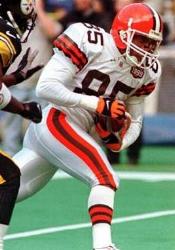
Tim Couch completed 11 of 19 passes for 193 yards with three touchdowns against no interceptions. Kevin Johnson (pictured at left) caught 4 passes for 96 yards and the two TDs, while Leslie Shepherd contributed 4 receptions for 52 yards. As usual, the team was ineffectual on the ground (62 yards on 21 attempts), with RB Karim Abdul-Jabbar leading the way with 39 yards on 13 carries.

For the Saints, Ricky Williams ran for 179 yards on 40 attempts, but also fumbled three times. The two Billy Joes at quarterback combined for just 13 completions in 29 attempts and each gave up an interception; Hobert had a TD pass among his four completions, while Tolliver was successful on 9 of 20 passes for 92 yards. Williams and Keith Poole both caught three passes (for 8 and 23 yards, respectively) while RB Aaron Craver gained 32 yards on his two receptions.

It was the fifth loss of the season for the Saints when holding a fourth quarter lead, on the way to a miserable 3-13 finish at the bottom of the NFC West; a major housecleaning ensued. Cleveland won once more and ended up last in the AFC Central with a 2-14 record, but they had made their first win a memorable one.

Tim Couch had a respectable rookie season, completing 55.9 % of his passes for 2447 yards with 15 touchdowns and 13 interceptions. However, he led the league by being sacked 56 times, and his career in Cleveland was ultimately disappointing.

Kevin Johnson led the Browns in pass receiving for the year with 66 catches for 986 yards (14.9 avg.) and eight touchdowns.

Thursday, October 28, 2010

2001: Saints Come From 18 Points Behind to Beat Rams


The New Orleans Saints were coming off of a 10-6 year in 2000 under first-year Head Coach Jim Haslett and were 3-2 in ’01 as they faced the St. Louis Rams, the team they had beaten out for the NFC West title and then defeated in the Wild Card playoff (the first playoff win in franchise history), at the Dome at America’s Center on October 28, 2001. The Rams, under second-year Head Coach Mike Martz, were a perfect 6-0 thus far and seemed almost invincible.

St. Louis, with its outstanding passing offense, struck quickly on the second play from scrimmage. WR Az-Zahir Hakim took the handoff on a reverse and the former high school quarterback proceeded to fire a pass to WR Isaac Bruce for a 51-yard touchdown. The Saints then fumbled the ball away on their first possession, as TE Cam Cleeland was stripped by St. Louis LB Don Davis after catching a short pass from QB Aaron Brooks. CB Aeneas Williams recovered for the Rams and five plays later, following pass completions by QB Kurt Warner of 25 yards to WR Torry Holt and 13 yards to TE Ernie Conwell, Conwell ran for a two-yard touchdown. St. Louis was ahead by 14-0 and the game was barely four minutes old.

New Orleans got on the board thanks to a 33-yard John Carney field goal, and the score was 14-3 after one quarter. But the Rams scored again early in the second quarter. A pass interference call on Saints CB Kevin Mathis gave St. Louis a 38-yard gain to the New Orleans 36 yard line, and then Warner connected on passes of 13 yards to RB Trung Canidate (filling in for injured star RB Marshall Faulk) and 19 to Bruce to set up Canidate’s one-yard touchdown run.

The Saints drove 66 yards in 12 plays for another field goal by Carney, this time of 44 yards. But Jeff Wilkins responded with a 54-yard field goal late in the period that gave the Rams a halftime lead of 24-6 (Wilkins had missed an attempt earlier that broke a string of 30 consecutive successful field goal attempts).

Down by 18 points, New Orleans came back in stunning fashion in the third quarter. First, rookie RB Deuce McAllister returned the opening kickoff of the second half 46 yards to the St. Louis 48. Two plays later, Brooks connected with WR Joe Horn for a 46-yard touchdown.

On the ensuing St. Louis possession, Saints safety Sammy Knight roared into the backfield on a safety blitz, batted Warner’s pass and intercepted it. His 13-yard return ended up at the Rams’ 16 yard line. New Orleans lost yardage on the possession, however, and settled for a 44-yard field goal by Carney.

St. Louis CB Dre’ Bly fumbled the kickoff and it was recovered for the Saints by RB Fred McAfee at the Rams 16. Five plays later Brooks rolled out and tossed a six-yard pass to Horn for a touchdown. An attempted two-point conversion failed when RB Ricky Williams was stopped short of the end zone, but the Saints were now only two points behind at 24-22.

The Rams went three-and-out on their next possession and had to punt. It took just two plays for New Orleans to take the lead when Brooks went deep down the sideline to WR Willie Jackson and connected for a 49-yard touchdown. Once again, the attempted two-point conversion failed, but the Saints were now ahead by 28-24.

The Saints onslaught continued when DE Darren Howard intercepted a short Warner pass and returned it 37 yards to the St. Louis 23. The resulting possession lasted five plays and ended with Carney hitting on a 23-yard field goal. The third quarter ended with the Saints in the lead at 31-24, having put up 25 points in the course of the period.

St. Louis finally got on the board again in the fourth quarter following a 12-play, 87-yard drive that ended with an eight-yard touchdown pass from Warner to Holt. With the score now tied at 31-31 and the clock winding down to under five minutes, it seemed as though the Rams would yet pull the game out. But at the New Orleans 23, Canidate, who had caught a screen pass, fumbled and safety Chris Oldham recovered for the Saints and ran 43 yards before being pushed out of bounds at the St. Louis 36.

A 14-yard run by Ricky Williams got the ball to the 22, but it seemed that the Rams had dodged a bullet four plays later when they blocked Carney’s 30-yard field goal attempt. However, Bly was penalized for being offsides, giving New Orleans a first down. They ran three times to run the clock down and Carney’s fifth field goal of the day, from 27 yards, gave the Saints a 34-31 win.


St. Louis outgained the Saints, 474 yards to 320, and had 25 first downs to New Orleans’ 15. But they also turned the ball over eight times, including the four that fueled the New Orleans third quarter comeback.

Aaron Brooks (pictured at top) completed 20 of 31 passes for 254 yards with three touchdowns and no interceptions. Joe Horn caught 8 passes for 121 yards and two of the TDs. Ricky Williams led the running game with 77 yards on 17 carries.

For the Rams, Kurt Warner went to the air 47 times with 29 completed for 385 yards; however, while he threw for one TD, he also surrendered four interceptions (two by Sammy Knight, pictured above left). Isaac Bruce was the most productive receiver, catching 7 passes for 179 yards and a touchdown, but while Trung Canidate caught 10 passes for 107 yards, he only gained 19 yards rushing on 12 carries in relief of Faulk, including the one short TD. Az-Zahir Hakim, who contributed a touchdown pass, was the team’s leading rusher with 20 yards on two runs.

“They're not robots, they can be beaten,” said Joe Horn afterward. “I think we proved that today and we look forward to meeting them again.” The result was very different when the clubs met for the rematch in New Orleans – the Rams won, 34-21. Indeed, St. Louis lost only once more the rest of the regular season in posting a 14-2 record and re-taking the NFC West. However, they were stunned by the underdog New England Patriots in the Super Bowl. New Orleans failed to generate any momentum from the come-from-behind win, going 3-7 and losing the last four games of the year. The Saints finished in third place in the division at 7-9.

Kurt Warner (pictured below) was the NFL’s leading passer (101.4 rating) and also led the league in completion percentage (68.7), passing yards (4830), touchdown passes (36), yards per attempt (8.8), yards per completion (12.9), and percentage of TD passes (6.6).

Aaron Brooks, in his first full season as the starting quarterback, ranked fourth in the NFL with a career-high 3832 yards and tossed 26 touchdown passes, although he was also among the league leaders with 22 interceptions.

Wednesday, October 27, 2010

1991: Saints Lose for First Time as Bears Score on Final Drive


The Chicago Bears were 5-2 as they traveled to New Orleans to take on the undefeated (7-0) Saints on October 27, 1991 at the Louisiana Superdome. The Bears were in their tenth season under the direction of fiery Head Coach Mike Ditka and were used to contending – since Ditka’s third season in 1984, they had only once had a losing season (or for that matter, failed to win at least 10 games), and that had been two years before, in 1989 when they were 6-10. They had bounced back to 11-5 in ’90 and had every expectation of dominating the NFC Central.

New Orleans, long an NFL bottom feeder, had begun to win in 1987 under the direction of Head Coach Jim Mora. The Saints had twice been in the playoffs, although with a mediocre 8-8 record in 1990. QB Bobby Hebert had returned after sitting out the ’90 season due to a contract dispute, and whether he or Steve Walsh, the previous year’s starter, was behind center, the team kept winning thanks to an outstanding defense – they had not allowed an opposing team to score in double digits since the second week of the season.

Neither team was able to muster much offense in the first few possessions until, late in the first quarter, Hebert threw a pass down the middle to WR Floyd Turner for a 65-yard touchdown. The Bears managed two field goals by Kevin Butler in the second quarter, of 34 and 48 yards, but had difficulty sustaining any sort of drive. New Orleans took a 10-6 advantage at halftime when Morten Andersen boomed a 60-yard field goal on the final play of the period.

Chicago QB Jim Harbaugh (pictured above) managed to complete just two of his 10 passes in the first half. The Saints had been far better at throwing the ball, but had gained just 16 yards on 10 rushing attempts.

The Bears got a break in the third quarter when New Orleans CB Vince Buck was called for pass interference, resulting in a 37-yard gain to the Saints nine yard line. Two plays later, RB Brad Muster ran six yards for a touchdown and Chicago was in the lead at 13-10.

Two possessions later, the Saints put together a 56-yard drive in six plays highlighted by a 34-yard pass completion from Hebert to Turner. An eight-yard touchdown pass to Turner put New Orleans back in front, 17-13.

Early in the fourth quarter, Butler missed a field goal attempt from 51 yards out. The Bears came no closer to scoring as the game progressed and they continued to struggle on offense against the fierce pass rush. With just under two minutes to go, they took over on their own 48 after a poor 12-yard punt by Tommy Barnhardt of the Saints. Even with the good field position, it seemed as though the New Orleans defense was in control – Harbaugh had failed to complete a pass in the second half and was now a combined two of 19.

However, the passing game suddenly came alive as Harbaugh immediately completed a throw to WR Wendell Davis for 27 yards to the New Orleans 25. RB Neal Anderson ran up the middle for seven yards, and then caught a pass from Harbaugh for six more. Finally, Harbaugh threw to WR Tom Waddle for a 12-yard touchdown and, with the successful extra point, a three-point lead.

The Saints were unable to come back in the final seconds – a fourth-and-16 pass from their own 21 fell incomplete and the Bears, stymied on offense for so much of the game, won by a score of 20-17.


New Orleans easily outgained Chicago, 313 yards to 178, including a net 262 passing yards compared to 36 for the Bears. Jim Harbaugh ended up with 5 completions in 22 attempts for 61 yards with the game-winning TD and two interceptions. Brad Muster led the running game with 57 yards on 10 carries, while Neal Anderson was right behind at 53 yards on 12 attempts. Three receivers accounted for all of the Bears’ pass receiving – Anderson and Tom Waddle (pictured at left) each caught two passes for 17 yards apiece, and Wendell Davis was the yardage leader on his lone 27-yard reception.

For the Saints, Bobby Hebert was successful on 27 of 39 passes for 291 yards with two touchdowns against one interception. Floyd Turner had a big day, catching 9 of those passes for 179 yards and both TDs. However, the running game never caught fire, as the team ran for a total of 51 yards on 23 carries – RB Gill Fenerty was the leader with 25 yards on 8 attempts.

The win over New Orleans was the second of an eventual five straight for the Bears on the way to an 11-5 record and second place finish in the NFC Central - it was good enough to secure a wild card spot in the postseason, although they lost to Dallas in the first round. The Saints, after the strong start, faltered in the second half of the season. They won their next two games but then dropped four straight and finished at 11-5, still good enough to win the NFC West although they fell to arch-rival Atlanta in the Wild Card playoff.

Saturday, September 25, 2010

2006: Saints Defeat Falcons in Return to Superdome


When the New Orleans Saints hosted the Atlanta Falcons at the Louisiana Superdome on September 25, 2006, it marked not just the first home game of the season for the Saints but a return to a city and stadium that the franchise had been forced to abandon for a year due to the effects of Hurricane Katrina.

The aftermath of the powerful storm in September of 2005 had, of course, been devastating for the city as a whole. The Superdome had sustained significant damage, and there were questions as to whether the Saints would return. For the team, it had meant a season on the road in which home games were split between San Antonio and Baton Rouge. They went 3-13 in ‘05, losing 11 of their last 12 games, and finished at the bottom of the NFC South.

The club that took the field in 2006 had been transformed in the offseason. There was a new head coach, Sean Payton, replacing Jim Haslett. There was also a new quarterback, Drew Brees, who had been signed away from the San Diego Chargers as a free agent. Star RB Deuce McAllister, who had been lost five games into the 2005 season with an ACL injury, was back healthy and joined by the Heisman-winning first round draft pick out of USC, Reggie Bush.

The Saints were already 2-0, having beaten Cleveland and Green Bay on the road, as they took the field for the Monday Night Football contest before a wildly enthusiastic crowd of 70,003 at the refurbished Superdome. They were hosting their arch-rivals, the Atlanta Falcons, who had also won their first two games in impressive fashion under third-year Head Coach Jim Mora Jr.

It didn’t take long for the Saints to take command. Atlanta had the first possession of the game and went three-and-out. The ensuing punt by Michael Koenen was blocked by safety and special teams standout Steve Gleason (pictured above) and recovered in the end zone for a touchdown by CB Curtis Deloach. It was the first touchdown given up in the ’06 season by the Falcons.

Atlanta followed up with a nine-play drive that yielded a 26-yard field goal by Morten Andersen. But after the two clubs traded punts, the Falcons gave up another TD when the Saints went 80 yards in eight plays capped by a double-reverse in which WR Devery Henderson ran for an 11-yard touchdown. New Orleans was up 14-3 at the end of the first quarter and in command the rest of the way.

John Carney kicked field goals of 37 and 51 yards in the second quarter, while the closest Atlanta came to scoring was a 25-yard field goal attempt by Andersen that was blocked. Carney booted a 20-yard field goal to cap the Saints’ first time-consuming possession of the second half, and that provided the final margin of 23-3.

The New Orleans defense didn’t let the Falcons offense get closer than the 31 yard line during the second half. They sacked Atlanta QB Michael Vick five times and held the Falcons to 229 yards (the Saints rolled up 326).

Drew Brees had a solid if unspectacular outing, completing 20 of 28 passes for 191 yards with no touchdowns or interceptions. Deuce McAllister led the running game with 81 yards on 19 carries while Reggie Bush ran the ball 13 times for 53 yards. Marques Colston was the leading receiver with 7 catches for 97 yards.

For the Falcons, Michael Vick was held to just 12 completions in 31 attempts for 137 yards, although none were picked off; Vick was also Atlanta’s leading rusher with 57 yards on six carries. Alge Crumpler led the receivers with 5 catches for 49 yards.

Afterward Brees said “From the moment I signed with the Saints, I was looking forward to this. It was a great night. It was something we’ll never forget.” Owner Tom Benson, who had taken heat for suggesting that the Saints might relocate, danced off the field with parasol in hand to the strains of “When the Saints Go Marching In”. A game ball was dedicated to the people of New Orleans.

The Saints went on to win the NFC South with a 10-6 record and advance farther into the postseason than any preceding team in franchise history, finally succumbing to the Chicago Bears in the NFC Championship game. Atlanta dropped to 7-9 to finish third in the division, costing Mora his job.

New Orleans led the NFL in team rushing with 6264 yards as McAllister ground out 1057 yards on 244 carries (4.3 average) with 10 TDs and Bush added 565 yards on 155 attempts with six scores. Bush also caught 88 passes for 742 yards and two TDs and averaged 7.7 yards on 28 punt returns with another touchdown.

Drew Brees (pictured below) led the league in passing yards with 4418 and had the best passer rating in the NFC (96.2). His 26 touchdown passes ranked third in the NFL, as did his 8.0 yards-per-attempt.

Michael Vick became the first quarterback to rush for a thousand yards (1039) with a league-leading 8.4 yards-per-carry.

Friday, September 17, 2010

1989: Packers Come From Behind to Defeat Saints


The Green Bay Packers had not been over .500 in the six consecutive seasons prior to 1989, and that had been in the strike-shortened 1982 campaign. In their first year under Head Coach Lindy Infante in ’88, they had gone 4-12. The club had signed 20 free agents in the offseason, more than any other team in the NFL. Of the holdovers, WR Sterling Sharpe had led the Packers in pass receiving as a rookie and LB Tim Harris had 13.5 sacks and led the team in tackles.

The Packers lost their opening game in ’89 to Tampa Bay and on September 17 hosted the New Orleans Saints at Lambeau Field. After years of underachieving, New Orleans had gone to the postseason for the first time in 1987 under Head Coach Jim Mora and followed up with a 10-6 record in ’88. They missed the playoffs, but it was still a respectable showing for a club that had not posted a winning record in its first 20 seasons.

The Saints took control from the start, scoring on their first three possessions. After receiving the opening kickoff, they drove 77 yards in eight plays with QB Bobby Hebert throwing a 32-yard touchdown pass to WR Lonzell Hill. The Packers went three-and-out and the Saints took eight plays to score again, in a 56-yard possession that was highlighted by a 15-yard pass from Hebert to WR Floyd Turner and 21-yard carry by RB Dalton Hilliard. Hilliard capped the drive with a three-yard TD run. Packers QB Don Majkowski (pictured above) tossed an interception to end the next possession shortly before the conclusion of the first quarter, which finished with New Orleans ahead by 14-0.

Two plays into the second quarter, the Saints extended their lead to 21-0 when Hebert tossed a one-yard touchdown pass to TE Hoby Brenner. After an exchange of punts, Green Bay finally got on the board. Majkowski threw passes of 11 yards to WR Perry Kemp and 20 yards to TE Ed West and RB Brent Fullwood ran in for a TD from a yard out. But New Orleans managed one more drive prior to the end of the half that culminated in a 38-yard Morten Andersen field goal and the Saints took a 24-7 lead into halftime.

The Packers began to climb out of the hole with their first possession in the third quarter. Majkowski completed all seven of his passes in a 14-play, 80-yard drive that ended with Fullwood scoring his second touchdown of the game on a four-yard run. After New Orleans went three-and-out in its possession and punted, Majkowski completed five more passes in a six-play drive with West hauling in a three-yard touchdown catch. Green Bay was now only down by three points, 24-21.

The Saints weren’t done yet, however, as Hebert led them on a six-play possession of their own that included passes of 13 and 28 yards to WR Eric Martin and concluded early in the fourth quarter with a 24-yard scoring throw to Hill. The Packers responded with yet another scoring possession, going 78 yards in five plays as West caught a 17-yard touchdown pass from Majkowski. It was again a three-point game at 31-28.


New Orleans came back with a long, 12-play possession that ran more than eight minutes off the clock and resulted in a 32-yard Andersen field goal. Green Bay struck quickly when they got the ball back with Majkowski passing to WR Jeff Query
(pictured at right) for a 35-yard gain to the Saints’ 45 yard line. But three plays later they faced a fourth-and-17 situation with under two minutes remaining to play. Majkowski again went to Query along the sideline, and the resulting 23-yard gain kept the drive alive. It ended with Majkowski throwing a three-yard touchdown pass to Sharpe, and with the successful extra point, Green Bay took the lead at 35-34 with 1:31 left on the clock.

The one-point margin held up when Hebert immediately went to the air and his long pass was intercepted by CB Van Jakes; Green Bay was able to run out the clock.


The Packers accumulated 490 total yards in their comeback victory to 367 for New Orleans. Don Majkowski completed 25 of 32 passes for 354 yards with three TDs and an interception. There were plenty of pass receiving stars as Sterling Sharpe (pictured at left) caught 8 passes for 107 yards and a touchdown, Ed West contributed 6 receptions for 87 yards and two scores, and Jeff Query made four catches for 84 yards, including the big plays in the final drive. Brent Fullwood also had a notable game rushing, gaining 125 yards on 18 carries with two TDs.

In defeat, Bobby Hebert tossed 32 passes, completed 23 of them for 282 yards and, like his Green Bay counterpart, with three touchdowns and one picked off. Lonzell Hill had 6 pass receptions for 90 yards and two TDs. However, the Saints didn’t gain as much on the ground, as Dalton Hilliard led the club with 43 yards on 13 attempts with a score.

It was the first sign of rejuvenation for the Packers, who ended up going 10-6 and finishing second (due to tiebreakers) in the NFC Central. They just missed the postseason. Meanwhile, New Orleans fell to a disappointing 9-7 and third place in the NFC West.

Don Majkowski had easily the best season of his career. He led the league in pass attempts (599), completions (353), and yards (4318) while firing 27 touchdown passes (third in the NFL) against 20 interceptions. The third-year quarterback out of Virginia was named to the Pro Bowl and received second-team All-NFL recognition from the Associated Press.

Sterling Sharpe led the NFL with 90 pass receptions and ranked second with 1423 yards and 12 touchdowns. He received All-Pro and Pro Bowl recognition, but unlike Majkowski there were better years ahead.

The Packers would regress to being a losing club again in 1990 and ’91, Infante’s last year as head coach. It would take the arrival of Infante’s successor, Mike Holmgren, and a young quarterback named Brett Favre in 1992 before Green Bay would begin to win again with consistency.

Saturday, September 11, 2010

1994: Brian Mitchell’s 225 Yards in Kick Returns Help Redskins Down Saints


Over the course of his 14-year NFL career, RB Brian Mitchell established himself as the most productive kick returner in pro football history. One game that showcased his abilities was on September 11, 1994 as the Washington Redskins faced the New Orleans Saints at the Louisiana Superdome.

The Redskins, just three years after a Super Bowl triumph, had fallen on hard times since the departure of Head Coach Joe Gibbs following the 1992 season. The team had dropped to 4-12 in ’93 under Richie Petitbon and, under new Head Coach Norv Turner, lost the season opening game the previous week to Seattle by a 28-7 score.

The Saints, 8-8 the previous year under Head Coach Jim Mora, had also lost their first game. They received the opening kickoff and drove 66 yards in 14 plays capped by a 29-yard Morten Andersen field goal. Mitchell returned the ensuing kickoff 31 yards to launch Washington’s first possession. The Redskins were forced to punt after five plays but got a break when CB Tyrone Legette of the Saints muffed the kick and LB Lamar Hollinquest recovered for Washington at the New Orleans 14 yard line. The Redskins capitalized three plays later when QB John Friesz completed a 14-yard touchdown pass to WR Henry Ellard.

New Orleans didn’t move the ball on its next possession and punted. Mitchell received the kick at his 26 yard line and returned it 74 yards for a TD and the Redskins were up 14-3.

After another brief possession, the Saints punted from the Washington 46. Tommy Barnhardt’s short, 27-yard kick provided no opportunity for another long return as Mitchell called for the fair catch at the 19. A long drive by the Redskins was for naught when they were unable to punch in from the one yard line and turned the ball over on downs. Again the Saints had to punt, this time a 48-yard boot by Barnhardt that Mitchell returned 16 yards.

Neither team was able to move the ball effectively for the remainder of the half, which ended with Andersen coming up short on a 53-yard field goal attempt for the Saints. However, Mitchell got the second half off to a rousing start with an 86-yard kickoff return to the New Orleans 15, where he was caught from behind by CB Tyrone Hughes (a good kick returner in his own right).

The Redskins made good use of the excellent field position as Friesz threw for a one-yard TD pass to RB Cedric Smith and a 21-3 lead. The Saints fought back, driving 74 yards in eight plays capped by a 17-yard touchdown pass from QB Jim Everett to WR Michael Haynes. The attempted two-point conversion failed.

Mitchell returned his third kickoff of the game for 21 yards. During the series that followed, he ran five yards for a first down and Washington went on to score another TD as Friesz again connected with Ellard, this time for 41 yards. After CB Tom Carter intercepted an Everett pass, the Redskins scored once again early in the fourth quarter when Chip Lohmiller booted a 31-yard field goal.

It was the turn of Tyrone Hughes to make a big return when he brought the ensuing kickoff back 43 yards to near midfield. However, while the Saints drove into Washington territory, they fumbled the ball away. Again the Redskins made the most of the break and eight plays later Friesz threw his third scoring pass of the game, this time to WR Desmond Howard for 31 yards and a 38-9 lead.

New Orleans was able to score two touchdowns, on a four-yard pass from Everett to WR Torrance Small (followed by a successful two-point conversion) and three-yard run by FB Brad Muster, but it only served to make the final tally a bit more respectable. Washington came away with a 38-24 win.

Brian Mitchell gained a total of 225 yards on kick returns (three kickoffs for 138 yards and two punts for 87 yards). On offense, he contributed a further 27 yards on seven carries for an overall 252 yards.

Mitchell’s returns, combined with New Orleans turnovers, were a major factor in Washington’s win. The Saints outgained the Redskins, 408 to 343 yards, as Jim Everett passed for 376 yards in trying to come from behind, completing 31 of 46 passes with two touchdowns and an interception. New Orleans wasn’t able to run the ball, gaining just 28 yards on 15 carries. Leading receivers for the Saints were Michael Haynes, with 6 catches for 87 yards and a TD, and WR Quinn Early, who had 5 receptions for 83 yards.

RB Reggie Brooks led the ground game for the Redskins by gaining 92 yards on 32 carries. John Friesz completed 15 of 22 passes for 195 yards, but with four touchdowns and no interceptions. Henry Ellard accounted for two of the scores while catching three passes for 72 yards.

In the end, it was not a particularly noteworthy season for either team. The Redskins won just twice more to finish at 3-13 and last in the NFC East – the club’s worst showing since 1961. New Orleans came in second in the NFC West with a 7-9 tally.

Brian Mitchell was one of the few bright spots for Washington as he led the NFL in all-purpose yards (2477, his career high), punt returning (14.1 avg., also a career high), combined kick returns (90), and combined kick return yardage (a then-NFL record 1930). He scored two touchdowns on punt returns and his 25.5 kickoff return average ranked fifth in the NFC. The league-leading all-purpose yardage total broke down as 1478 on 58 kickoff returns, 452 on 32 punt returns, 311 on 78 rushes, and 236 from 26 pass receptions.

It was an outstanding season, but not unusually so, for the fifth-year pro out of Southwestern Louisiana. Mitchell would end up returning more kickoffs (607) for more yards (14,014) than any other NFL player, averaging 23.1 yards per return and scoring four touchdowns. Likewise as a punt returner, he set lifetime standards for returns (463) and yardage (4999) and was second in TDs (9) while averaging 10.8 yards. Mitchell gained a total of 23,316 all-purpose yards over the course of 14 seasons with three teams, of which 19,013 came on kick returns. His 13 touchdowns on combined returns set yet another league career record. While not the fastest of all kick returners by any means, he returned kicks with a skill and savvy that made him consistently productive.

Tuesday, July 6, 2010

1967: Jim Taylor Signs with Saints


The expansion New Orleans Saints achieved a high-profile signing on July 6, 1967 when Jim Taylor, star fullback with the Green Bay Packers, inked a contract. Taylor had played out his option with the Packers, and while clearly on the downside of his great career at age 31 (he would turn 32 early in the ’67 season) and after 1811 carries, had been contacted by several teams. A native of Baton Rouge who had played his college football at LSU, the new franchise in New Orleans was a natural choice.

Taylor had been with Green Bay since 1958 and was at the heart of the outstanding ground game during the Vince Lombardi coaching era. He rushed for over a thousand yards in five consecutive seasons and won the NFL rushing title with 1474 yards in 1962, the one year between 1957 and ’65 that Cleveland’s Jim Brown didn’t. He also set a record of 19 rushing touchdowns in that ’62 campaign – a mark that stood until 1983.

But after averaging 4.8 yards per carry during his first seven years in Green Bay, he averaged 3.5 yards in both the ’65 and ’66 seasons. A very physically punishing runner, the 6’0”, 214-pound Taylor was clearly wearing down. The Packers had drafted Jim Grabowski out of Illinois as his replacement, and after not signing a contract in his option year of 1966, it was apparent that his tenure in Green Bay had come to an end. Taylor’s high-profile backfield mate for much of his tenure with the Packers, HB Paul Hornung, was chosen by the Saints in the expansion draft but was forced to retire before the season due to a nagging neck injury.

While he provided a recognizable name for the new franchise, it was nevertheless an expansion team and not to be confused with the championship club Taylor had just left. The New Orleans offensive line was certainly not on a par with its Green Bay counterpart that had included Hall of Famers Jim Ringo at center (through 1963) and OT Forrest Gregg, and the outstanding pulling guards Jerry Kramer and Fred “Fuzzy” Thurston – nor, for that matter, was much of the rest of the club. As sportswriter Arnold Hano put it after the first preseason game, “The starting guards…were men named Jake Kupp and Del Williams, and they do not remind you of Jerry Kramer and Fred Thurston. Backing up Kupp and Williams are other guards who do not even remind you of Kupp and Williams.”

The Saints went 3-11 in their inaugural season and while Taylor was the leading rusher, it was with just 390 yards on 130 carries, for a 3.0 average gain with two touchdowns. He also caught 38 passes, second best on the team, for 251 yards and no scores. Bothered by nagging injuries, he split time at fullback with the less-accomplished veteran Ernie Wheelwright. His best rushing total was 39 yards on 14 carries in a loss to the Cowboys; he caught 7 passes for 50 yards in a contest at Philadelphia (the Eagles, who had been the first team to lose a regular season game to the Saints, 31-24 at Tulane Stadium, gained revenge in the rematch by a 48-21 margin).

Gary Cuozzo struggled as the starting quarterback, particularly as a classic drop-back passer behind a poor group of blockers, and split time with the more mobile veterans Bill Kilmer and Gary Wood. Rookie WR Dan Abramowicz, an unheralded 17th round draft pick out of Xavier of Ohio, was the star on offense with 50 pass receptions for 721 yards and six TDs. CB Dave Whitsell, a veteran obtained from the Bears, starred on defense where he was the NFL’s co-leader in interceptions with 10 (along with Detroit’s Lem Barney). Moreover, the Saints drew large and enthusiastic crowds at Tulane Stadium.

Taylor returned for the 1968 season, but when he was assigned to special teams for the opening preseason game, he left the club and announced his retirement. For Taylor, it was an unbecoming finale to his Hall of Fame career. He retired as the NFL’s number two rusher of all-time with 8597 yards on 1941 carries for a 4.4-yard average gain with 83 touchdowns. Taylor also caught 225 passes for another 1756 yards and 10 TDs.

In seven postseason games, he added 508 yards on 146 attempts (3.5 average) and two touchdowns, plus 19 catches for 137 yards and no scores. His playoff rushing numbers might not appear impressive, but he had memorable showings against strong defensive clubs (in particular the 1962 NFL title game against the Giants).

It was perhaps unfortunate that Taylor was a contemporary of Jim Brown, because he was overshadowed by the great Cleveland fullback throughout the best years of his career – a situation that he clearly resented. He was not gifted with the same level of talent as Brown, but Taylor devoted himself to conditioning and had a solid work ethic. Quiet off the field, he was an intimidating force on it, snarling at and taunting opposing defensive players while never shying from contact and fighting for every inch of ground he could gain. He was a perfect fit in the Green Bay offense and, while Jim Brown won the rushing titles and accolades, it was Taylor playing on four championship teams to Brown’s one.

Thursday, April 29, 2010

2006: Texans Draft Mario Williams 1st Overall Ahead of Bush & Young


After steadily progressing in their first three seasons in the NFL, the Houston Texans dropped to a league-worst 2-14 record in 2005. Head Coach Dom Capers and his staff were dismissed, and offensive-minded Gary Kubiak was hired in his place.

However, with the first pick in the NFL draft on April 29, 2006 the Texans opted for help on defense and made official the selection of North Carolina State DE Mario Williams as their choice (he had actually been signed to a contract the night before).

The decision drew criticism from both commentators and fans. At a draft party held at Reliant Stadium, many of the attendees booed the selection of Williams and began chanting “Reg-gie! Reg-gie!” in reference to Reggie Bush, the star running back and Heisman Trophy winner from USC. There had also been sentiment for picking a local favorite, QB Vince Young from Texas. They ended up being the next two players drafted, by the Saints and Titans, respectively.

Not all of the reviews were critical, to be sure. As one scout said, “I like the Texans’ pick of Mario Williams over Reggie Bush. If you tell me I can have a great running back or I can have a great defensive end, I’ll take the defensive end every time. He’ll have a longer career, he’s on the field for more plays, and defensive ends are harder to find than running backs.”

The 6’7”, 295-pound Williams had chosen to leave school early to enter the draft, but was considered by scouts to be ready for the NFL. In 2005, he had recorded 62 tackles (24 of them for a loss) and 14.5 sacks over the course of 12 games. Moreover, he filled a clear need for a Houston defense that had ranked next to last in the league, including 32nd against the run and 24th vs. the pass (to be sure, they ranked 30th in total offense as well). New defensive coordinator Richard Smith was replacing the 3-4 scheme favored by Capers with a 4-3 alignment, and Williams seemed a good fit for the revamped defensive line.

Initially, the critics appeared to be vindicated by the results of the 2006 season. While the team’s record improved to 6-10, Williams suffered through an injury-marred and inconsistent campaign and recorded just 4.5 sacks. Meanwhile, Bush proved to be a potent complement to power runner Deuce McAllister, accumulating 1523 all-purpose yards (742 on 88 pass receptions alone) as the Saints ranked first in team offense and made it to the postseason. Vince Young showed great promise with the Titans, passing for 2199 yards and running for another 552 while being selected Offensive Rookie of the Year by the Associated Press.

The Houston offense ranked 28th in the NFL. QB David Carr, the first player ever drafted by the club in 2002, continued to be mired in mediocrity. RB Ron Dayne led the team in rushing with 612 yards. A revamping followed in the offseason.

However, the situation for Williams, especially in comparison to Bush and Young, shifted significantly from 2007 onward. Healthy and playing with greater confidence, he tied for third in the league in sacks with 14. In ’08, he had another 12 sacks, was a first team All-NFL selection of The Sporting News and second team pick by the AP, and went to the Pro Bowl for the first time. That was followed up in 2009 with another Sporting News first team All-NFL pick and second Pro Bowl invitation.

Reggie Bush failed to build upon his fine rookie season and his performance was decidedly uneven. While a dynamic player with outstanding outside running ability and good receiving skills out of the backfield who contributed to a championship team, he had durability issues and did not fulfill the hopes that he could be an every-down running back – let alone an elite performer. He averaged just 3.7 yards-per-carry in his first three seasons (although he also caught 213 passes). Strictly a role player, his numbers in all categories declined in 2009 - but his postseason performance was solid, in particular an impressive showing against Arizona in the NFC Divisional playoff.

Vince Young struggled in his second season and was benched for virtually all of his third; brought back into the starting lineup midway through the ’09 campaign with favorable results, his career is at an uncertain stage.

While all three careers are very much in progress, after four seasons, the selection of Williams in the top spot of the first round in ’06 has looked more justified with each passing year.

Saturday, April 17, 2010

1999: Saints Trade All Picks to Draft Ricky Williams


The first round of the 1999 NFL draft was held on April 17, and it was eventful. Early speculation had been that RB Ricky Williams, who had won the Heisman Trophy at Texas while accumulating an NCAA Division I-A-record 6279 yards, would be the hottest commodity. But doubts began to arise as draft weekend approached - there were questions about the 6’0”, 225-pound power runner’s conditioning, attitude, dreadlocked appearance, and introverted nature.

In addition, the quarterback class was considered to be a strong one and the first three teams all went for that position. The newly-reconstituted Cleveland Browns, as an expansion team for the ’99 season, had the first pick and took Tim Couch, a 6’5”, 225-pound signal caller from Kentucky. The Philadelphia Eagles, coming off of a 3-13 season and with a new offense-minded head coach in Andy Reid, chose Donovan McNabb from Syracuse. Cincinnati completed the quarterback trifecta by taking Oregon’s Akili Smith.

Choosing fourth in the first round were the Indianapolis Colts, and having just drafted Peyton Manning the year before, their interest was in a running back (they had also just traded veteran Marshall Faulk to the Rams). However, they passed Williams over for Edgerrin James of Miami, who they felt was a better fit for their offense.

The fifth choice belonged to the Washington Redskins (picked up from Carolina thanks to a trade for DE Sean Gilbert the previous year). In a stunning move, the New Orleans Saints traded their entire draft allotment of six picks in 1999 plus their first and third round choices in 2000 to the Redskins in order to draft Williams. It was a controversial deal from the moment it was announced, and spurred debate for years afterward.

The Saints had gone 6-10 in ’98 and, moreover, had the league’s worst running attack. Mike Ditka, going into the third year of his head coaching comeback in New Orleans, viewed Williams as the centerpiece of his conservative offense and had made clear well in advance of the draft that he considered the Texas back worth the price of the club’s entire draft slate. GM Bill Kuharich went ahead with the deal, in spite the misgivings of some in the organization.

Ditka was ecstatic. The day after the draft, he appeared before a group of Saints fans in a Hawaiian shirt and dreadlock wig and shouted, “We are going to win the Super Bowl…We got Ricky, and he’s the final piece of the puzzle. I really believe that.” Ditka and Williams later appeared on the cover of ESPN magazine as a bride and groom, emphasizing the degree to which the coach had gambled his future on the prize running back.

Meanwhile, the Redskins turned around and dealt some of their draft bounty to the Chicago Bears in order to move up to the seventh spot in the first round and select CB Champ Bailey from Georgia. The Bears, trading down in the first round to stockpile picks, took QB Cade McNown of UCLA in the 12th slot (the original draft position of the Saints), just after another quarterback, Daunte Culpepper from Central Florida, was taken by Minnesota in the 11th spot.

Williams signed a comparatively cheap and insentive-laden contract (he made $3.8 million as a rookie, compared with James’ $14.8 million in Indianapolis) and proceeded to have a miserable season. He gained just 884 yards on 253 carries for a paltry 3.5-yard average with two touchdowns as a result of ankle, elbow, and toe injuries. He also alienated teammates and fans alike with his behavior and critical media quotes.

The Saints finished in last place in the NFC West with a 3-13 record, and owner Tom Benson fired Ditka and the rest of the coaching staff, as well as GM Kuharich.

The other teams involved in the deal didn’t fare all that well either. The Redskins ended up trading all but three of the draft picks away, and those three turned out to be LB Nate Stimson in the fourth round of the ’99 draft, LB LaVar Arrington in the first round in 2000, and DB Lloyd Harrison in the third round in 2000. Arrington had a solid career, but Stimson failed to catch on and Harrison bounced from Washington to the Chargers and Dolphins without distinguishing himself over a three-year career.

The deal with the Bears brought the opportunity to draft an outstanding performer in Bailey, but he and Arrington proved to be the only players of value from the dealmaking. The Redskins made the playoffs in 1999 with a 10-6 record, but were mediocre over the course of the ensuing five seasons. GM Charley Casserly was fired following the ’99 campaign, and Head Coach Norv Turner didn’t complete the 2000 season.

McNown was a huge disappointment for the Bears (as was the case with most of the highly-touted 1999 quarterback class), lasting just two mediocre seasons. The other players that Chicago drafted in ‘99 with the Saints picks that had come by way of Washington were WR D’Wayne Bates (third round) and LB Khari Samuel (fifth round). Bates caught a total of 15 passes over three years in Chicago before moving on to Minnesota (he caught 50 passes for 689 yards in 2002, but lasted just one more season). Samuel started one game for the Bears in 1999.

Mark Hatley, the director of player personnel, was fired in 2001 after Chicago, last place finishers in the NFC Central in 1997 and ’98, continued to land at the bottom of the standings in ’99 and 2000.

Washington traded two of the ’99 draft choices to Denver, and the Broncos used them on TE Desmond Clark (sixth round) and WR Billy Miller (seventh round). Ironically, Miller ended up being a reserve with the Saints.

Things did improve for Ricky Williams in New Orleans, where he had back-to-back thousand-yard seasons in 2000 and ’01. However, he never came close to meeting expectations and was dealt to Miami. He led the NFL with 1853 rushing yards in ’02, but drug and behavioral issues hampered his career thereafter.

The all-for-one deal of 1999 proved poisonous to the three teams most significantly involved. Almost all of the general managers and coaches who had been part of the trade and its related transactions were fired within two seasons. The Saints suffered most of all, in particular Ditka (pictured below), although he steadfastly defended the trade long afterward.