Showing posts with label Detroit Lions. Show all posts

Thursday, January 6, 2011

1963: Lions Beat Steelers in Playoff Bowl as Layne Plays for Last Time


The Detroit Lions were appearing in the Playoff Bowl for the third straight year on January 6, 1963. While it was a meaningless postseason exhibition game, it still attested to the fact that they had placed second in the NFL’s Western Conference from 1960-62. Detroit did so again in ’62 with an 11-3 record, third best in the NFL.

Representing the Eastern Conference were the Pittsburgh Steelers, who had gone 9-5 in their sixth season under Head Coach Buddy Parker – the same coach who had led the Lions to back-to-back NFL titles in 1952 and ’53. The Steelers had won six of their last seven games and were largely a veteran club. QB Bobby Layne was nearing the end of his Hall of Fame career, and it was 34-year-old Ed Brown, formerly of the Bears, who would be starting against the Lions. Ninth-year FB John Henry Johnson had the finest season of his distinguished career, rushing for 1141 yards. Split end Buddy Dial was a potent deep threat, while TE Preston Carpenter was chosen for the Pro Bowl. Savvy veterans, center Buzz Nutter and DT Gene “Big Daddy” Lipscomb, were also picked for the Pro Bowl, and other key contributors over 30 were DT/DE Ernie Stautner and LB George Tarasovic. Lou Michaels, a placekicker as well as defensive end, set a new NFL record with 26 field goals.

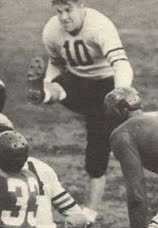
Detroit had demolished the Steelers during the regular season by a 45-7 margin, but that was at the beginning of the year and before they began to reel off wins. Coached by Parker’s successor, George Wilson, the Lions were renowned for their defense that included tackles Roger Brown and Alex Karras, MLB Joe Schmidt, and the league’s best secondary with cornerbacks Dick “Night Train” Lane and Dick LeBeau and safeties Yale Lary and Gary Lowe. The offense continued to be a problem, and the acquisition of QB Milt Plum (pictured above) from Cleveland during the previous offseason, although an improvement, did not fully resolve the issue.

There were 36,284 fans for the nationally-telecast game at Miami’s Orange Bowl, the game’s best attendance to date (and exceeding the 35,000 threshold that NFL Commissioner Pete Rozelle stated was necessary for Miami to continue hosting the event). The Steelers were also debuting a new (and now familiar) black helmet design, having worn gold helmets previously.

The Detroit offense looked good in the first quarter, twice driving into field goal range. The first possession included passes by Plum of 20 yards to split end Gail Cogdill and 14 to flanker Pat Studstill. However, Wayne Walker missed a 29-yard field goal attempt. The second drive began just before the end of the scoreless opening period as FB Ken Webb ran for 32 yards (the longest carry of the day) to just past midfield. Plum passed the team down to the 18, and this time Walker was successful on a field goal attempt from 27 yards.

The Steelers couldn’t get beyond their 40 yard line until midway through the second quarter when they put together an 11-play drive for a touchdown. A pass interference call on a third-and-16 play got the drive moving, and a 19-yard pass from Ed Brown to Carpenter gained 19 yards, followed by a 26-yard throw to Dial for another 26 down to the Detroit 19. HB Dick Hoak scored on a six-yard run and the Steelers led by 7-3.

The Lions again drove into Pittsburgh territory, but LB Tom Bettis intercepted a pass by Plum at the goal line. However, Detroit LB Carl Brettschneider returned the favor by intercepting a Brown pass and returning it 32 yards to the Pittsburgh 34; the Lions capitalized with a 20-yard TD pass from Plum to Webb in the last minute of the half. It was 10-7 in favor of Detroit at the intermission.

In the third quarter, Pittsburgh’s Michaels tied the score at 10-10 with a 40-yard field goal. Following an interception of Plum by safety Clendon Thomas, Michaels tried another field goal but missed from 38 yards.

The Lions came back as Plum connected with HB Dan Lewis on a 74-yard pass play to the Pittsburgh five. Webb scored his second TD shortly thereafter on a two-yard run, and Detroit was ahead to stay.

In the fourth quarter, Pittsburgh DB Glenn Glass intercepted a pass and returned it 28 yards to the Detroit 35. However, blitzes by the Lions defense resulted in sacks that pushed the ball back to the 47 and the Steelers came up empty.

Brown was replaced at quarterback for Pittsburgh midway through the fourth quarter by Layne, appearing in the last game of his illustrious career, and ironically against the team that he had quarterbacked so successfully from 1950 through the second game of the ’58 season. Having just turned 36, the old pro might have been broken down physically, but still had competitive fire and provided some excitement as he sought to bring the Steelers from behind. He completed three passes to get Pittsburgh to the Detroit 21 yard line. However, two long throws by Layne fell incomplete as the Lions defense held. A field goal attempt by Michaels was blocked.

Detroit tried to extend its lead on the following possession, but a 32-yard field goal attempt by Walker was partially blocked and fell short, setting the stage for one last try by Layne and the Steelers. A final drive to midfield ended when Layne was intercepted by Yale Lary, essentially finishing the contest. Detroit won by a score of 17-10.

For an exhibition game, there was plenty of hard hitting and several players went down with injuries. John Henry Johnson suffered an apparent concussion, and Pittsburgh DB Willie Daniel broke his jaw while OT Dan James injured his leg. Detroit’s Ken Webb was knocked out when hit by Lipscomb.

The Lions won, despite giving up three interceptions and missing two of three field goal attempts. However, they registered six sacks in all and intercepted two passes while also blocking a field goal attempt.


Milt Plum was selected as the game’s MVP as he completed 16 of 29 throws for 274 yards and a TD (the yardage total ended up being the highest in the 10-game history of the Playoff Bowl). Dan Lewis (pictured at left) had 115 receiving yards while Ken Webb gained 47 yards on the ground to lead the club.

For Pittsburgh, Ed Brown completed 5 of 12 passes for 82 yards while Bobby Layne (pictured below) was good on 4 of 8 throws for 69 yards. Dick Hoak was the leading rusher with 64 yards.

Bobby Layne’s next stop was the Pro Football Hall of Fame five years later. Tragically, “Big Daddy” Lipscomb, who appeared in the Pro Bowl the following week, died from a drug overdose in May.

With the win over the Steelers, the Lions were victors in all three of their Playoff Bowl games. They would not appear in the contest again (the last was played following the 1969 season), but the three wins were the most by any team.

Tuesday, December 21, 2010

1952: Pat Harder Spurs Lions to Win Over Rams in Conference Playoff


The 1952 NFL season ended with both the Detroit Lions and Los Angeles Rams tied atop the National Conference with 9-3 records, necessitating a playoff game. The clubs met at Detroit’s Briggs Stadium on December 21 to determine who would represent the conference against the Cleveland Browns for the league championship.

The Rams were the defending league champions and had made it to the title game three consecutive years as either the Western Division champ (1949) or champion of the renamed National Conference (1950 and ’51). There had nevertheless been organizational turmoil early in the season as Joe Stydahar, the head coach since 1950, resigned after a bad loss in the opening game and assistant Hamp Pool (with whom Stydahar had been feuding) was elevated to the top job. After getting off to a sluggish 1-3 start, LA won eight straight games. The Rams still boasted the league’s most explosive offense that included quarterbacks Norm Van Brocklin and Bob Waterfield, receivers Tom Fears and Elroy “Crazylegs” Hirsch, and the NFL’s leading rusher, FB Dan Towler.


Detroit, meanwhile, was a team on the rise under second-year Head Coach Buddy Parker. The offense was led by QB Bobby Layne, who had been obtained in 1950 and proved to be an excellent fit with his passing and leadership abilities. Star all-purpose HB Doak Walker missed time due to injury, but HB Bob “Hunchy” Hoernschemeyer (pictured at left) ranked fifth in the NFL in rushing (457 yards). 30-year-old veteran FB Pat Harder (pictured at top) had been obtained from the Cardinals, with respectable results, although more due to his blocking than running. End Cloyce Box led the league in touchdowns with 15. The defense was especially tough, with a backfield that was perhaps the best in the NFL.

There were 47,645 fans present on a cold, foggy day in Detroit. The Lions scored on their first possession, following an uncharacteristically poor punt by Van Brocklin. The Rams were double-teaming Box, as well as Walker out of the backfield, so Layne threw passes down the middle to big (262-pound) end Leon Hart that gained, first, 22 yards and then 13. Harder capped the 52-yard drive with a 12-yard touchdown run and successfully kicked the extra point to make it 7-0.

There was no further scoring in the opening period, but, following a miss by Waterfield on a 34-yard field goal attempt in the second quarter, Detroit put together a six-play, 80-yard drive that ended with Harder running for a four-yard TD. The possession was highlighted by two passes to Walker, one from Layne for a 50-yard gain and the other an option pass by Hoernschemeyer that went for 24 yards and put the Lions in scoring position. The Rams finally got on the board near the end of the half when Van Brocklin tossed a 15-yard touchdown pass to Fears that capped a seven-play drive following an interception and made it 14-7.

Early in the third quarter, Van Brocklin threw a pass to end Bob Carey at the Detroit 40 that looked to be a big play in the making, but Carey fumbled and safety Yale Lary recovered for the Lions. Detroit made the most of the break as Walker threw a halfback option pass to Hart in the end zone for a 24-yard TD. Shortly thereafter, a 43-yard field goal by Harder (who had kicked all of the extra points as well) increased Detroit’s margin to 24-7.

The Rams fought back with an 80-yard drive deep into Lions territory, highlighted by a 47-yard run by HB Skeets Quinlan, but after getting a first down on the six yard line, four straight runs into the line by Towler were stopped and LA was forced to turn the ball over on downs at the Detroit one.

However, in the fourth quarter Los Angeles got a break when Layne went to the air deep in his own territory and was intercepted by middle guard Stan West, who returned it to the Detroit 20. Waterfield replaced Van Brocklin at quarterback and shortly thereafter Towler scored from five yards out to cut the Lions’ margin to 24-14. It was a three-point game when LA’s Verda “Vitamin T” Smith returned a punt 56 yards for another TD.

With the game coming down to the last minute, the Rams had the ball at their own 11 but a pass from Waterfield, intended for Hirsch, was instead intercepted by LB LaVern Torgeson at the LA 30. Hoernschemeyer scored a nine-yard clinching touchdown and the Lions won the game and division title by a score of 31-21.


Detroit outgained the Rams by 365 yards to 307 and had the edge in first downs with 18 to LA’s 15. While the Lions gave up more turnovers (four to three), the two fumbles and the last-minute interception were more costly to Los Angeles.

Pat Harder was the player of the game for Detroit as he ran for 72 yards on 8 carries, including two touchdowns, and caught a pass for six more yards. Adding up the two TDs, one field goal, and four extra points, he accounted for 19 points.

Doak Walker (pictured above right) ran for 29 yards on 7 attempts, caught two passes for 75 more yards, and threw a touchdown pass. Bob Hoernschemeyer gained 49 yards on 11 rushes, including a TD.

Bobby Layne (pictured below) completed 9 of 21 passes for 144 yards and was intercepted four times. The Lions made good use of their two halfback option passes that totaled 48 yards and directly scored one touchdown while setting up another. Leon Hart was the leading pass receiver for the Lions with 5 catches for 86 yards and a TD.


For the Rams, Norm Van Brocklin completed 15 of 19 passes for 166 yards with a touchdown and none intercepted while Bob Waterfield added 3 of 9 for 13 yards and was picked off once. Tom Fears led the receivers with 7 catches for 76 yards and a TD while Crazylegs Hirsch had 5 receptions for 45 yards. “Deacon Dan” Towler ran for 54 yards on 13 carries and had one touchdown.

The game truly marked a changing of the guard in the West (the conferences would be renamed Western and Eastern in 1953). The Lions went on to defeat the Browns for the NFL Championship in ’52 and won the Western Conference again in 1953 and ’54 (in all instances they faced Cleveland in the title game, winning again in ’53 but losing in 1954). The Rams did not return to the postseason until 1955.

Pat Harder played one more season in 1953. While a good fullback, his kicking made him significant to two championship teams (the 1947 Cardinals as well as ’52 Lions) and he was the NFL’s scoring leader in three consecutive seasons (1947 to ’49). Harder retired with 531 career points that included 38 touchdowns, 35 field goals, and 198 extra points.

The playoff game against the Lions was the last for Bob Waterfield (pictured below). The quarterback who led the Rams to their first championship in 1945 while the franchise was still in Cleveland, he had also been a good defensive back during the single-platoon era and was one of the league’s best kickers as well. Waterfield was inducted into the Pro Football Hall of Fame in 1965.

Monday, December 20, 2010

1981: Bucs Inflict First Home Loss of Season on Lions to Win NFC Central


The NFC Central title was on the line on December 20, 1981 as the Detroit Lions hosted the Tampa Bay Buccaneers at the Pontiac Silverdome. For the Lions, under Head Coach Monte Clark, it was auspicious to be playing at home – they were undefeated there thus far in ’81 and had beaten the Vikings impressively by a 45-7 score the week before. But both teams were 8-7, highlighting the mediocrity of the division.

Detroit may have been unbeatable in the Silverdome but had been far less successful on the road, going 1-7 (including a loss at Tampa). Starting QB Gary Danielson went down for the year in the fourth game and, after backup Jeff Komlo proved inadequate, Eric Hipple, who had seen no action in his 1980 rookie season, took over and played surprisingly well. He had good receivers to throw to in wide receivers Freddie Scott and Leonard Thompson, as well as TE David Hill. But even more significant was RB Billy Sims, the star second-year player out of Oklahoma who was among the rushing leaders. The defense was best against the run and featured DT Doug English, DE Dave Pureifory, LB Ken Fantetti, and FS Jimmy Allen.


Head Coach John McKay’s Buccaneers had come out of nowhere to win the division in 1979, regressed in ’80, but were now contending again. They had won three of their last four and a big part of it had been the performance of QB Doug Williams, particularly when passing to deep-threat WR Kevin House (pictured at left). TE Jimmie Giles was also a Pro Bowl-quality player. The defense may not have been as formidable as in ’79, but it was still anchored by star DE Lee Roy Selmon (pictured at top) and the backfield was tough to pass against.

There was a big crowd of 80,444 on hand to see if the Lions could remain dominant at home and make it to the postseason. The Bucs scored first with a 40-yard field goal by Bill Capece in the opening period, but Detroit went ahead 7-3 thanks to a nine-yard touchdown run by Hipple in the second quarter.

It appeared that the Lions would add to the margin as they again drove deep into Tampa Bay territory, but Hipple’s pass intended for Scott was intercepted by safety Cedric Brown at the three yard line and returned to the 16. On the Bucs’ first play, Williams lofted a pass to House that resulted in an 84-yard touchdown. Rather than being ahead by seven to ten points, Detroit was down by 10-7 at halftime.

Eddie Murray tied the score for the Lions with a 47-yard field goal with just over five minutes remaining in the third quarter. But as the game entered the fourth quarter, Tampa Bay took command with 10 points in a span of 70 seconds.

First, Capece broke the tie with a field goal 12 seconds into the final period. The biggest play of the game came on the following Detroit possession. In a third-and-10 situation, Selmon hit Hipple from behind and forced a fumble that was recovered by NT David Logan, who gathered the ball in on one hop off the artificial surface and ran 21 yards for a touchdown. From 10-10, the Buccaneers now held a 20-10 lead.

Still, the Lions, urged on by the enthusiastic crowd, came back and drove to the Tampa Bay 13. But once again Hipple was intercepted by Brown, this time in the end zone. While Detroit managed to score once more with 1:21 remaining as Hipple connected with Thompson for an eight-yard TD, it was too late. The Bucs came away with a 20-17 win and the division title.

The Lions outgained Tampa Bay (340 yards to 276) and also had the edge in first downs (21 to 11). But they turned the ball over three times, to none suffered by the Bucs, and that was the key to the outcome.

Doug Williams completed just 8 of 19 passes for 172 yards, but that included the long touchdown pass and he tossed no interceptions. Kevin House caught only one pass, but it was for 84 yards and a TD. RB James Owens was the club’s leading rusher, with 61 yards on 17 carries, and also caught two passes for 49 yards that included Tampa Bay’s second-longest completion of the day, of 35 yards. Jimmie Giles caught two passes as well, totaling 19 yards.


Eric Hipple (pictured at right) was successful on 18 of 28 passes for 205 yards, but his one touchdown was offset by two costly interceptions. Billy Sims was held to 76 yards on 19 carries and caught three passes for 39 more. RB Dexter Bussey had a team-leading four catches out of the backfield for 32 yards, while Freddie Scott gained 56 yards on his three receptions.

The 9-7 Buccaneers traveled to Dallas for the Divisional playoff, and lost convincingly by a 38-0 score. Detroit’s 8-8 tally tied for second with Green Bay.

Doug Williams (pictured below) passed for a career-high 3563 yards and had 19 touchdown passes as opposed to 14 interceptions. His 7.6 yards per attempt ranked seventh in the league, as did his 3.0 percentage of interceptions.

Eric Hipple led the NFL in both yards per attempt (8.5, tied with Denver’s Craig Morton) and yards per completion (16.8). He threw for 2358 yards with 14 touchdown passes and 15 interceptions. While he created some excitement early on, his nine-year career ended up being decidedly average.

Kevin House capped a breakout season with the long scoring catch against Detroit. Following a quiet rookie season in which he had one reception, House caught 56 passes for a career-high 1176 yards (21.0 avg.) and 9 TDs in ’81.

Billy Sims placed third among NFL rushers with 1437 yards on 296 carries (4.9 avg.) that included 13 touchdowns.

Cedric Brown ended up with nine interceptions, tying him for third in the NFL with Detroit’s Jimmy Allen, among others. In nine seasons, all spent with Tampa Bay, he intercepted 29 passes to rank third in franchise history to date. Few were bigger than the two against the Lions.

Wednesday, December 15, 2010

1935: Lions Beat Grounded Giants for NFL Championship


The weather in Detroit for the NFL Championship game on December 15, 1935 was gray, wet, and windy. The field at the University of Detroit’s Titan Stadium was sloppy – good news for the ground-oriented Lions, but inauspicious for the visiting New York Giants.

Detroit, under the direction of Head Coach George “Potsy” Clark, didn’t throw the ball much (a total of 142 passes all season, second fewest in the league). But two of the top four rushers in the NFL played for the Lions - second-ranked wingback Ernie Caddel (450 yards) and fourth-ranked tailback Dutch Clark (427 yards), who also led the NFL in scoring (55 points). Bill Shepherd had come to the Lions from the Boston Redskins during the season and, between the two teams, came in fifth in rushing, right behind Clark (425 yards). Clark (pictured above), along with tailback/wingback Glenn Presnell, directed the offense and was known for his shifty running style. Caddel and Shepherd provided the speed. FB Ace Gutowsky supplied the power. After a slow start, the Lions finished out at 3-0-1 to accumulate a 7-3-2 record, thus beating out the Packers for the Western Division title.

The Giants, coached by Steve Owen, were the defending league champions and had won the Eastern Division in each of the first two years of division play. They had the NFL’s best passer in tailback Ed Danowski, who led the league in attempts (113), completions (57), yards (794), and touchdowns (10). Rookie end Tod Goodwin led the NFL with 26 catches and was second in receiving yards with 432. FB Kink Richards was the top runner, with a third-ranked 449 yards. New York went 9-3 during the regular season to again top the division and earn a spot in the title contest, which they were heavily favored to win.

There were 15,000 hardy fans on hand to see if the Lions, like major league baseball’s Tigers back in October, could bring a championship to Detroit. The Lions took the opening kickoff and drove down field. They were helped by two long passing plays, including one from Gutowsky that hit Danowski, playing defense, in the chest and was caught by end Ed Klewicki. Gutowsky capped the 61-yard drive with a two-yard touchdown run and Presnell kicked the extra point for the 7-0 lead.


The Giants came back with a drive of their own, but came up empty when FB Ken Strong (pictured at left) missed a 34-yard field goal attempt. Even more costly, Goodwin suffered broken ribs when hit after making a catch and was lost for the remainder of the game. As the team’s next-most-productive receiver throughout the year, wingback Dale Burnett, was already out with a hand infection, New York’s aerial attack was hindered all the more.

The Giants got a break by recovering a Detroit fumble on the next possession, but once again failed to capitalize when they were held on downs. The Lions scored again when Clark slithered through the Giants defense for a 40-yard touchdown. While the PAT attempt failed, Detroit held a 13-0 lead at the end of the first quarter.

The Lions came close to scoring again in the second quarter when end Harry Ebding blocked a Danowski punt but, after recovering and running to the Giants’ two yard line, fumbled the ball, which traveled through the end zone for a touchback.

Midway through the second quarter, New York finally got on the board. A Danowski pass was partially deflected by Gutowsky, but Strong managed to catch it with one hand and run for a 42-yard touchdown. Strong successfully kicked the extra point and the Lions’ lead was cut to 13-7 at halftime.


The third quarter was scoreless, but in the fourth quarter the Giants threatened, failing to get on the board in each instance. With three minutes remaining to play, Danowski attempted a quick kick that was too low and hit one of his blockers, and it was recovered by Detroit tackle George Christensen at the New York 26. The Lions ran five straight plays into the line and then, on the sixth, Clark faked a handoff to Gutowsky straight ahead and instead gave the ball to Caddel (pictured at right), who swept to the outside for a four-yard touchdown. With Clark’s kick, the Lions now held a commanding 20-7 lead.

Detroit scored once more when, after tailback Harry Newman returned the ensuing kickoff to the Giants’ 32, on first down Danowski went to the air and was intercepted by FB/LB Buddy Parker, the future head coach of the Lions, who returned it to the 10 yard line. Parker himself scored on a four-yard run on third down, although he missed the extra point. Detroit won by a final score of 26-7 for its first NFL Championship.

The Lions outgained the Giants with 303 yards to 194 and also had the edge in first downs, 16 to 9. 235 of Detroit’s yards came on the ground – the Lions threw only five passes and the two completions on the opening drive were it for the day. However, the Giants were able to complete just four of 13 passes for the one TD and gave up two interceptions.

Monday, November 29, 2010

1934: Bears Edge Lions in Thanksgiving Showdown


A Thanksgiving tradition began on November 29, 1934 when the Detroit Lions hosted the Chicago Bears at the University of Detroit’s Titan Stadium. The Lions, transplanted from Portsmouth, Ohio, where they played as the Spartans from 1930-33, were 10-1 entering the contest, having run off a record seven straight shutouts to start the season. They had lost to Green Bay for the first time the previous Sunday, by a score of 3-0, and had given up a total of 30 points in all.

Star tailback Dutch Clark had come out of a year’s retirement to lead a talented backfield for Head Coach George “Potsy” Clark’s club that included FB Ace Gutowsky, wingback Ernie Caddel, and tailback Glenn Presnell. End Buster Mitchell and guard Ox Emerson were All-Pro-calibre players.

The Bears were the defending NFL champions and came into the contest undefeated at 11-0. Under the direction of George Halas, the owner and head coach, Chicago typically dominated opponents and had only allowed two teams to score in double figures all season.

There was a sellout crowd of 25,000 fans in attendance for the Western Division showdown, and the game was broadcast nationally on radio (new Lions owner George Richards was a radio executive). Detroit got the first break of the day, with a defensive play that set up the first touchdown. With the Bears at their own 36, Mitchell intercepted a deflected pass by QB Carl Brumbaugh and returned it to the Chicago four yard line. Gutowsky ran for a touchdown from there and Clark drop-kicked the extra point.

The Bears tied the game thanks to HB Gene Ronzani scoring on a 14-yard pass into the end zone from QB Keith Molesworth early in the second quarter, with Jack Manders (pictured at top) adding the extra point on a placekick. The play was set up on a long completion by the same combination of Molesworth to Ronzani that put Chicago in scoring position.


The Lions regained the lead when Presnell kicked a 42-yard field goal. Gutowsky (pictured at left) powered over again for another touchdown shortly thereafter, capping a drive that began at the Detroit 35, but Clark’s extra point attempt was blocked. The Lions were up by 16-7 at the half. In the third quarter, Manders kicked field goals of 21 and 42 yards, cutting Detroit’s lead to 16-13.

The key play of the game occurred in the fourth quarter when G Joe Zeller intercepted a Gutowsky pass at his own 46 and returned it to the Detroit four yard line, where Gutowsky himself finally pulled him down. Two plunges into the line gained two yards, but then FB Bronko Nagurski, faking another run, instead reared up and floated a pass to end Bill Hewitt in the end zone for what proved to be the winning touchdown. Nagurski’s PAT attempt was blocked.

The Lions drove from their own 20 to the Chicago 14 yard line but gave up the ball on downs with less than a minute to play, clinching the 19-16 win for the Bears.

Detroit outrushed the Bears with 201 yards to 116 and led in first downs, 14 to 6, but Chicago’s passing attack and the kicking of Manders made the difference.

The win clinched the Western Division title for the Bears, and they emphasized the point by beating the Lions again in the season finale the following week in Chicago. Thus, they ended the season with a perfect 13-0 record, but were upset by the Giants in the NFL Championship game. Detroit finished second at 10-3.

Bill Hewitt’s game-winning touchdown reception was one of a league-leading five TD catches, out of a total of 11 receptions (Hewitt pictured below, #56 without helmet).

Jack Manders led the NFL with 10 field goals (by comparison, the five runners-up, which included Glenn Presnell and Dutch Clark, had four apiece), 28 extra points, and 76 points (Clark was the runner-up in both categories with 13 PATs and 73 points), showing why he earned the nickname “Automatic Jack”.

The Thanksgiving Day game was considered a success and, except for a brief hiatus during World War II, the Lions have continued to host a game every Thanksgiving.

Monday, November 22, 2010

1962: Lions Hand Packers Only Defeat of Season in “Thanksgiving Day Massacre”


After ten weeks of the 1962 NFL season, the Green Bay Packers were undefeated at 10-0 and apparently cruising toward a second consecutive league title. The Detroit Lions were 8-2 with four games left to play and had lost a hard-fought 9-7 game at Green Bay in Week 4. The clubs were scheduled to meet at Tiger Stadium on Thanksgiving Day, November 22, and the Lions were determined to exact their revenge.

Head Coach Vince Lombardi’s Packers were the highest-scoring team in the league, as well as the best all-around. The offensive line, which contained two future Hall of Famers in center Jim Ringo and tackle Forrest Gregg and an outstanding tandem of guards in All-Pro Jerry Kramer and Fred “Fuzzy” Thurston, allowed the team to roll up yardage on the ground. FB Jim Taylor already had 1121 yards rushing. QB Bart Starr could pass effectively (he came into the game ranked second in the NFL) and had outstanding receivers in flanker Boyd Dowler, split end Max McGee, and TE Ron Kramer (also an outstanding blocker).

Detroit, coached by George Wilson, had long been established as a premier defensive club. Tackles Alex Karras and Roger Brown, MLB Joe Schmidt, CB Dick “Night Train” Lane, and safety Yale Lary were all among the best at their positions (Lary was also an outstanding punter). The Packers had been fortunate to beat them in the first meeting, and therein lay the seeds of discontent among Detroit’s offensive and defensive units.

Pro Bowl QB Milt Plum had been obtained by the Lions from the Browns in the previous offseason, and there was speculation that the upgrade at quarterback might boost Detroit past the Packers in the Western Conference. However, the offense continued to lag, and it was an interception thrown by Plum that had set up Green Bay’s winning field goal in the first meeting.

It didn’t take long for the attacking Detroit defense to stop the Packers in their tracks. Before an enthusiastic sellout home crowd of 57,598, they dumped Starr for a 15-yard loss the first time he dropped back to pass on Green Bay’s third play. Later in the first quarter, Dowler shanked a punt that traveled only 15 yards and gave the Lions the ball on the Green Bay 41. On a third-and-two play, Plum froze the defense by faking a handoff to FB Nick Pietrosante and then fired a pass to split end Gail Cogdill who ran past two defenders for a 33-yard touchdown.

Detroit put the Packers away in the second quarter. Green Bay HB Tom Moore, substituting for the injured Paul Hornung, fumbled and LB Carl Brettschneider recovered at his own 47 yard line. Shortly thereafter, Plum hit Cogdill again for a 27-yard TD and 14-0 lead.


On Green Bay’s next possession, Roger Brown (pictured at left) hit Starr while setting up to pass and forced a fumble that DE Sam Williams picked up and ran into the end zone for a six-yard touchdown. When the Packers got the ball back, again pinned deep in their own territory, Starr faded back into his end zone and was sacked for a safety by Brown, who had run over both Thurston and Taylor in his pursuit of the quarterback. The Lions had scored 16 points in under three minutes of action.

Green Bay got a break late in the second quarter when McGee was roughed while punting from his end zone and the offense put together a sustained drive of 56 yards that included five completed passes by Starr. But Jerry Kramer’s field goal attempt missed after being partially blocked and the Lions carried the 23-0 lead into halftime.

Detroit didn’t let up in the third quarter, as Lane intercepted Starr’s first pass of the second half to set up a 47-yard field goal by Plum. That was the end of the scoring for the Lions. The Packers managed two late touchdowns in the fourth quarter – one by the defense – and the final score was 26-14.

Detroit’s domination of the game that came to be referred to as “The Thanksgiving Day Massacre” was more complete than the score indicated. While both teams turned the ball over five times, the Lions outgained the Packers, 304 yards to 122. The usually unstoppable Green Bay running attack was held to just 73 yards on 27 attempts. Bart Starr was sacked 10 times for a net loss of 93 yards, giving Green Bay just 49 net passing yards (Plum was not sacked at all).

While the defense dominated, Detroit’s offense played just well enough. Milt Plum completed 8 of 16 passes for 137 yards with two touchdowns and two interceptions. FB Ken Webb, who took over for the injured Nick Pietrosante, gained 62 yards on 11 carries while HB Tom Watkins ran the ball 17 times for 55 yards. Gail Cogdill (pictured below) caught three passes for 79 yards and the two big TDs.


As for the Packers, when Bart Starr was able to throw, he completed 11 of 19 for 142 yards with no TDs and two interceptions. Jim Taylor gained just 47 yards on 13 carries with a touchdown – most of it came later in the game, as he was held to -3 yards in the first half. Ron Kramer caught four passes for 62 yards, and Boyd Dowler also had four receptions, for 41 yards.

“It's a known fact that the Detroit defense is good,” summed up Vince Lombardi. “They
completely overpowered us in the first half…My club wasn't flat. We were ready. They just overwhelmed us.”

Green Bay didn’t lose another game (they came back the next week to thrash the hapless Rams by a score of 41-10) and finished the season at 13-1 atop the Western Conference. They defeated the Giants once again to repeat as NFL champions. The Lions lost the season finale to end up at 11-3 and in second place; their reward was a trip to Miami for the meaningless Playoff Bowl for the third straight year.

The Detroit defense was ranked number one overall in the NFL, giving up a total of 3217 yards (30 yards less than the Packers), and were also best against the run (1231 yards). The 177 points allowed was second best to Green Bay’s 148. Roger Brown, Joe Schmidt, “Night Train” Lane, and Yale Lary were all consensus first team All-Pro selections and were selected to the Pro Bowl along with Alex Karras.

Sunday, October 24, 2010

1993: Rubley Rallies Rams, But Lions Prevail in Final Seconds

(NOTE TO READERS: Today's post marks the first anniversary of the launch of Today in Pro Football History. For regular readers, thank you, I hope you have enjoyed it and will continue to do so. For newcomers, I encourage you to take a look at the archived material. Feedback and suggestions are always welcome - there is an e-mail link on my profile page. And now, back to the game...)


The Los Angeles Rams were off to a 2-4 start as they hosted the Detroit Lions (4-2) at Anaheim Stadium on October 24, 1993. The Rams had fallen on hard times since going 11-5 in 1989 and making it to the NFC Championship game. In the intervening three seasons they were a combined 14-34. Nine-year Head Coach John Robinson had been replaced by Chuck Knox in ’92 – it was a second stint in LA for the coach who had led the club to a 57-20-1 mark and five division titles from 1973-77. A 6-10 tally in 1992 had been considered progress.

Los Angeles added quality with first round draft choices DT Sean Gilbert in 1992 and RB Jerome Bettis in ’93. But while Gilbert was putting together a Pro Bowl season and Bettis had gained 187 yards in the previous two games, eighth-year veteran QB Jim Everett was still in a prolonged slump and had thrown 9 interceptions as opposed to 7 touchdowns.

The Lions, under Head Coach Wayne Fontes, relied most heavily on star RB Barry Sanders. With an improved defense under the guidance of defensive coordinator Hank Bullough, Detroit had held its opponents to 20 or fewer points in five of the six games thus far.

The first quarter was scoreless. Detroit’s offense drove to the LA 28 yard line on its second possession, with QB Rodney Peete connecting with WR Herman Moore on passes that covered 15 and 18 yards, but Jason Hanson missed a 45-yard field goal attempt.

The Rams got a break in the second quarter when CB Todd Lyght intercepted a Peete pass at midfield. But a drive to the Detroit 23 ended with Everett being intercepted by CB Tim McKyer. In the last two minutes of the half, another Rams drive ended when Everett fumbled at the Detroit 44 and NT Lawrence Pete recovered for the Lions. Eight plays later, Hanson was successful on a 25-yard field goal attempt as time ran out and the Lions went into halftime with a 3-0 lead.

Bettis had run well for the Rams, gaining 85 yards on 16 carries, but Everett was a dismal two of nine for 12 yards passing. Sanders gained 50 yards on 15 attempts for the Lions.

The third quarter promised more futility for the Rams as they went three-and-out on their first possession, which ended with Everett being sacked. But following a 12-play drive by the Lions that resulted in another Hanson field goal, this time from 24 yards, Knox benched the ineffective veteran quarterback and replaced him with second-year backup T.J. Rubley (pictured at top).

Rubley had been selected by the Rams in the ninth round of the 1992 draft out of Tulsa. He had played well in the preseason but saw no action during his rookie year and was making his regular season NFL debut against the Lions.

In his first series, Rubley largely kept the ball on the ground, handing off to Bettis five times for 25 yards. He took off on a six-yard run himself and completed one of three passes before the Rams were forced to punt.

Taking over on the last play of the third quarter, Detroit’s offense methodically drove down the field. The big play was a 40-yard pass completion from Peete to WR Aubrey Matthews to get to the LA 25 yard line. Six plays later, Sanders ran around end for a five-yard touchdown and the Lions had what appeared to be a safe 13-0 lead.

However, Rubley completed five of six passes on the next possession, took off on an 11-yard run along the way, and with the last completion hit WR Ernie Jones for a four-yard touchdown.

The Lions went three-and-out on their next possession and Rubley and the Rams took over at their own 32 with 3:39 left to play. The young quarterback tossed two completions to veteran WR Henry Ellard that totaled 17 yards and then found WR Todd Kinchen for 24 to the Detroit 21 yard line. Two plays later, and just after the two-minute warning, Rubley connected with Jones once again for a 21-yard touchdown. While Tony Zendejas missed the extra point attempt, the score was now tied at 13-13.

There would be no storybook ending for LA on this day, however. Peete completed two passes, including a key 25-yard completion to TE Rodney Holman that set up an 18-yard field goal by Hanson and the Lions prevailed, 16-13.


In relief of Everett, T.J. Rubley completed 12 of 17 passes for 151 yards with two touchdowns and none intercepted. Jerome Bettis had another outstanding day as he gained 113 yards on 23 carries. Todd Kinchen was the leading receiver with four catches for 60 yards (Henry Ellard also caught four passes, for 32 yards).

For Detroit, Barry Sanders ran for 91 yards on 26 carries, including the one TD. Rodney Peete was successful on 15 of 25 pass attempts for 249 yards and an interception. Herman Moore gained 120 yards on 6 pass receptions.

Rubley’s magic wore off over the remainder of the season. While he led Los Angeles to two wins, overall the team went 5-11 to finish at the bottom of the NFC West. Rubley completed 57.1 % of his passes for 1338 yards with eight touchdowns and six interceptions. In the offseason, Everett was dealt to New Orleans but Chris Miller was obtained from Atlanta to take over the starting role, and another veteran, Chris Chandler, arrived to be the backup. Rubley became an afterthought.

More lasting success came to Jerome Bettis, who ranked second in the NFL with 1429 yards rushing on 294 carries. He outrushed Barry Sanders, who gained 1115 yards on 243 carries for the Lions. Detroit went 10-6 and won the NFC Central but fell to the Packers in the Wild Card playoff round.

As a footnote, T.J. Rubley’s NFL career came to a bad – and abrupt – end. After seeing no action with the Rams in 1994, he moved on to become the number three quarterback in Green Bay in ’95. In a game against Minnesota, both starter Brett Favre and primary backup Ty Detmer were injured and Rubley entered with the score tied at 38-38. On a third-and-one play, Head Coach Mike Holmgren called for a quarterback sneak, but Rubley audibled and passed instead. The throw was bad and the Vikings intercepted and drove to the winning score. Holmgren cut Rubley the following week, and while he saw action with the World League of American Football and Canadian Football League, he was done in the NFL.

Thursday, October 7, 2010

1945: Packers Score 41 Points in 2nd Quarter Against Lions


The Green Bay Packers, defending NFL champions, won their first game of the 1945 season against the arch-rival Chicago Bears and now faced the Detroit Lions on October 7 at the Wisconsin State Fair Park in West Allis. Still under the direction of founding Head Coach Curly Lambeau, Green Bay had coaxed the great end Don Hutson (pictured at right), who had wanted to retire, into coming back for another year.

The Lions, under third-year Head Coach Gus Dorais, had won six straight games, dating back to the ’44 season. An 0-11 doormat as recently as 1942, the Lions had improved under Dorais and gone 6-3-1. They had lost star tailback Frank Sinkwich to military duty (and afterward would lose him to the rival AAFC), thus diminishing the passing attack, but the Lions had compensated by beefing up the running game.

There was a capacity crowd of 23,500 in attendance for the key division matchup. They witnessed a scoreless first quarter. However, late in the period, a short punt by tailback Roy McKay gave the Lions the ball on the Green Bay 29. Tailback Chuck Fenenbock threw a pass to end Jack Matheson that covered 16 yards and followed up with a seven-yard run. Fenenbock started off the second quarter by running the remaining eight yards for a touchdown and 7-0 Lions lead.

For the remainder of the quarter, it was all Green Bay. Following the kickoff, McKay immediately hit Hutson on a 56-yard touchdown pass play. The Packers followed up with a 41-yard TD pass play from tailback Irv Comp to reserve end Clyde Goodnight.

It was McKay-to-Hutson again for a 46-yard touchdown completion and 21-7 Green Bay lead. Shortly thereafter, an interception by back Ben Starret set up another Hutson touchdown, this on a 17-yard pass from McKay. However, Hutson’s extra point attempt (he also typically handled the team’s placekicking) was blocked by the Lions.

Still, the onslaught continued as FB/LB Ted Fritsch intercepted a pass by Detroit tailback Cotton Price and returned it 69 yards for a touchdown. Before the half, Hutson scored his fourth touchdown of the second quarter on a six-yard pass from McKay. Green Bay led at the intermission by a score of 41-7, made all the more remarkable because all 41 points had been scored in one quarter.

Hutson accounted for a total of 29 of those points with five extra points in addition to the four touchdowns.

The second half was anticlimactic. The Packers got a safety in the third quarter when Goodnight tackled halfback Dave Ryan in the end zone on a punt return. However, Ryan connected with end John Greene on a 62-yard touchdown pass play late in the fourth quarter. The final score was 57-21.

Remarkably, the Lions had 15 first downs to Green Bay’s 7 and outgained the Packers on the ground, 137 yards to 53. They even had a slight edge in passing yards, 244 to 242. However, Detroit also turned the ball over six times, to just once for the Packers. And, of course, Green Bay’s second quarter bombardment easily determined the outcome. The 41 points remain the record for a single team in one NFL quarter.

The offensive stars for the Packers were Hutson, with six catches for 144 yards and four touchdowns, and Roy McKay, who completed 6 of 14 passes for 151 yards with the four TDs and none intercepted. Hutson also added two more extra points to give him a single-game point total of 31.

The strong start did not translate into season-long success for the Packers, who were swept by the eventual-champion Cleveland Rams in both of their meetings and ended up at 6-4 and in third place in the Western Division. The Lions, who beat the Packers when the clubs met again at the end of the year, came in second at 7-3.

In his final season, Don Hutson led the NFL in pass receptions (47) and was second in receiving yards (834), touchdown receptions (9), total touchdowns (10, tied with Frank Liebel of the Giants), and scoring (97 points). He retired as the all-time career leader in pass receptions (488 – the runner-up at the time had 298), receiving yards (7991), touchdown receptions (99 – which stood until 1989), total touchdowns (105), and scoring (823 points).

Roy McKay, typically splitting the tailback duties with Irv Comp, threw just one more touchdown pass the rest of the way (Comp threw 7) and had a total of 520 passing yards.

Friday, September 10, 2010

1937: Hugo Bezdek Becomes Only MLB Manager to Coach NFL Team


The Cleveland Rams franchise that joined the National Football League in 1937 had been significantly transformed from the team that played in the second American Football League in 1936. Only four players were retained from the ’36 club, and the ownership and management had been completely overhauled. Homer Marshman headed the new ownership group, and as the new head coach they signed Hugo Bezdek to a three-year contract. When the Rams hosted the Detroit Lions at League Park in their season-opening game on September 10, Bezdek became the only person to have both managed a major league baseball club and coached a team in the NFL.

The 53-year-old Bezdek, who had been born in Prague of what was then part of Austria-Hungary, had played football at the University of Chicago before beginning his college coaching career at the University of Oregon. After a year, he moved on to the University of Arkansas where he was head coach for five seasons and inspired the nickname that the school’s athletic teams use to this day when, at a rally following an undefeated season, he referred to the team as “a wild band of razorback hogs”.

From Arkansas it was back to Oregon for Bezdek, and while there he also worked as a scout for the Pittsburgh Pirates of major league baseball’s National League. When Nixey Callahan was dismissed as the team’s manager during the 1917 season, Pittsburgh owner Barney Dreyfuss hired Bezdek. The new manager worked no miracles during the remainder of the ’17 season, as the Pirates finished at the bottom of the NL with a 51-103 record (30-59 under Bezdek). The results were better in 1918 (65-60) and ’19 (71-68), for an overall major league managing record of 166-187.

In the meantime, Bezdek had continued to coach football at Oregon before moving on to Penn State, where he was head coach and athletic director. Bezdek quit the Pirates when Penn State expanded his duties (he also coached the baseball team) and he stayed there as head football coach through 1929 and AD until 1937.

Bezdek had been a successful college coach, putting together winning records at every school – his tally as football coach at Penn State had been 65-30-11. Unfortunately for him, the move to the NFL did not work out so well.

Before a crowd of 24,800 on a drizzly Friday night, the Rams lost badly in the opener to the Lions by a score of 28-0. The Rams committed five turnovers, including a pass interception that was returned 45 yards for a touchdown by Detroit lineman Tom Hupke.

It was the beginning of a season in which Cleveland ended up at the bottom of the Western Division with an NFL-worst 1-11 record. After defeating the Eagles in their second game at Philadelphia by a score of 21-3, the Rams not only lost their remaining games but only scored in double figures one more time during the season (in a 35-10 loss to Green Bay).

The offense was conservative, to the annoyance of the team owners who wanted a more wide-open attack that would appeal to the fans, but Bezdek insisted that the team had to establish a consistent running game before it could pass effectively. The Rams ranked next-to-last in both rushing (930 yards) and passing (839), and were at the bottom in overall offense (1769). They also scored the fewest points, with a grand total of 75 for the year.

The owners pressured Bezdek to resign following the disappointing season, but he refused (the three-year contract was no doubt a consideration on both sides). As a result, life was made miserable for him in his second year, with the ownership interfering in personnel decisions and undermining his authority. After the club started off 0-3 in 1938, Bezdek was fired. His overall NFL coaching record was 1-13.

The pro stint effectively marked the end of Bezdek’s coaching career, although he did lead Delaware Valley College to a 2-5 record in 1949. Although an unsuccessful head coach in the pro ranks, his 127-58-16 tally as a college coach gained him election to the College Football Hall of Fame in 1954, two years after his death.

As for the Rams, Art Lewis took over as head coach for the remainder of the ’38 season and went 4-4 for an overall 4-7 record. Dutch Clark, Hall of Fame tailback for the Lions who had played against Bezdek and the Rams in that first contest in 1937, became the head coach in 1939 and the team broke even at .500 (5-5-1).

Tuesday, September 7, 2010

2008: Turner’s 220 Rushing Yards & Ryan’s Passing Lead Falcons Over Lions


The 2007 NFL season had been a dreadful one for the Atlanta Falcons, both on and off the field. QB Michael Vick had already been a source of some controversy for not better developing his great potential, but his off-field involvement in an illegal dog-fighting ring forced his removal from the team and eventual imprisonment. Then, 13 games into the season, first-year Head Coach Bobby Petrino abruptly resigned to return to the college ranks at Arkansas. The Falcons went 4-12 to end up at the bottom of the NFC South.

In the offseason, owner Arthur Blank took steps to revitalize the organization. Thomas Dimitroff, chief of scouting for the Patriots, was hired as general manager. Mike Smith, who had been defensive coordinator in Jacksonville, became the new head coach. In the first round of the draft, the Falcons chose QB Matt Ryan of Boston College. The roster was revamped: RB Michael Turner (pictured above), who had been backing up LaDainian Tomlinson in San Diego, was acquired as a free agent, as were safety Erik Coleman and PK Jason Elam; CB Domonique Foxworth was picked up in a trade with Denver just before the first game.

The Falcons opened the 2008 season on September 7 at the Georgia Dome against the Detroit Lions. Detroit was coming off its seventh straight losing season, although the 7-9 finish had been the best record of that string. Third year Head Coach Rod Marinelli had revamped both the players and coaching staff in an effort to yield better results.

It didn’t take long for the restructured Atlanta offense to score points. Ryan (pictured below), who had won the starting quarterback job during the preseason, handed off to Turner twice before firing his first regular season NFL pass – a 62-yard touchdown to WR Michael Jenkins. The Falcons scored on their next two possessions as well, on runs by Turner that covered 66 and five yards, and had a 21-0 lead at the end of the first quarter.


The Lions fought back in the second quarter, controlling the ball for much of the time and scoring two touchdowns on a three-yard run by RB Kevin Smith and 21-yard pass from QB Jon Kitna to WR Roy Williams. Atlanta’s lead was just 21-14 at halftime.

The Falcons took decisive control in the third quarter as Elam kicked a 50-yard field goal and RB Jerious Norwood ran 10 yards for a TD. The Lions scored once more after an eight-play, 75-yard drive capped by Kitna’s one-yard touchdown pass to TE Casey Fitzsimmons. But Atlanta put together a 12-play possession that was completed by Elam’s 25-yard field goal in the fourth quarter and the Lions were unable to come back. The final score was 34-21 in favor of the Falcons.

Atlanta set a team record in outrushing the Lions, 318 yards to 70. Michael Turner also set an individual club record as he gained 220 yards on 22 carries with the two touchdowns. It was also a record for a player in his first game with an NFL team.

Matt Ryan completed 9 of 13 passes for 161 yards with a TD and none picked off. WR Roddy White and Jerious Norwood both caught two passes, for 54 and six yards, respectively, while Jenkins had the most receiving yards for Atlanta with his lone reception, the 62-yard TD.

Detroit had to go to the air far more often as Jon Kitna threw 33 passes and completed 24 of them for 262 yards with two touchdowns and an interception. WR Calvin Johnson was the leading receiver with 7 catches for 107 yards. Kevin Smith gained 48 yards on 16 carries with the one TD.

A delighted Mike Smith, having achieved his first head coaching win at any level, said “We wanted a fast start, and I thought we did that.” The rookie quarterback, Ryan, showed emotion (after throwing his first touchdown pass, he knocked over C Todd McClure while charging down the field in celebration). He also showed poise and leadership. As Turner said afterward, “He didn’t seem like a rookie. He took control of the huddle…He was a real drill sergeant out there. He was letting everyone know who was in control.”

The Falcons built upon their opening game win to go 11-5, finishing second in the NFC South and earning a wild card berth in the postseason; they lost to the Arizona Cardinals in the opening round. The loss for Detroit was the first of many as the Lions ended up with an 0-16 record.

Michael Turner was the NFL’s second-leading rusher with 1699 yards on 376 carries for a 4.5-yard average and 17 touchdowns. He had a second 200-yard rushing game during the course of the season as well and received consensus 1st team All-Pro honors as well as selection to the Pro Bowl. Matt Ryan started all 16 games and passed for 3440 yards with 16 touchdowns and 11 interceptions. He ranked fourth in the league in yards per attempt (7.9) and second in yards per completion (13.0) and was named Offensive Rookie of the Year by the Associated Press.

Thursday, August 12, 2010

1957: Buddy Parker Abruptly Quits as Coach of Lions


On August 12, 1957 a “Meet the Lions” banquet was held at a hotel in Detroit. The team was still in training camp with the first preseason game coming up shortly and some 600 fans were in attendance. When it was time for Head Coach Buddy Parker to speak, it was assumed that he would utter the usual cliches typical of such occasions. Instead, he said “I can’t handle this team anymore. It’s the worst team I’ve ever seen in training camp. They have no life, no go, just a completely dead team. I’m leaving Detroit football. And I’m leaving tonight.”

At least one member of the audience laughed, thinking that Parker was joking. He was serious, however, and in the end simply walked off the podium and out of the building, leaving behind a stunned group of team executives, fans, and reporters.

Under Buddy Parker, the Lions had been one of the NFL’s strongest teams. Since taking over as head coach in 1951, they had gone 47-23-2 and won three conference titles and back-to-back league championships in 1952 and ’53.

The offense, directed by fiery fellow Texan Bobby Layne at quarterback (pictured at bottom with Parker), was solid and prominently included OT Lou Creekmur, guards Harley Sewell and Dick Stanfel, ends Cloyce Box and Dorne Dibble, and halfbacks Doak Walker and Bob “Hunchy” Hoernschemeyer. Parker proved adept at adjusting the offense to his personnel, effectively utilizing the power of FB Pat Harder, obtained from the Cardinals at age 29 in 1951, and then featuring the outside speed of halfbacks Hoernschemeyer and Gene Gedman while maximizing Walker’s all-around talents. With the resourceful Layne at quarterback, the Lions utilized play action passes to great effect and pioneered in the development of the two-minute offense.

As effective as the offense was, the Lions were especially renowned for their defense. Middle guard Les Bingaman had provided a 300-pound impediment to opposing runners and, when he retired, Joe Schmidt became a groundbreaking and exceptional middle linebacker. The secondary was particularly outstanding, as the Lions led the way in the art of drafting athletes for the defensive backfield. Known as “Chris’s Gang” due to the presence of safety Jack Christiansen, the unit also included fellow safety (and eventual fellow member of the Pro Football Hall of Fame) Yale Lary as well as halfbacks Jim David, Bob Smith, and Bill Stits.

In three consecutive seasons, Parker and the Lions faced off for the NFL title against Paul Brown and the Cleveland Browns; the Lions won the first two of those encounters. But Parker was shattered by the failure to win a third consecutive championship in 1954, losing badly to the Browns by a score of 56-10.

Detroit sank to 3-9 in 1955, but in ’56 the Lions recovered to post a 9-3 record and missed winning the Western Conference by a half game to the 9-2-1 Bears. In the showdown for first place, Layne had been knocked out of the game when blindsided by Chicago’s DE Ed Meadows on a very late hit, although the inability to stop Bears FB Rick Casares, who gained 190 yards rushing, was likely an even larger factor in the loss.

But by the 1957 preseason, a number of issues were rumbling beneath the surface where Buddy Parker and the Lions were concerned. While Parker never elaborated on his reason for the abrupt departure, it was known that he was frustrated with divisions among the team’s owners that had led to meddling and open second-guessing of the coach’s decisions. An hour prior to the banquet, he had been summoned to a suite at the hotel where one of the owners was throwing a cocktail party, and found several of the players there. It might well have been the last straw.

Assistant coach George Wilson was elevated to head coach and the Lions went on to win the NFL championship, once more defeating the Browns in the climactic game. Bobby Layne broke his leg late in the season, but veteran backup Tobin Rote – obtained to provide solid relief in the event of another injury to Layne – capably guided the offense the rest of the way.

Buddy Parker didn’t remain unemployed long - after rumors had him replacing Weeb Ewbank in Baltimore, he was hired by the Pittsburgh Steelers two weeks after leaving the Lions. Layne was reunited with Parker in 1958, and the perennially-losing Steelers put together a 7-4-1 record.

Parker may have been an excellent tactician who was adept at game management, but he was also temperamental and prone to outbursts. The Lions obtained his services after he had quit the Chicago Cardinals in a huff, where he had been co-coach for a year and was caught in the midst of an ownership dispute. He would abruptly quit the Steelers shortly before the 1965 season, after compiling a 51-47-6 tally through eight years, and was finished as an NFL head coach at age 51.

Thursday, August 5, 2010

1967: Broncos Stun Lions in First Preseason Game Between AFL-NFL Teams


The merger between the NFL and AFL that was agreed to in 1966 was implemented in phases. In the first, following the ’66 season, a game was played between the champions of the two leagues (now known as Super Bowl I). For 1967, there was a common draft of college talent between the two leagues, and while they would still play separate schedules until 1970, interleague preseason games could be scheduled. While at one level the contests were mere exhibition games that counted for nothing in the standings, to the participants they meant a great deal. In particular, the AFL players were determined to prove their mettle against the clubs from the older NFL.

Such was the case as the AFL’s Denver Broncos hosted the NFL’s Detroit Lions at University of Denver Stadium on August 5, 1967. The Broncos, a club that had never produced a record above .500 in any season and had gone 4-10 in ’66, hardly seemed likely to fare well against any NFL team. Under new Head Coach Lou Saban, who had led Buffalo to back-to-back championships in 1964 and ’65 before coaching for a year at the University of Maryland, the team was in the process of being revamped. Gone were key veterans that Saban deemed unfit for taking part in a rebuilding effort like split end Lionel Taylor, safety Goose Gonsoulin, and guard Jerry Sturm. Most notable among the newcomers was the rookie first draft choice out of Syracuse, halfback Floyd Little. Denver had lost its first preseason game, against the second-year Miami Dolphins by a score of 19-2.

The Lions also had a new head coach in Joe Schmidt, at age 35 only two years removed from his Hall of Famer career as a linebacker. Detroit had gone 4-9-1 in 1966 and was also in transition. Defense had long been the team’s strong suit, and they still had a strong veteran core of defensive tackles Roger Brown and Alex Karras, linebackers Mike Lucci and Wayne Walker, and safety Dick LeBeau. Veteran QB Milt Plum was recovered after missing half of the season due to injury and was being challenged by Karl Sweetan, who had performed creditably as a rookie in his absence. The top three picks in the draft had added HB Mel Farr from UCLA, CB Lem Barney of Jackson State, and Tennessee LB Paul Naumoff.

There were 21,288 fans in attendance for the Saturday evening contest. Neither team was able to mount much offense in the first half. Playing inspired football, the Broncos defense kept the Lions offense out of the end zone; the closest Detroit penetrated was to the Denver 36 yard line. Safety Lonnie Wright made two big plays, intercepting a Sweetan pass at his own 20 and then batting down a long Detroit pass in the end zone to stop another drive.

Following a 56-yard pass play from QB Scotty Glacken to flanker Al Denson, Errol Mann kicked a 35-yard field goal that staked the Broncos to a 3-0 lead (while Mann failed to make it to the regular season with Denver, ironically, he eventually ended up kicking for the Lions for 7 ½ years).

The key play of the game occurred on a 4th and 11 situation at the Detroit 44 in the third quarter. Denver punter Bob Scarpitto (pictured at top) ran instead of kicking and picked up 28 yards and a first down at the Lions 16 yard line. Six plays later, FB Cookie Gilchrist bulled into the end zone from a yard out and the Broncos led by 10-0.

Detroit finally scored in the fourth quarter as Plum threw a 15-yard touchdown pass to WR Bill Malinchak. That was it for the Lions, and Mann’s second field goal of the game from 32 yards out capped the scoring at 13-7 in favor of Denver.

On the bus after the game, Roger Brown of the Lions moaned “The Denver Broncos…it didn’t happen!” But Coach Schmidt summed up by saying, “I want to pay tribute to the Denver team. And, if the other AFL teams show as much desire, there will be many other surprises in the preseason inter-league competition.”

While the Broncos went on to defeat the Vikings, 14-9, and the defending champion Kansas City Chiefs thrashed the Chicago Bears by an astounding score of 66-24, the NFL teams won the remaining contests and had an overall record of 13-3 in the 1967 interleague preseason games.

For all of the excitement and heightened expectations, the Broncos still ended up at the bottom of the AFL’s Western Division with a 3-11 record. Detroit finished the ’67 regular season with a 5-7-2 tally that ranked third in the Central Division of the NFL’s Western Conference.