Showing posts with label New York Giants. Show all posts

Friday, January 28, 2011

2001: Ravens Throttle Giants in Super Bowl XXXV


Nine weeks into the 2000 NFL season, the Baltimore Ravens were 5-4 and hardly seemed likely to reach the postseason, let alone the Super Bowl. But from that point they won seven straight games to close out the regular season, securing a wild card spot with a 12-4 record that placed them second in the AFC Central. From there they dominated the Broncos at home and the Titans (the club that won the division title) and Raiders on the road to win the AFC title and storm into a Super Bowl matchup against the New York Giants on January 28, 2001 at Raymond James Stadium in Tampa.

Under Head Coach Brian Billick, the Ravens were propelled forward by the defense. At defensive tackle, Pro Bowler Sam Adams and Tony Siragusa effectively plugged the middle of the line. The brilliant All-Pro MLB Ray Lewis (pictured above) led a unit that included Peter Boulware and Jamie Sharper on the outside. Cornerbacks Duane Starks and Chris McAlister were highly effective and joined in the backfield by 35-year-old Pro Bowl FS Rod Woodson and SS Kim Herring. The unit gave up just 165 points over the course of the 16-game season, shutting out four opponents and allowing no more than one TD in 11 contests. If anything, it had stepped up its game in the playoffs.

At midseason, Trent Dilfer took over for Tony Banks at quarterback and provided good leadership as well as a steady hand as game-manager of a conservative, run-oriented offense that kept mistakes at a minimum. Rookie RB Jamal Lewis came on strong in the second half as well, gaining 1364 yards on the ground. 11th-year veteran TE Shannon Sharpe caught 67 passes. OT Jonathan Ogden anchored the offensive line.

The Giants, coached by Jim Fassel, had also gone 12-4 in winning the NFC East, and won more consistently across the course of the season. QB Kerry Collins took every snap and threw for 3610 yards and 22 touchdowns, reviving his career. Running backs Tiki Barber and Ron Dayne combined for 1776 rushing yards and 13 TDs (although Dayne tailed off badly toward the end), and Barber also added 70 pass receptions for 719 yards. Wide receivers Amani Toomer and Ike Hilliard were effective and caught 15 scoring passes between them. The solid defense featured Pro Bowl LB Jessie Armstead, DE Michael Strahan, MLB Mike Barrow, and CB Jason Sehorn. New York defeated the Eagles in the Divisional playoff round and then routed the Vikings for the NFC title.


The game started quietly as neither team was able to generate much offense, although as they exchanged punts, the Ravens were winning the battle for field position. The Giants had the first possession of the game, but the second and third times they had the ball, they started at their own 13 and one yard lines, respectively. Midway through the first quarter, WR Jermaine Lewis (pictured at left) returned a punt 33 yards into New York territory, and while a holding penalty cost the Ravens ten yards, they started in good field position at the 41. Two plays later, Dilfer threw to WR Brandon Stokley for a 38-yard touchdown and 7-0 lead.

The clubs returned to trading punts, with Sharper intercepting a Collins pass in the second quarter that Baltimore was unable to capitalize on, but which stopped New York’s deepest penetration thus far (to midfield). The Giants nearly got a big break when Armstead intercepted a Dilfer pass and returned it for an apparent TD, but a defensive holding penalty on DT Keith Hamilton nullified the play.

With less than four minutes remaining in the half, the Ravens took over at their own 12 following another punt by the Giants, but following a six-yard completion to Stokley and a two-yard run by Jamal Lewis, Dilfer threw a pass to WR Qadry Ismail for a 44-yard gain down the left sideline to the New York 36. Four plays later, Matt Stover kicked a 47-yard field goal.

The Giants, getting the ball back with 1:34 remaining on the clock, briefly created some excitement as Collins completed a 17-yard pass to WR Ron Dixon and Barber took off on a 26-yard run to the Ravens’ 29 yard line. But on the next play, McAlister intercepted a Collins pass to snuff out the threat and Baltimore held a 10-0 lead going into halftime.

Following a punt by the Ravens on the first possession of the third quarter, Collins was again intercepted, this time by Kim Herring. Tony Banks replaced Dilfer at quarterback for this series (Dilfer had suffered a hand injury), but after Baltimore advanced to the New York 24, Stover missed a 41-yard field goal attempt.

The game settled back into a monotony of short possessions ending in punts until suddenly a stunning scoring spree erupted. First, Starks intercepted a Collins pass and returned it 49 yards for a touchdown to stretch Baltimore’s lead to 17-0. However, Dixon returned the ensuing kickoff 97 yards for a TD to make it a 10-point game again. But on the next kickoff, it was Jermaine Lewis responding for the Ravens with an 83-yard touchdown. In just 36 seconds, a Super Bowl-record three touchdowns were scored, and the tally now stood at 24-7 in favor of Baltimore.

After that outburst, the game settled back into a defensive struggle. Baltimore took advantage of a short punt by Brad Maynard from his end zone to start with good field position at the New York 38 and drove to a three-yard touchdown run by Jamal Lewis. A fumble by Dixon on the ensuing kickoff return set up a 34-yard Stover field goal for the game’s final points. New York gained just one first down in its last four possessions and Baltimore came away the winner by a score of 34-7.

The Ravens defense capped a tremendous year by holding the Giants to 152 total yards and 11 first downs, and Ray Lewis was named the game’s MVP (Lewis accounted for 11 tackles, four assists, and four blocked passes). Collins was sacked four times and intercepted four times as well. Baltimore’s offense did little to generate excitement, but gained 244 yards and didn’t turn the ball over (thanks to the negated interception), as opposed to New York’s five turnovers. The teams set a Super Bowl record by punting 21 times (11 by the Giants, 10 by Baltimore).

Trent Dilfer (pictured below) completed 12 of 25 passes for 153 yards and a touchdown. Jamal Lewis ran for 102 yards on 27 carries that included a TD. Brandon Stokley caught three passes for 52 yards and a touchdown and TE Ben Coates added three receptions for 30 yards.


For the Giants, Kerry Collins had a rough outing, completing just 15 of 39 passes for 112 yards and four interceptions. Tiki Barber led the team in rushing with 49 yards on 11 carries and also caught 6 passes for 26 yards. Ike Hilliard’s 30 yards on three receptions led the team.

“We came after them early, set a tempo,” said Baltimore’s defensive coordinator, Marvin Lewis. “We applied pressure to let them know we'll play our defense and keep attacking and not let anyone take us out of our game.”

Speaking of the kickoff return for a TD by Jermaine Lewis that trumped Ron Dixon’s, Brian Billick said, “The emotional swing of the game at that point, you could see it on their side. When Jermaine took it back the other way, it was more dramatic...The emotional flipflop, even though the points were the same, I think had to be devastating to them.”

It was a triumphant return to Tampa for Trent Dilfer, who had spent six disappointing seasons with the Buccaneers before moving on to the Ravens. However, winning the Super Bowl did not guarantee job security and he was released in the offseason, catching on with Seattle.

The Ravens parted ways with Dilfer due to the free agent signing of the more highly-esteemed Elvis Grbac, who had been a Pro Bowl quarterback for the Chiefs. While Grbac ultimately proved to be a disappointment, the team again made it to the postseason in 2001, once more as a wild card, but fell to Pittsburgh in the Divisional round. New York dropped more precipitously, going 7-9 in ’01 before returning to the postseason as a wild card team in 2002 – the Giants would not vie again for a championship until the 2007 season.

Tuesday, January 25, 2011

1987: Simms Leads Giants to Win Over Broncos in Super Bowl XXI


The New York Giants had not won a NFL Championship since 1956, and lost five title games in the seven seasons that followed. After that came a long dry spell, but on January 25, 1987 the club’s title game absence came to an end as they took on the Denver Broncos in Super Bowl XXI at the Rose Bowl in Pasadena, California.

Under Head Coach Bill Parcells, the Giants plowed through the 1986 regular season with a 14-2 record, winning their last eight contests to finish atop the NFC East. The offense was conservative and led by 32-year-old QB Phil Simms (pictured above), who passed for 3487 yards and 21 touchdowns, but also 22 interceptions. All-Pro RB Joe Morris ran for 1516 yards and 14 touchdowns, and TE Mark Bavaro blocked well and caught 66 passes for 1001 yards to also receive first-team All-Pro recognition. However, the wide receivers were average at best. The defense was outstanding and featured OLB Lawrence Taylor, with his 20.5 sacks. NT Jim Burt and DE Leonard Marshall were Pro Bowlers on the defensive line, and OLB Carl Banks and ILB Harry Carson were outstanding performers as well. New York thrashed the 49ers in the Divisional round of the playoffs and shut out Washington for the NFC title.

The Denver Broncos, coached by Dan Reeves, won the AFC West with an 11-5 tally. They had beaten the Patriots in their Divisional playoff game and then got past the Browns in a dramatic overtime win for the AFC Championship. QB John Elway (pictured below left) had keyed the victory over Cleveland by leading a remarkable 98-yard game-tying drive to force the sudden death period, and the fourth-year pro was the very embodiment of a franchise quarterback. Veteran WR Steve Watson was joined by rising stars Mark Jackson and Vance Johnson, while TE Orson Mobley was a pleasant surprise. The running game, however, was ordinary. The defense featured DE Rulon Jones, versatile All-Pro LB Karl Mecklenburg, and SS Dennis Smith.


There was a crowd of 101,063 at the huge stadium on a pleasant, 76-degree day in Southern California. The Broncos drove to a score on their first possession, with Elway setting the tone on the first play by scrambling away from the rush and running 10 yards. He also threw down the middle to Jackson for a 24-yard gain into New York territory at the 39. Rich Karlis capped the seven-play drive with a 48-yard field goal.

The Giants responded with a scoring drive of their own. Simms completed all six of his passes on the nine-play, 78-yard possession, including a six-yard touchdown pass to TE Zeke Mowatt. New York was ahead by 7-3.

Denver came back with a 58-yard drive in six plays to score another touchdown. Elway had four completions, including a screen pass to RB Sammy Winder that gained nine yards to the Giants’ 24 and, with two penalties tacked on (a late hit called on Carson and unsportsmanlike conduct on Taylor), the ball was moved to the six. Three plays later, Elway took off on a four-yard quarterback draw and dove into the end zone. With the extra point, the Broncos were back in front at 10-7 after a quarter of action.

New York’s next possession, which stretched into the second quarter, resulted in the first punt of the day. Denver again moved into Giants territory on an Elway pass to Vance Johnson that covered 54 yards to the 28 yard line. With Elway completing short passes, the Broncos moved inside the ten, and a seven-yard completion to RB Steve Sewell on third-and-two gave Denver a first-and-goal at the one.

On first down, Elway swept to the right and was dropped for a one-yard loss by Taylor. RB Gerald Willhite carried up the middle for no gain. Now facing third down, Elway pitched out to Winder, who attempted to run a sweep to the left but was dropped by Banks for a four-yard loss. Backed up to the six on fourth down, Karlis attempted a 23-yard field goal that he shanked to the right. Instead of opening up a six-to-ten point lead on the Giants, the Broncos came up empty.

New York punted following its next possession, and Denver took over at its own 15. Elway was sacked, threw an incomplete pass, and then was sacked again, this time by DE George Martin for a safety that cut the Broncos lead to one point. The Giants went three-and-out after receiving the free kick, and Denver regained possession with just over a minute remaining in the half. Elway completed a 31-yard pass to Watson to the New York 32. A shovel pass to Willhite gained 11 yards, but the drive was stopped there. Karlis again missed on a field goal attempt, this time from 34 yards, and the score remained at 10-9 in favor of Denver at halftime.

The Broncos had missed scoring opportunities in the first half, and the Giants made them pay in the third quarter. On the first possession of the second half, New York rolled 63 yards in nine plays that featured five more completions by Simms, including one of 13-yards to Bavaro for a touchdown. With the PAT, the Giants were back in front at 16-10. Along the way, the Giants had converted a fourth-and-one play when they went into punt formation and the up-man, reserve QB Jeff Rutledge, moved up under center, took the snap, and plowed ahead for two yards and the first down.

Following a three-and-out series by the Broncos, the Giants, primarily keeping the ball on the ground, drove 32 yards in eight plays that concluded with a 21-yard Raul Allegre field goal. Denver again couldn’t move the ball on its next possession, and four plays after the Giants got the ball back, Simms completed a pass on a flea-flicker play to WR Phil McConkey for a 44-yard gain to the Broncos’ one yard line. On the next play, Morris ran the final yard for a TD and the Giants had a commanding 26-10 lead in the final seconds of the period.

Elway was intercepted by CB Elvis Patterson early in the fourth quarter, which led to yet another Giants score. Simms threw for a 36-yard gain to WR Stacy Robinson and on the sixth play of the drive, a pass into the end zone that was deflected off of Bavaro’s shoulder was caught by McConkey for a six-yard touchdown.

Karlis finally connected on a field goal, from 28 yards, with six minutes left to play, and the Giants promptly drove 46 yards in five plays that featured a Simms bootleg of 22 yards and ended with RB Ottis Anderson running for a two-yard TD up the middle (Allegre missed the extra point attempt). The Broncos scored one last, long, and meaningless touchdown on a 47-yard pass play from Elway to Johnson, but the outcome had long been decided. The Giants won by a final score of 39-20.

New York outgained the Broncos (399 yards to 372) while both teams had 24 first downs. The Giants outrushed Denver (136 yards to 52) and sacked Elway four times, while Simms was dumped just once. There was only one turnover in the game, by Denver on Elway’s one interception.


Phil Simms, the game’s MVP, set a Super Bowl record for passing efficiency as he completed 22 of 25 passes for 268 yards and three touchdowns. Joe Morris (pictured at right) ran for 67 yards and a TD on 20 carries. Three Giants caught four passes apiece (Morris, Mark Bavaro, and FB Maurice Carthon) while Stacy Robinson had the most receiving yards with 62 on his three receptions.

John Elway was successful on 22 of 37 throws for 304 yards with a touchdown and the interception and, tellingly, was Denver’s leading rusher with 27 yards and a TD on six carries. Gerald Willhite gained 19 yards on four attempts and was one of two receivers on the Broncos with 5 catches, for 39 yards. The other was Vance Johnson, who gained 121 yards and scored a touchdown.

As to the key series of the game, in the second quarter when Denver failed to score after having a first down on the New York one yard line, Dan Reeves said afterward, “It hurt us. How much I don’t know. But being down there, first-and-goal on the one, and not getting any points, that hurts.”

Of the outstanding performance by Phil Simms, Bill Parcells said, “Phil Simms was just unbelievable. He quarterbacked as good a game as ever has been played.”

“If it weren't for him, we couldn't have done it,” said Lawrence Taylor of Simms. Taylor added, “We've been the best all season. We expected to win. We deserved to win.”

The Giants dropped off to 6-9 in 1987, but were back up to 10-6 in ’88 and a division-winning 12-4 in 1989. They won a second Super Bowl under Coach Parcells (pictured below) in 1990. Denver returned to the Super Bowl the following year, and lost even more convincingly to the Redskins. John Elway and the Broncos would eventually become champions, after three misses in the 80s, but it would not happen until the Super Bowl following the 1997 season.

Saturday, January 15, 2011

1939: Champion Giants Win First Pro All-Star Game


While the Pro Bowl dates back to the 1950 season as the NFL’s annual postseason all-star game, there was an earlier version called the Pro All-Star Game. The first was held on January 15, 1939 at Wrigley Field in Los Angeles, better known as a minor league baseball ballpark.

Referred to in the media as the first “professional bowl football game”, the format was different than that of the Pro Bowl. Instead of being a matchup of the top players from two different conferences, the Pro All-Star Game featured the winner of the NFL Championship game against a squad of stars from the rest of the league. In the case of the first contest, the New York Giants faced an All-Star roster that was filled by not only players from the other NFL teams, but from two local independent pro football clubs, the Los Angeles Bulldogs and Hollywood Stars. Game proceeds were donated to the Salvation Army.

There was a disappointing crowd estimated at around 20,000 on hand on a bleak and cold day, with fog covering much of the Los Angeles basin. The starting backfield for the All-Stars consisted of Washington tailback Sammy Baugh, FB Clarke Hinkle of the Packers, QB Ernie Pinckert of the Redskins, and Detroit HB Lloyd Cardwell. Starting linemen included ends Gaynell Tinsley of the Cardinals and Perry Schwartz of Brooklyn, tackles Bruiser Kinard of the Dodgers and Joe Stydahar of the Bears, guards Byron Gentry of Pittsburgh and Pete Mehringer of the LA Bulldogs, and Detroit center John Wiatrak. The team was coached by Washington’s Ray Flaherty and Gus Henderson of the Lions.

The Giants, coached by Steve Owen, had gone 8-2-1 during the 1938 season and defeated the Packers by a score of 23-17 for the NFL title. Center Mel Hein was the league’s MVP, QB Ed Danowski (pictured above) was an All-Pro and one of the better passers, and FB Tuffy Leemans was the second-leading rusher (463 yards). New York had a deep and talented club.

Despite the array of outstanding players, the first half was unexciting, and both sides were especially ragged during the first quarter. The Giants finally scored in the second quarter as Len “Feets” Barnum kicked an 18-yard field goal following an interception at midfield by LB/FB Johnny “Bull” Karcis. The All-Stars came back to tie the score with a 19-yard field goal by Green Bay’s Ernie Smith with 20 seconds left in the half after driving from their 35.


Following a missed 47-yard field goal attempt by New York’s Ward Cuff in the third quarter, the All-Stars took over at their 20. Baugh threw a 10-yard pass to Schwartz and then, on second and inches, a pass to Cardwell (pictured at left), who caught it at the New York 40 and ran the rest of the way for a 70-yard touchdown in the game’s most spectacular play. Joe Stydahar kicked the extra point to give the All-Stars a 10-3 lead.

Late in the same period, the Giants began a 73-yard drive that carried over into the fourth quarter. Danowski completed five straight passes with the last one being a 32-yard scoring throw to end Chuck Gelatka at the goal line. Cuff kicked the tying extra point.

The All-Stars moved deep into Giants territory on a drive that featured the running of FB Johnny Drake of the Rams and Green Bay tailback Cecil Isbell. However, they came up empty when a 21-yard field goal try was partially blocked.


With less than five minutes remaining in the game, Rams tailback Ed Goddard fumbled a punt inside his own 20 that G Orville Tuttle recovered for the Giants. Leemans ran three times for seven yards and then Cuff (pictured at right) kicked a 20-yard field goal. The Giants held on to win, 13-10.

New York had the edge in first downs over the All-Stars, 13 to 10. Ed Danowski completed 9 of 13 passes to overshadow Sammy Baugh, who was successful on 4 of 9.

There was much disappointment over the low turnout and comments in the newspapers to the effect that Los Angeles was not yet a major league pro football venue.

“They told me the game would turn the customers away,” Giants owner Tim Mara said, “and I believed 'em. So I brought the team out and the game cost me plenty of money, not to mention the tough afternoons I had at Santa Anita (a local racetrack).”

Despite the complaints, the next two Pro All-Star games were held in Los Angeles, although at Gilmore Stadium rather than Wrigley Field. The last two games of the series, following the 1941 and ’42 seasons, were held in New York and Philadelphia, respectively, due to World War II restrictions on crowd-drawing events in West Coast cities that might be vulnerable to attack. In all, the NFL champions won four of the games, the All-Stars one.

Friday, January 7, 2011

1990: Quick-Striking Rams Beat Giants in OT of Divisional Playoff Game


The NFC Divisional playoff game on January 7, 1990 at Giants Stadium in the New Jersey Meadowlands featured the host Giants, champions of the NFC East with a 12-4 record, against the visiting Los Angeles Rams, second place finishers in the NFC West at 11-5. It was truly a contrast in styles.

New York, coached by Bill Parcells, was a conservative club and most of its games in 1989 were close. The Giants had a sturdy defense that featured linebackers Lawrence Taylor and Carl Banks, DE Leonard Marshall, and CB Mark Collins. Injury-plagued QB Phil Simms guided the offense that benefited from the play of RB Ottis Anderson (1023 yards), who was 32 and hadn’t been anywhere near 1000 yards in a season in five years. But the loss of star TE Mark Bavaro to a midseason injury had been detrimental. Moreover, New York, after winning the Super Bowl following the ’86 season, had missed the playoffs in 1987 and ’88 and had trouble against playoff teams during the regular season, despite their impressive record.

The Rams were coached by John Robinson and were as exciting and pass-oriented offensively as the Giants weren’t. QB Jim Everett set a new team record with 4310 passing yards and had outstanding receivers to throw to in Henry Ellard (70 catches, 1382 yards) and Willie “Flipper” Anderson (44 catches, 1146 yards, a 26.0 average per reception). Los Angeles could run the ball, too, as RB Greg Bell gained 1137 yards and scored 15 touchdowns. However, while the defense boasted some stellar performers such as pass rushing LB Kevin Greene and CB Jerry Gray, it tended to give up far too many points. LA, after finishing behind the 49ers in the division, easily defeated the Eagles in wintry weather at Philadelphia in the Wild Card playoff game.

There were 76,325 fans at Giants Stadium, and the home team largely dominated the first half. On the first LA possession, Lawrence Taylor, sacking Everett for the first of two times, forced a fumble at the New York 11 that LB Gary Reasons recovered. Placekicker Raul Allegre, who had just been activated after six games following an injury, kicked two field goals in the first quarter, of 35 and 41 yards. The Rams had trouble moving the ball on offense and defensively had difficulty containing Ottis Anderson (pictured below). However, the Giants couldn’t get into the end zone, allowing Los Angeles to stay in the game.


Late in the second quarter, the second turnover of the game occurred when LA’s Jerry Gray tipped a Simms pass that was intercepted by safety Michael Stewart, who grabbed the ball near midfield and returned it 29 yards. On the next play, Everett threw a 20-yard touchdown pass to Willie Anderson that made the score 7-6 with 17 seconds left in the half.

On the first drive of the second half, Everett was intercepted in the end zone by Collins. The ensuing New York drive ended in a punt, but Sean Landeta’s 49-yard kick was fielded by CB Darryl Henley for the Rams, who lost 11 yards trying to return it. LA had to punt it back, and the Giants proceeded to drive 82 yards in 14 plays capped by Ottis Anderson’s two-yard run for a TD with just under two minutes remaining in the third quarter. Anderson had six rushes for 28 yards on the drive while Simms completed passes of 11 yards to rookie RB Dave Meggett to the Rams’ 40 and to TE Zeke Mowatt for 23 yards to the nine yard line. New York was back in front by 13-7.

The Rams responded with a 69-yard drive that led to a 31-yard Lansford field goal less than three minutes into the fourth quarter. Everett threw to Ellard for gains of 23 and 16 yards along the way, and Bell ran for 16 yards on a draw play. The Giants’ lead was narrowed to 13-10.

The Rams drove to the tying field goal on a 75-yard possession in which Everett was successful on six of seven passes for 44 yards. The quarterback also had a 13-yard run to the New York 12. Lansford kicked a 22-yard field goal to tie the game with 3:01 left on the clock and send it into overtime.

LA won the toss to gain first possession in the sudden death period. The Rams advanced from their 23 to the 48 on a 12-yard pass to TE Pete Holohan and 13-yard completion to Ellard. Giants CB Sheldon White then drew an interference call on Willie Anderson that resulted in a 27-yard advance into New York territory. On the next play, following a five-yard penalty for a false start, Anderson beat Collins for a 30-yard touchdown in the right corner of the end zone (pictured at top) and kept right on running into the tunnel leading to the locker rooms as the home crowd sat stunned. The contest went just 1:06 into overtime and was won by the Rams, 19-13.

While the Giants had dominated the first half, overall Los Angeles ended up with more total yards (448 to 344) and first downs (26 to 20). The Rams gave up two turnovers, but after the two early sacks by Lawrence Taylor, Everett wasn’t thrown for a loss again.


Jim Everett threw 44 passes and completed 25 of them for 315 yards with two touchdowns and an interception. Henry Ellard (pictured at left) caught 8 passes for 125 yards while “Flipper” Anderson scored on both of his two receptions that covered 50 yards. Greg Bell ran for 87 yards on 19 attempts.

For the Giants, Ottis Anderson was the star with 120 rushing yards on 24 carries, including a TD. Phil Simms completed 14 of 29 passes for 180 yards and had one picked off. Dave Meggett caught four passes out of the backfield for 52 yards and Zeke Mowatt also gained 52 yards, on three receptions.

“We were being outplayed most of the half and we went in with a lead,” Jim Everett (pictured below) said regarding the impact of the late first half touchdown. “That kind of told us we might have some breaks.”

The Giants were unhappy with the interference call on Sheldon White, claiming the ball was not catchable. Field judge Bernie Kukar explained his call by saying, “The defensive man did not play the ball, he played the man. He wrapped the receiver while the ball was still catchable.”

“This game is more than one play,” concluded Bill Parcells. “I'm proud of my guys, they played their hearts out."

It was the third straight win on the east coast for the Rams, who won at New England in the season finale to clinch the wild card slot and then won at Philadelphia in the first round before coming to Giants Stadium.

But while the Rams were glad to get another shot at the division-rival 49ers in the NFC Championship game, a club they had split with in the season series, it was San Francisco handily winning the conference title by a 30-3 score.

Thursday, December 30, 2010

1956: Giants Dominate Bears on Frozen Field for NFL Title


Temperatures in New York City were in the 20s and the field at Yankee Stadium was frozen for the NFL Championship game on December 30, 1956. The head coach of the host Giants, Jim Lee Howell, made the decision to have the players wear sneakers – reminiscent of the 1934 title game (although the sneakers were available prior to, rather than obtained during, the game). While in this instance the Bears did likewise, the result would be similar to the earlier contest.

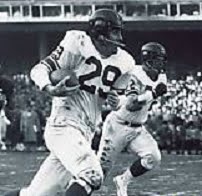
The Giants had won the Eastern Conference with an 8-3-1 record. The offense, directed by assistant coach Vince Lombardi and led by 35-year-old QB Charlie Conerly, was conservative but effective and contained the consensus league MVP in HB Frank Gifford, who ran for 819 yards and added another 603 yards on 51 pass receptions. Defense was the team’s strength, however, coached by assistant Tom Landry and containing All-Pros in DT Roosevelt Grier, DE Andy Robustelli, and safety Emlen Tunnell. Rookie MLB Sam Huff had an impact, as did veteran newcomers HB Ed Hughes and DT Dick Modzelewski.

As had been the case in 1934, New York’s opponent was the Chicago Bears, leaders in the Western Conference at 9-2-1. George Halas still directed the club as owner, although he had retired as head coach (he came out of retirement in 1958) in favor of longtime assistant Paddy Driscoll. Chicago had the NFL’s leading rusher in FB Rick Casares (1126 yards) and the leading passer, QB Ed Brown (9.9 yards per attempt), who split time with George Blanda. All-Pro end Harlon Hill caught 47 passes for 1128 yards and 11 touchdowns. The defense, anchored by All-Pro middle guard Bill George, was rugged. The two teams had played to a 17-17 tie during the regular season and the Bears were favored coming into the title game.

The Giants were concluding their first season as tenants at Yankee Stadium, and there were 56,836 fans present. New York got off to a quick start as HB Gene Filipski returned the opening kickoff 53 yards to the Chicago 39 yard line. Four plays later, FB Mel Triplett ran 17 yards up the middle for a touchdown (pictured above). It didn’t get any better for the Bears when, on their first possession following the ensuing kickoff, Casares fumbled on the second play and Robustelli recovered for New York at the Chicago 15. Ben Agajanian ended up kicking a 17-yard field goal. Before the first quarter was over, Agajanian kicked for another three points, from 43 yards, after safety Jim Patton intercepted a Brown pass.


It was 13-0 after the first quarter as Conerly (pictured at right) entered the contest for the Giants. In an unorthodox arrangement, backup QB Don Heinrich typically started and ran the offense for the first couple of series while Conerly studied the defense’s tendencies from the sideline. With the veteran quarterback now directing the attack, New York’s lead was extended to 20-0 three minutes into the second quarter as HB Alex Webster ran three yards for a touchdown.

The Bears finally got a break when a punt was fumbled by Tunnell at the New York 25 and DT John Mellekas recovered for Chicago. A five-play drive was capped by Casares running nine yards for a TD. However, any hopes the Bears might have had of getting back into the game were dashed when the Giants responded by driving 72 yards in five plays, including a pass from Conerly to Webster that covered 50 yards and a 20-yard run by Triplett down to the Chicago two yard line. Webster finished off the possession with another short scoring run, this time from a yard out. Less than two minutes later, Giants guard Ray Beck blocked a punt by Brown that was recovered in the end zone for a TD by DB Henry Moore. The score was 34-7 at the half.

The second half added little of note. The New York defense continued to shut down the Bears, with either Brown or Blanda behind center, and Chicago even switched from the T-formation to the double-wing in an unsuccessful effort to generate offense. The Giants put together a third quarter scoring drive of 80 yards in four plays that ended with a Conerly pass to end Kyle Rote for a nine-yard touchdown (the extra point attempt failed).

New York scored once more, in the fourth quarter, as Conerly passed to Gifford for 14 yards. Backup Bobby Clatterbuck replaced the veteran quarterback at that point and the game ended with the Giants winning by a very convincing 47-7 margin.


The Giants outgained Chicago, 348 yards to 270, and held the Bears to just 67 yards on the ground. Charlie Conerly didn’t need to go to the air often, but was efficient when he did so, completing 7 of 10 passes for 195 yards with two touchdowns and no interceptions. Mel Triplett was the leading rusher, gaining 71 yards on 13 carries with a TD, while Frank Gifford (pictured at left) had 30 yards on five attempts and also caught four passes for 131 yards and a touchdown. Alex Webster (pictured below right), who had the two short scoring runs among his 12 carries for 27 yards, added another 5 pass receptions for 76 yards.


The Bears went to the air 47 times, with Ed Brown completing just 8 of 20 passes for 97 yards with an interception and George Blanda succeeding on 12 of 27 throws for 140 yards, also having one picked off. Rick Casares gained only 43 yards on 14 carries with Chicago’s lone score, but also had the costly early fumble. Harlon Hill caught 6 passes for 87 yards, but most came after the outcome had been decided. End Jim Dooley added another 6 receptions for 66 yards.

“The frozen field was no excuse,” said Paddy Driscoll afterward. “They just ran on it and we didn’t…we just didn’t have it…the Giants played a great game.”

It was the first NFL Championship for the Giants in 18 years. While the team would make it back to the title game five times in the next seven seasons, the win in 1956 would be their last until the Super Bowl following the 1986 season.

Friday, December 17, 2010

1944: Packers Beat Giants for NFL Title on Two Fritsch TDs


By 1944, the manpower shortage in the NFL was acute due to World War II. It was apparent in the rosters of the teams that met for the NFL Championship on December 17 at the Polo Grounds in New York. The host Giants had former Packers star tailback Arnie Herber, who had come out of retirement at age 34, as well as one of their own past stars, 38-year-old fullback Ken Strong, back after a five-year absence to primarily handle the placekicking.

New York, under 14th-year Head Coach Steve Owen, went 8-1-1 to narrowly place first in the Eastern Division over the 7-1-2 Eagles. In addition to Herber’s passing, the Giants had FB Bill Paschal, who led the league in rushing (737 yards), carries (196), and touchdowns (9). They also featured wingback Ward Cuff, who ran for 425 yards and tied Philadelphia’s Steve Van Buren for the best average gain per carry at 5.6. 14-year center Mel Hein and All-Pro G Len Younce anchored the line.

Head Coach Curly Lambeau’s Green Bay Packers were a mix of young and old, but their key player remained end Don Hutson, the NFL leader in pass receptions (58), receiving yards (866), scoring (85 points) and, tied with Paschal, touchdowns (9). Second-year tailback Irv Comp led the league in passing yards (1159) and was second in TD passes (12, tied with Detroit’s Frank Sinkwich). The Packers won their first six games on the way to winning the Western Division with an 8-2 record, although one of the losses had been to the Giants a month before.

The Giants were at a disadvantage coming into the title game because Paschal had injured his ankle in the season’s last game, but they did have star tackle Al Blozis available, who had missed most of the year after going into the military but had been granted a pass to be able to play in the championship contest.

There were 46,016 fans present for what promised to be a tough defensive battle. The first quarter was scoreless, but early in the second period the Packers returned a punt to the New York 48 and followed that with two big runs, of 20 yards by HB Joe Laws and 27 yards by FB Ted Fritsch (pictured at top) that put them in a first-and-goal situation at the one. The Giants held on the next three plays, but finally Fritsch plowed into the end zone and, with Hutson’s successful extra point, Green Bay held a 7-0 advantage.

New York’s defense concentrated on disrupting Green Bay’s passing game and, more specifically, Hutson. Late in the second quarter, the great end finally got open and gathered in a Comp pass for a 24-yard gain to the Giants’ 30. Three plays later, with time running out, Hutson ran a crossing pattern that caused the defense to shift along with him. He was successfully being used as a decoy – Comp threw to Fritsch, who had looped out of the backfield and was all alone at the five yard line, easily able to complete the 28-yard touchdown play. Again Hutson added the extra point, and Green Bay led by a 14-0 margin at the half.

The Giants hadn’t been able to move beyond their 35 yard line during the first half, but late in the third quarter they put together a drive featuring a 41-yard pass from Herber to end Frank Liebel that took them into scoring position. Cuff, playing in the tailback position rather than his usual wingback spot, ran for a one-yard touchdown to start the fourth quarter and, with Strong’s PAT, the Green Bay margin was cut to seven points.

The Giants were unable to score again, however, as the Packers played conservatively on offense and, thanks to interceptions and good punts, kept New York from getting close. Late in the game the Giants threatened one last time, but a Herber pass was intercepted by back Paul Duhart at the Green Bay 20 to clinch the 14-7 win for the Packers.


Green Bay outgained the Giants, 237 yards to 199, and in particular outrushed them with 163 yards to 85 for New York. Joe Laws was the leading ground gainer with 74 yards on 13 carries while Ted Fritsch ran for 58 yards on 17 attempts, including a TD and also had the other Packer touchdown on his lone pass reception. Irv Comp (pictured at left) completed just three of 10 passes for 73 yards with the TD and three interceptions. Don Hutson caught two of those passes for 47 yards and, while he didn’t score any touchdowns, played a key role as a decoy.

For New York, Arnie Herber, with inadequate run support and a defense geared to shut down the aerial game, was able to complete just 8 of 22 passes for 117 yards. He had no TDs and was intercepted four times (Laws accounted for three of the pickoffs). Ward Cuff ran for 55 yards on 12 attempts, including a touchdown, and caught two passes for another 25 yards. Bill Paschal, forced to sit out most of the contest, ran the ball only twice, for three yards. Frank Liebel caught three passes for 71 yards.

The championship was the last for the Packers under their founder, Lambeau – after winning six titles (three prior to the advent of division play and the championship game in 1933), Green Bay would not win another until 1961.

The game was also the last for the 6’6”, 250-pound Al Blozis (pictured below). A consensus All-Pro in 1943, he rejoined his infantry unit after the title game. Six weeks later, he was killed in action during the Battle of the Bulge. His number 32 was retired by the Giants.

Wednesday, December 15, 2010

1935: Lions Beat Grounded Giants for NFL Championship


The weather in Detroit for the NFL Championship game on December 15, 1935 was gray, wet, and windy. The field at the University of Detroit’s Titan Stadium was sloppy – good news for the ground-oriented Lions, but inauspicious for the visiting New York Giants.

Detroit, under the direction of Head Coach George “Potsy” Clark, didn’t throw the ball much (a total of 142 passes all season, second fewest in the league). But two of the top four rushers in the NFL played for the Lions - second-ranked wingback Ernie Caddel (450 yards) and fourth-ranked tailback Dutch Clark (427 yards), who also led the NFL in scoring (55 points). Bill Shepherd had come to the Lions from the Boston Redskins during the season and, between the two teams, came in fifth in rushing, right behind Clark (425 yards). Clark (pictured above), along with tailback/wingback Glenn Presnell, directed the offense and was known for his shifty running style. Caddel and Shepherd provided the speed. FB Ace Gutowsky supplied the power. After a slow start, the Lions finished out at 3-0-1 to accumulate a 7-3-2 record, thus beating out the Packers for the Western Division title.

The Giants, coached by Steve Owen, were the defending league champions and had won the Eastern Division in each of the first two years of division play. They had the NFL’s best passer in tailback Ed Danowski, who led the league in attempts (113), completions (57), yards (794), and touchdowns (10). Rookie end Tod Goodwin led the NFL with 26 catches and was second in receiving yards with 432. FB Kink Richards was the top runner, with a third-ranked 449 yards. New York went 9-3 during the regular season to again top the division and earn a spot in the title contest, which they were heavily favored to win.

There were 15,000 hardy fans on hand to see if the Lions, like major league baseball’s Tigers back in October, could bring a championship to Detroit. The Lions took the opening kickoff and drove down field. They were helped by two long passing plays, including one from Gutowsky that hit Danowski, playing defense, in the chest and was caught by end Ed Klewicki. Gutowsky capped the 61-yard drive with a two-yard touchdown run and Presnell kicked the extra point for the 7-0 lead.


The Giants came back with a drive of their own, but came up empty when FB Ken Strong (pictured at left) missed a 34-yard field goal attempt. Even more costly, Goodwin suffered broken ribs when hit after making a catch and was lost for the remainder of the game. As the team’s next-most-productive receiver throughout the year, wingback Dale Burnett, was already out with a hand infection, New York’s aerial attack was hindered all the more.

The Giants got a break by recovering a Detroit fumble on the next possession, but once again failed to capitalize when they were held on downs. The Lions scored again when Clark slithered through the Giants defense for a 40-yard touchdown. While the PAT attempt failed, Detroit held a 13-0 lead at the end of the first quarter.

The Lions came close to scoring again in the second quarter when end Harry Ebding blocked a Danowski punt but, after recovering and running to the Giants’ two yard line, fumbled the ball, which traveled through the end zone for a touchback.

Midway through the second quarter, New York finally got on the board. A Danowski pass was partially deflected by Gutowsky, but Strong managed to catch it with one hand and run for a 42-yard touchdown. Strong successfully kicked the extra point and the Lions’ lead was cut to 13-7 at halftime.


The third quarter was scoreless, but in the fourth quarter the Giants threatened, failing to get on the board in each instance. With three minutes remaining to play, Danowski attempted a quick kick that was too low and hit one of his blockers, and it was recovered by Detroit tackle George Christensen at the New York 26. The Lions ran five straight plays into the line and then, on the sixth, Clark faked a handoff to Gutowsky straight ahead and instead gave the ball to Caddel (pictured at right), who swept to the outside for a four-yard touchdown. With Clark’s kick, the Lions now held a commanding 20-7 lead.

Detroit scored once more when, after tailback Harry Newman returned the ensuing kickoff to the Giants’ 32, on first down Danowski went to the air and was intercepted by FB/LB Buddy Parker, the future head coach of the Lions, who returned it to the 10 yard line. Parker himself scored on a four-yard run on third down, although he missed the extra point. Detroit won by a final score of 26-7 for its first NFL Championship.

The Lions outgained the Giants with 303 yards to 194 and also had the edge in first downs, 16 to 9. 235 of Detroit’s yards came on the ground – the Lions threw only five passes and the two completions on the opening drive were it for the day. However, the Giants were able to complete just four of 13 passes for the one TD and gave up two interceptions.

Tuesday, December 14, 2010

1958: Summerall FG Lifts Giants Past Browns to Force Playoff


The battle for the NFL’s Eastern Conference had come down to the season finale on December 14, 1958 as the New York Giants hosted the Cleveland Browns at Yankee Stadium. The Giants were 8-3 and a game behind the 9-2 Browns. Thus, New York needed to win in order to force a playoff with Cleveland for the conference title. A loss or tie would propel the Browns into the championship game.

New York’s head coach was Jim Lee Howell, but he had two highly able assistants in Vince Lombardi to run the offense and Tom Landry to direct the defense. They were a solid, veteran club on both sides of the ball, featuring QB Charlie Conerly, halfbacks Frank Gifford and Alex Webster, OT Roosevelt Brown, and C Ray Wietecha on offense and DE Andy Robustelli, MLB Sam Huff, and safety Jim Patton on defense. However, they had played poorly in the preseason and got off to a 2-2 start in the regular season games before winning six of their last seven contests (one of their wins had been against the Browns in Cleveland).

As for Cleveland, Head Coach Paul Brown’s club featured second-year FB Jim Brown on offense, who had already broken the single-season rushing record. If teams concentrated too heavily on stopping him, rookie HB Bobby Mitchell made them pay with his outstanding outside running ability. Second-year QB Milt Plum was still something of a project, but the offensive line was a good one and the defense contained Pro Bowl-quality players in tackles Bob Gain and Don Colo, LB Walt Michaels, and HB Don Paul.

The Browns wasted no time in taking the lead as Jim Brown ran 65 yards for a touchdown on the first play from scrimmage. There was no further scoring until the second quarter, when Giants DE Jim Katcavage recovered a fumble at the Cleveland 38 by HB Lew Carpenter and the Giants capitalized as Pat Summerall kicked a 46-yard field goal.

The Browns responded with a 22-yard Lou Groza field goal that was set up by a 51-yard pass play from Plum to flanker Ray Renfro. Cleveland held a 10-3 lead at the half.

In their first possession of the third quarter, the Browns drove to the New York 13 yard line. But in a call that was heavily second-guessed afterward, Paul Brown chose to try a fake field goal. Holder Bobby Freeman attempted to run around left end but was tackled for a loss by LB Harland Svare. Instead of potentially taking a 13-3 lead (Groza had missed two earlier attempts, but this would have been from just 20 yards with the ball well placed at the center of the field), the margin remained seven points.

The teams traded punts after the failure on the fake. Now in the fourth quarter, and following a fumble by Plum that the Giants recovered on the Cleveland 45, New York came back with trickery of its own. End Kyle Rote had noted that the Browns were vulnerable to the halfback option pass because HB Don Paul and safety Junior Wren were quick to run up and defend against the sweep coming in their direction. On the first play following the fumble recovery, Conerly pitched to Gifford, who ran to his right on an apparent power sweep. The Browns defense shifted to stop the run, and Gifford fired a pass to Rote, who was finally brought down after a 39-yard gain to the six yard line. After two running plays into the line lost yardage, the Giants again ran the option play and Gifford threw to end Bob Schnelker in the end zone for an eight-yard touchdown (pictured below). Following Summerall’s extra point, the score was tied at 10-10.


The Browns, playing conservatively to run the clock down since a tie was as good as a win for their purposes, punted the ball back to the Giants. New York proceeded to drive from its own 30 to the Cleveland 25, but Summerall missed a 33-yard field goal attempt with less than five minutes to play.

The New York defense again forced the Browns to punt, but punter Dick Deschaine, who encountered a heavy rush, got off a poor 22-yard kick that went out at the Cleveland 43. The Giants misfired on three passes, including a long throw to Webster at the goal line that the halfback dropped and one to Gifford that was ruled an incomplete pass (although the Browns insisted afterward that it was a fumble).

With just over two minutes left, Summerall, who had suffered a knee injury in the previous contest against Detroit and was listed as doubtful in the week leading up to the game, kicked a 49-yard field goal through the snow for the winning points (pictured at top). The final score was 13-10, setting up the rematch at the same venue the following week.


The game had been a tough defensive struggle, and the two Cleveland turnovers, against none by the Giants, played a key role. The Browns outgained New York, 257 yards to 226. Jim Brown (pictured at right) accounted for 148 yards on 26 carries (bringing his record total to 1527), but other than the game-opening 65-yard score, the great fullback had been well defensed. Cleveland passed for just 107 yards, to 162 for the Giants.

“Imagine having to heat the Browns three times in one season to even get into the championship game,” said Jim Lee Howell. “Once is tough enough. Twice, and now again.”

In the rematch of the two 9-3 teams for the conference title the following week, the Giants defense shut the Browns down even more effectively and won, 10-0. They lost the NFL Championship game to the Baltimore Colts in a 23-17 overtime classic.

Pat Summerall, in his first year with the Giants after a season in Detroit and five with the Chicago Cardinals, was successful on 12 of 23 field goals in 1958, none bigger than the kick to beat the Browns. As he returned to the sideline following the climactic field goal, Vince Lombardi said to him, “You know you can’t kick a football that far, don’t you?”

Thursday, November 25, 2010

1990: Division Rivals Knock Giants & 49ers From Ranks of Unbeaten


Ten games into the 1990 NFL season, both the defending-champion San Francisco 49ers and New York Giants were sporting perfect 10-0 records. With the teams scheduled to meet in San Francisco the next week, speculation was rampant that it could be a showdown of unbeaten teams for supremacy in the NFC. But first they each had to face fierce division rivals on November 25.

In the case of the Giants, coached by Bill Parcells, it meant traveling to Philadelphia’s Veterans Stadium to take on Buddy Ryan’s Eagles. The Giants had been successful with a conservative offense that rarely turned the ball over, in combination with a solid defense. The Eagles played in the style of the brash Ryan, aggressive on defense while dependent upon the flashy skills of QB Randall Cunningham (pictured above) on offense. They had gotten off to a slow start in ’90, going 1-3 to begin the season (including an opening-game loss to New York at Giants Stadium), but had won their last four games prior to hosting the Giants and were 6-4 overall.

The first half was closely fought. New York scored initially on a 15-yard pass from QB Phil Simms to WR Mark Ingram and the Eagles responded as Cunningham connected with WR Fred Barnett for a 49-yard TD. In the second quarter, Cunningham capped a drive of over nine minutes by leaping into the end zone for a touchdown from a yard out. TE Mark Bavaro caught a four-yard scoring pass from Simms, but the extra point was missed and the Eagles led by the slender margin of 14-13 at halftime.

Roger Ruzek kicked a 39-yard field goal to extend Philadelphia’s lead to 17-13 in the third quarter, but in a span of 22 seconds in the fourth quarter the Eagles essentially put the game away. First, Cunningham passed to WR Calvin Williams for a six-yard touchdown. Then, LB Seth Joyner deflected a Simms pass that was intercepted by MLB Byron Evans, who ran untouched for a 23-yard TD. That provided the final score of 31-13 as the Eagles toppled the Giants.

The Eagles controlled the ball for over 38 minutes and rolled up the most yards against the Giants thus far with 405. The Giants, who typically ran the ball 60 percent of the time, were forced to throw 40 passes. Phil Simms, who had only been intercepted twice in the previous ten games, was picked off twice by the Eagles and completed only 17 of his passes.

Randall Cunningham passed for 229 yards and two touchdowns, with no interceptions, and ran for 66 yards on 9 carries with a TD. He was named NFC Offensive Player of the Week for his efforts. RB Keith Byars caught 8 passes for 128 yards.

It was the first regular season loss for the Giants in 14 games dating back to December 1989, and the Eagles had beaten them then. It also delayed the Giants from clinching the NFC East title.

Meanwhile, at San Francisco’s Candlestick Park, the 49ers ran into trouble against the Los Angeles Rams. The Rams, under Head Coach John Robinson, were having a poor season and came into the game at 3-7 and hardly seemed a match for the two-time defending league champions that had won a record-tying 18 straight games. Under Head Coach George Seifert, the 49ers were known for their passing offense, led by QB Joe Montana and WR Jerry Rice.

However, in the wind and rain at Candlestick Park, the Rams forced four turnovers in the first half and took a 21-7 lead. RB Cleveland Gary accounted for the first two TDs of the game, first on a 22-yard option pass from FB Buford McGee and then on a 10-yard run in the second quarter. The 49ers scored on a five-yard pass from Montana to WR John Taylor, but McGee ran for a six-yard touchdown to provide the 14-point margin at the half.

It appeared that the 49ers might pull off a successful comeback in the third quarter. Montana threw a screen pass to RB Harry Sydney that was good for a 23-yard touchdown. Mike Cofer booted a 42-yard field goal before the period was over that pulled the Niners to within 21-17.

But on San Francisco’s next possession, Montana was intercepted by Rams SS Vince Newsome and LA went 90 yards in 17 plays to score a game-clinching touchdown as Gary ran in from a yard out. The final score was 28-17.

The Rams outgained the 49ers, 350 yards to 291, and turned the ball over twice, as compared to a total of six times by the Niners. Joe Montana threw for 235 yards and two touchdowns, but was intercepted three times. Jerry Rice caught 7 passes for 72 yards, but gave up one of the fumbles.


Meanwhile, WR Willie “Flipper” Anderson caught 8 passes for 149 yards and Cleveland Gary (pictured at left) ran for 68 yards on 24 carries and caught three passes for 27 yards while scoring three touchdowns. QB Jim Everett was successful on 16 of 27 passes for 224 yards with one picked off.

The 49ers won the showdown against the Giants the next week, stripped of the glamour of being a battle of unbeatens, by a low score of 7-3. San Francisco lost once more in the regular season to finish atop the NFC West at 14-2. New York ended up winning the NFC East at 13-3. The two teams met in the NFC Championship game, where the Giants prevailed and went on to win the Super Bowl over Buffalo.

The Eagles lost their next two games after upsetting the Giants, and ended up in second place in the NFC East at 10-6. They qualified for the playoffs as a wild card team, but lost to the Redskins in the first round, costing Ryan his job. For the Rams, the upset of the 49ers was the high point of an otherwise dismal year. They defeated the Browns the next week, but lost their last four games to finish at 5-11 for third place in the NFC West.

Wednesday, November 10, 2010

1974: Jets Defeat Giants in Overtime After Namath Runs for Tying TD


Any game between New York City’s two NFL teams can’t help but generate interest, no matter how the clubs rank in the standings. The NFL-AFL merger in 1970 had made possible regular season play between the long-established Giants and the comparative newcomers from the rival league, the Jets. On November 10, 1974 the two clubs met for the second time at the Yale Bowl in New Haven, Connecticut - the temporary home of the Giants, with Yankee Stadium under renovation and the new stadium in the New Jersey Meadowlands still two years from completion (they shifted to Shea Stadium for ’75).

The Giants were under a first-year head coach, Bill Arnsparger, and had finished with a winning record just twice in the previous ten years. The situation was no better in ’74 as they came into the contest with the Jets at 2-6. However, they had made a major switch at quarterback two weeks before, dealing away underperforming veteran Norm Snead to the 49ers while trading a first draft choice to the Dallas Cowboys for Craig Morton. Morton, once a promising starter in Dallas who had lost out to Roger Staubach, played well in a win at Kansas City in the Giants’ previous game. Snead, Carl Summerell, and Jim Del Gaizo had failed to throw a touchdown pass to a wide receiver in six games, but Morton managed to do that much in his second game with the club.

The Jets had a new head coach as well in Charley Winner, designated successor to the retired Weeb Ewbank, but there was no question at quarterback for the Jets, as long as Joe Namath (pictured above) was healthy enough to play – even if he and the club were off to a poor start. The Jets had been 4-10 in ’73, with Namath missing most of the season, and were 1-7 thus far in 1974 while Broadway Joe had been intercepted 17 times.

There were 67,740 fans at the Yale Bowl for the battle of the New York teams. The Jets started off the scoring in the first quarter as Namath connected with WR David Knight for a 19-yard touchdown. Pete Gogolak kicked a 26-yard field goal for the Giants later in the period, and the older club took the lead in the second quarter when Morton threw a two-yard TD pass to TE Bob Tucker.

Pat Leahy, in his first NFL game with the Jets following an injury to Bobby Howfield, booted a 34-yard field goal to tie the score, but it was 13-10 in favor of the Giants at the half after Gogolak kicked a second field goal of 22 yards.

The Jets launched the third quarter with a drive that used up the first ten minutes and ended with a 22-yard field goal by Leahy. In their next possession, the Giants struck quickly with Morton throwing a 12-yard touchdown pass to WR Bob Grim, and maintained a 20-13 lead into the fourth quarter.

The Jets put together another long possession, using 14 plays to drive down to the Giants’ three yard line. With a third-and-goal situation, Namath tied the score with a three-yard touchdown run (more accurately, a hobble) that surprised everyone, including his teammates. Originally, the play was to be a handoff to HB Emerson Boozer, but Namath saw the Giants’ weak-side LB, Brad Van Pelt, move inside and decided to keep the ball. With Leahy’s extra point, the game was tied at 20-20.

The Jets had an opportunity to win in regulation, but with 12 seconds left Leahy’s 29-yard field goal attempt was blocked by CB Jim Stienke.

1974 was the first season in which regular-season games ending in a tie went into an overtime period. The Giants won the toss and RB Joe Dawkins returned the kickoff 53 yards to give them good field position. They drove to the Jets’ 25 but, after coming up a yard short on a third-and-three play, Gogolak missed the resulting 42-yard field goal attempt.

Starting from his own 25, Namath completed consecutive passes of 42 yards to TE Rich Caster and 12 yards to WR Jerome Barkum. From the Giants’ 21, Boozer ran for back-to-back six yard runs and then RB Jazz Jackson took a pitchout for four yards to the five. From there, Namath lobbed a pass to Boozer, who had beaten Van Pelt, in the left corner of the end zone for the winning touchdown at 6:53 in overtime. The final score was 26-20.


The Jets outgained the Giants (425 yards to 340) and had the edge in first downs (27 to 22). There were no turnovers and game had few penalties – the Jets were flagged twice for a total of 15 yards, and the Giants just once for five yards.

Joe Namath completed 20 of 31 passes for 236 yards with two touchdowns and no interceptions. RB Bob Burns, who played only one season and gained a total of 158 yards on the ground, had the best game of his brief career filling in for the injured FB John Riggins with 101 yards on 21 attempts. Emerson Boozer (pictured above left) added 58 yards on 13 carries and had four pass receptions for 43 yards and the game-winning TD. Jerome Barkum caught 5 passes for 24 yards, while Rich Caster gained the most yards receiving with 68 on three catches.

Craig Morton had a solid outing for the Giants in defeat, with numbers that were almost identical to Namath’s – 21 of 32 passes completed for 237 yards with two TDs and none picked off. Joe Dawkins led the club in rushing with 49 yards on 11 carries and caught 6 passes for 37 yards. WR Walker Gillette gained 83 yards on his five receptions.

“It was a great victory for us when we really needed one,” said Namath afterward. “Emotionally, it has to rank with the Oakland game in 1968 when we won the AFL title, it was a big game for us. You lose one to the other guys in town and you have to take a lot of heat from a lot of people.”

Of the decision to keep the ball on the game-tying touchdown run rather than hand off, Broadway Joe added, “I didn’t tell Boozer, I didn’t tell anybody. The fake always works better that way.” Said Boozer, “I didn’t know what to think. When I didn’t get the ball, I thought fumble.”

Since the first regular season game to go into overtime (between Denver and Pittsburgh) ended in a tie, the Jets became the first NFL team to win a regular season overtime game. It also gave the club a big lift as it proved to be the first of six straight wins (following six consecutive losses) to end the season. The Jets finished at 7-7 and tied with the Patriots for third in the AFC East. The Giants lost the remainder of their games to end up at 2-12 and at the bottom of the NFC East.

Joe Namath’s statistics improved along with the team’s fortunes. While he still ended up leading the NFL by throwing 22 interceptions, only five of those came during the season-ending winning streak. His 2616 passing yards and 20 touchdowns both ranked second in the NFL, as did his 361 attempts.


Craig Morton (pictured at left) threw for 1510 yards in eight games for the Giants with 9 TD passes and 13 interceptions. His 29.6 pass attempts per game ranked second in the NFL and his averages of 188.8 yards and 15.3 completions ranked third. But taking over in the midst of the season and with a mediocre supporting cast, the resulting record in his starts was 1-6.

The new placekicker, Pat Leahy, made the most of his opportunity with the Jets. He ended up playing for them through 1991, a total of 18 seasons, and ended up as the franchise leader in points (1470) and field goals (304).

Thursday, November 4, 2010

1962: Sonny Randle Catches 16 Passes for 256 Yards vs. Giants


Split end Ulmo “Sonny” Randle came to the Chicago Cardinals out of the University of Virginia in 1959, and after spending a year learning his craft, broke out with an All-Pro season in ’60 (the franchise’s first year in St. Louis) in which 15 of his 62 receptions were good for touchdowns.

One of the fastest players in the NFL, his success was all the more impressive coming with a team that lacked an established quarterback. In an attempt to dramatically upgrade for 1961, the Cardinals signed 31-year-old Sam Etcheverry, an all-time great quarterback in the Canadian Football League, but he proved to be a sore-armed disappointment in the NFL. Randle’s numbers dropped to 44 catches and 9 TDs, but he was still chosen to the Pro Bowl.

St. Louis had a new head coach in 1962, Wally Lemm, and after a faltering start Etcheverry gave way to second-year QB Charley Johnson. The team was 2-4-1 and coming off of a win over the Cowboys as they took on the defending champions of the Eastern Conference, the New York Giants, at Yankee Stadium on November 4.

The Giants, under Head Coach Allie Sherman, were 5-2 and had just pulled off a big win over Washington in which QB Y.A. Tittle passed for 505 yards and seven touchdowns. They had already beaten the Cardinals convincingly in St. Louis (31-14), but that was with Etcheverry starting at quarterback and Johnson coming on in relief - they would find that Johnson was developing quickly.

New York took a 7-0 lead in the first quarter on a 39-yard pass play from Tittle to flanker Frank Gifford. But the Cardinals responded with two touchdowns in the second quarter, an eight-yard pass from Johnson to TE Taz Anderson and a four-yard run by HB John David Crow. In between, Don Chandler kicked a 33-yard field goal for the Giants. But the Cardinals defense played well, New York’s offense seemed flat after the big performance the previous week, and it was St. Louis ahead at halftime by a 14-10 score.

In addition, Coach Lemm had moved Randle from his usual split end position to flanker, where he was defended by CB Dick Lynch rather than Erich Barnes, and it was paying off.

The Cardinals defense continued to stymie the Giants in the scoreless third quarter. New York was able to gain only 29 yards on its possessions and Tittle missed on 12 consecutive passes before finding Gifford again for a 32-yard touchdown early in the fourth quarter. The Giants were back in front at 17-14, but the action began to heat up considerably.

St. Louis came right back, with Johnson throwing to Randle for a 55-yard touchdown and a 21-17 lead. New York fought back on the next drive, with a fake field goal being the key play. Facing a fourth down on the St. Louis 31, the Giants lined up for an apparent 38-yard field goal attempt by Chandler, but the holder, backup QB Ralph Guglielmi, instead fired a pass to DE Andy Robustelli, who was lined up as a receiver with the field goal unit, for a 26-yard gain to the five yard line. Two plays later, FB Alex Webster ran off tackle from three yards out for a TD and the Giants were back in front at 24-21.

The St. Louis offense wasn’t finished and drove 80 yards in 12 plays, four of which were passes to Randle. Johnson also ran for a 16-yard gain and capped the drive with a one-yard plunge. With 4:55 left on the clock, the Cardinals were back in the lead by 28-24.

The Giants struck quickly after the ensuing kickoff was returned 33 yards by HB Sam Horner. Tittle tossed a pass to HB Phil King that gained 37 yards to the St. Louis 20, and then followed up with a pass to Webster for the final 20 yards and a touchdown.

The Cardinals again battled back, but with under two minutes remaining Lynch, a talented player who had his hands full covering Randle, intercepted a pass by Johnson at the New York 27 to avoid the upset and nail down the 31-28 win.

In defeat, the big story was Sonny Randle’s performance as he caught 16 passes for 256 yards and a touchdown. It was the second-highest single-game pass receiving performance up to that time, and against one of the NFL’s most highly-regarded defenses.

The Cardinals rolled up an impressive 494 total yards and 29 first downs, to 266 yards and 15 first downs for New York. However, they also gave up five turnovers, to one by the Giants.


Charley Johnson (pictured at left) completed 26 of 41 passes for 365 yards with two touchdowns and three interceptions. John David Crow was the leading rusher for St. Louis, gaining 56 yards on 19 attempts, including a TD. FB Prentice Gautt added 44 yards on 12 carries.

In winning, Y.A. Tittle was successful on only 8 of 31 passes for 172 yards, but three were for touchdowns against one interception. Phil King had three catches for 62 yards while Frank Gifford scored on both of his pass receptions that totaled 71 yards. Alex Webster was New York’s top ground gainer with 50 yards on 16 attempts, including a TD, and caught one pass for the game-winning touchdown.

The Giants, having survived the scare, went undefeated the rest of the way through the regular season to finish at 12-2 and again win the Eastern Conference, although they lost to Green Bay in the NFL title game once more. St. Louis ended up at 4-9-1 and in sixth place in the conference, but the stage was set for significant improvement over the next two seasons.

Sonny Randle finished second in the league in both receptions (63 – one ahead of teammate Bobby Joe Conrad) and yards (1158). His seven TD catches tied for seventh, and his 18.4 yards per catch was his highest to date. Randle was selected to the Pro Bowl for the third straight year. He played eight years with the Cardinals, going to one more Pro Bowl following the 1965 season, then was with the 49ers in 1967 and the start of his last year in ’68. Randle moved on to Dallas, where he ended his career – his final totals were 365 receptions for 5996 yards (16.4 avg.) and 65 touchdowns.

Charley Johnson ranked second in the NFL in yards per completion (16.3) as he threw for 2440 yards with 16 touchdowns and 20 interceptions. His emergence, aided by an outstanding receiving corps and Etcheverry’s tutelage, would correspond with the club’s improvement.

Tuesday, October 19, 2010

2003: Punchless Eagles Beat Giants on Stunning Punt Return by Westbrook


The Philadelphia Eagles had been to the NFC Championship game in 2001 and ‘02, but Head Coach Andy Reid’s team was off to a slow start in 2003. They were embarrassed 17-0 by the reigning champions, the Tampa Bay Buccaneers, in the opening game that was also their regular season debut at the new Lincoln Financial Field, and then lost badly to the Patriots the following week. QB Donovan McNabb had been struggling through the first five games due to a bruised right thumb and lingered at the bottom of the passing rankings. The team’s record stood at 2-3 as they traveled to Giants Stadium to take on the division rival New York Giants on October 19.

The Giants were also underachieving at 2-3 under Head Coach Jim Fassel. The club had scored a total of 16 points in the prior two games as QB Kerry Collins tossed seven interceptions and no touchdown passes.

Philadelphia got the early advantage in its second possession of the game, driving 89 yards in 11 plays and highlighted by McNabb throwing to TE L.J. Smith for a 25-yard gain. RB Brian Westbrook ran around end for the last six yards and a touchdown that gave the Eagles a 7-0 lead.

Neither team was able to move the ball effectively for the remainder of the half. A promising second quarter drive by the Giants ended with TE Jeremy Shockey fumbling the ball away at the Philadelphia 19 yard line after a nine-yard gain on a pass from Collins. However, three plays later McNabb was intercepted by CB Will Allen and the Giants had the ball at the Eagles’ 29 with 1:23 remaining in the half. Brett Conway kicked a 39-yard field goal to make the score 7-3 at the intermission.

New York went ahead 10-7 in the third quarter after a 12-play drive that went 62 yards and produced a one-yard TD pass from Collins to Shockey. It looked like that would be enough as the game moved through the fourth quarter and the Eagles offense remained stymied, ending five consecutive possessions with punts – all but one of them had been three-and-out.

Midway through the fourth quarter it appeared that the Giants would score again, but on a third-and-five play at the Philadelphia 10 yard line Collins fumbled after being hit by LB Mark Simoneau and DT Corey Simon recovered for the Eagles to end the threat.

With Philadelphia out of time outs and 1:34 remaining on the clock, the Giants entrusted their defense to finish the job and Jeff Feagles punted. Westbrook fielded the short, wobbly kick on the bounce and quickly blew through the wall of defenders. Running past the Giants’ bench, he flew past Feagles and then just stayed inbounds as he eluded one last tackler, TE Marcellus Rivers, before completing the 84-yard touchdown return (pictured at top).

78,883 fans sat in stunned silence as the play was reviewed by the officials, who ascertained that Westbrook had indeed not stepped out of bounds.

New York still had one last chance and, following the ensuing kickoff, Collins tossed a pass to WR Amani Toomer for a 20-yard gain to the Philadelphia 44 yard line with 1:12 now left to play. But four more passes netted just one more completion for six yards, and the last one on fourth-and-four was broken up by CB Bobby Taylor. The Eagles came away with a shocking 14-10 win.

The stunning nature of the victory was all the more evidenced by the statistics. The Eagles had gained just 134 total yards, to 339 for the Giants. A net of just 47 of those yards had come through the air (McNabb was sacked three times for a loss of 17 yards) while they had gained 87 yards on the ground. Philadelphia accumulated 9 first downs, while the Giants had 25.

Donovan McNabb completed only 9 of 23 passes for 64 yards with an interception. L.J. Smith’s one catch had made him the team’s receiving yardage leader with 25. Brian Westbrook led the team in rushing with 67 yards on 15 carries, caught three passes for another 11, and returned three kickoffs for 61 yards and the punt for 84 – the combined total came to 223 yards and included both of the team’s touchdowns.

In defeat, Kerry Collins was successful on 22 of 36 passes for 174 yards with one TD and none intercepted. RB Tiki Barber gained 79 yards on 19 carries and RB Dorsey Levens, playing in his first game for the Giants, contributed another 64 yards on 16 attempts. Barber and Jeremy Shockey each caught five passes (for 34 and 23 yards, respectively) while Amani Toomer was the receiving yardage leader with 54 yards on four catches.

For the Eagles, the dramatic result proved to be the turning point of the season as they proceeded to win nine straight and finished once again at the top of the NFC East with a 12-4 record. They made it to a third straight conference title game, but lost to Carolina. New York won its next two contests, but then lost the remaining eight to close out at 4-12 and at the bottom of the division. In the housecleaning that followed, both Coach Fassel and Collins were sent packing.

Donovan McNabb’s return to full health was a significant factor in Philadelphia’s second-half surge. He ended up passing for 3216 yards with 16 TDs and 11 interceptions and was named to his fourth of an eventual five straight Pro Bowls (six overall with the Eagles).


In his second season out of Villanova, Brian Westbrook (pictured at left) emerged as a major all-purpose talent. He returned a second punt for a touchdown during the season and ranked first in the NFC with a 15.3 average on 20 returns. Overall, he gained 1738 all-purpose yards with 613 rushing on 117 carries, 332 on 37 pass receptions, 487 on 23 kickoff returns, and 306 returning punts. While he would be used far less on punt returns in future seasons (and not at all on kickoff returns), his yards from rushing and pass receiving rose greatly.