Showing posts with label New England Patriots. Show all posts

Thursday, February 3, 2011

2002: Patriots Stun Rams to Win Super Bowl XXXVI


Super Bowl XXXVI on February 3, 2002 looked to be a blowout in the making. The St. Louis Rams, with a 14-2 record and seeking to win two titles in three years, were up against the 11-5 New England Patriots, who had come from nowhere and were not considered to be of the same caliber.

The Rams, under Head Coach Mike Martz, entered the 2001 season expecting to contend for a title. They boasted the NFL’s most explosive offense, led by QB Kurt Warner, the league leader in passing (101.4 rating), passing yards (4830), touchdowns (36), completions (375), yards per attempt (8.8), and completion percentage (68.7) as well as league MVP choice of the Associated Press and NEA. Wide receivers Isaac Bruce and Torry Holt were both Pro Bowl performers. RB Marshall Faulk, who ran for 1382 yards and gained another 765 on 83 catches, garnered the other MVP trophies (Pro Football Writers Association and Bert Bell Award). The unheralded defense benefited from the addition of 33-year-old CB Aeneas Williams. Having won the NFC West with the league’s best record, St. Louis routed the Packers in the Divisional playoff and then got past the Eagles to win the conference title.

In 2000, the first year under Head Coach Bill Belichick, the Patriots finished at the bottom of the AFC East with a 5-11 tally, and not much more was anticipated in ’01. It certainly didn’t appear that the team was anything special when it fell to 5-5 following a loss to the Rams in November. But from that point, New England didn’t lose again, winning the last six regular season games. They barely defeated the Raiders in a snowy Divisional round contest and got past Pittsburgh for the AFC Championship. Coaching, starting with Belichick, certainly played a role, as did the coming together of a defense that didn’t allow more than 17 points in any of those eight wins. But the emergence of QB Tom Brady (pictured above), who took over for injured veteran QB Drew Bledsoe in September, paid huge dividends as he displayed outstanding game-management skills and great ability in clutch situations. Still, the Patriots came into the Super Bowl as two-touchdown underdogs.

There was a crowd of 72,922 at the Louisiana Superdome in New Orleans and the Patriots broke with tradition by eschewing the usual player introductions to be introduced en masse as a team, emphasizing the club’s cohesiveness. The clubs traded punts to start off the game. On their second possession, the Rams drove 48 yards in ten plays with Warner completing six of seven passes. Jeff Wilkins kicked a 50-yard field goal to give St. Louis the early lead.

After the Patriots went three-and-out, the Rams again drove into New England territory, the highlight being a 29-yard pass completion from Warner to WR Az-Zahir Hakim on the second play of the second quarter. But after penetrating to the 34 yard line, Wilkins was wide to the left on a 52-yard field goal attempt.
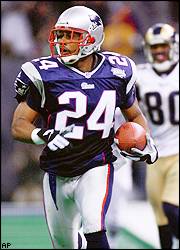

New England held onto the ball for seven plays but again had to punt. However, on the third play of the next St. Louis possession, CB Ty Law intercepted a Warner pass that was intended for Bruce and returned it 47 yards for a touchdown (pictured at right). In stunning fashion, the Patriots were in front at 7-3.

With under two minutes remaining in the first half, Warner threw to WR Ricky Proehl for a 15-yard gain to the New England 40, but safety Antwan Harris forced a fumble and CB Terrell Buckley recovered for the Patriots. Brady hit on passes to WR Troy Brown for 16 yards and eight yards to TE Jermaine Wiggins to get to the St. Louis 24. Following an eight-yard carry by RB Kevin Faulk, Brady threw to WR David Patten for an eight-yard TD and the Patriots went into halftime with an improbable 14-3 lead.

Coach Belichick had learned from the loss to St. Louis during the regular season, when he had tried to key on blitzing Warner. This time, he sought to keep Marshall Faulk in check and loaded up with as many as six or seven defensive backs on each play. The strategy was having the desired effect, as Warner’s rhythm was disrupted and the fleet wide receivers were kept in check.

The teams went back to trading punts in the third quarter, battling for field position. Late in the period, after the Rams had advanced to the New England 45, Warner was intercepted again, this time by CB Otis Smith, who returned the pickoff 30 yards to the St. Louis 33. Five plays later, Adam Vinatieri kicked a 37-yard field goal to make the score 17-3.

With the game moving into the fourth quarter, the Rams began to come alive as Warner hit on short passes, completing six in a row to reach the New England three. Following two incompletions and facing a fourth-and-three situation, Warner ran and fumbled when hit by LB Roman Phifer. Patriots FS Tebucky Jones picked up the ball and took off for an apparent 97-yard touchdown, but the play was nullified by a defensive holding penalty on DE Willie McGinest. Gaining a huge reprieve, Warner ran for a two-yard touchdown shortly thereafter and New England’s margin was cut to 17-10.

The teams again traded punts, and the Patriots had consecutive three-and-out possessions. After the second one, and with under two minutes remaining, the Rams took over at their 45 yard line. Warner threw to Hakim for 18 yards, WR Yo Murphy for 11, and then the slow-but-steady Proehl for a 26-yard touchdown. With the extra point, the game was tied at 17-17 and it appeared likely that the contest would go into overtime.

New England’s offense took over at its own 17 with 1:21 now on the clock and no timeouts remaining. Brady threw two passes to RB J.R. Redmond that covered 13 yards. After an incompletion, he went to Redmond again for another 11 yards to his own 41. A 23-yard pass to Brown took the ball into Rams territory at the 36 and a throw to Wiggins added another six yards. With seven seconds now remaining, Brady spiked the ball to stop the clock and Vinatieri, who was rapidly becoming recognized as an outstanding clutch kicker, booted a game-winning 48-yard field goal (pictured below). In an amazing upset, the Patriots won their first championship by a score of 20-17.


The Rams won the statistical battle, outdistancing New England in total yards (427 to 267), first downs (26 to 15), and time of possession (33:30 to 26:30). But the Patriots didn’t turn the ball over, while taking advantage of three St. Louis turnovers to score 17 points.

Tom Brady was the game’s MVP as he completed 16 of 27 passes for 145 yards and a touchdown and showed great poise in directing the game-winning drive. Troy Brown (pictured below) led New England’s receivers with 6 catches for 89 yards. RB Antowain Smith rushed for 92 yards on 18 carries.


The strategy of keying on Marshall Faulk held the Rams’ running game to 90 yards, with Faulk gaining 76 of that total on 17 attempts and catching four passes for 54 yards – ordinary by his standards. Kurt Warner was successful on 28 of 44 passes for 365 yards, but with just one TD against two interceptions. Az-Zahir Hakim, Isaac Bruce, and Torry Holt all caught five passes apiece, with Hakim gaining the most yards (90; Bruce and Holt gained 56 and 49 yards, respectively).

“When Adam hit it, it was so true,” said Bill Belichick of Vinatieri’s game-winning field goal. “It was so high and so far. If you want a guy to make a play at the end of the game, he's the one.”

Of the Rams, Ty Law said, “I don't think they looked past us, but at the same time, I don't think they were expecting this type of fight.”

“I don't think we were overconfident,” a disappointed Kurt Warner stated from the St. Louis perspective. “We played hard, but those few turnovers, those few mistakes we made, they turned them into points. Some days they don't turn into anything, but they turned them into 17 points and a world championship. That's what's so hard about this loss. It was the fact our mistakes did us in today.”

The championship for the Patriots proved to not be a fluke as the club won two more over the next three years and consistently contended beyond that. St. Louis, in the meantime, moved in the opposite direction. Warner suffered through two injury-marred seasons in 2002-03 and was let go – he would eventually revive his career in Arizona. The team dropped to 7-9 in ’02, and after rebounding to 12-4 in 2003, fell into mediocrity thereafter.

Wednesday, January 26, 2011

1997: Packers Defeat Patriots with Big Plays in Super Bowl XXXI


The Green Bay Packers had won a record 11 NFL championships and the first two Super Bowls, when it was a contest between the champions of rival leagues and not yet the NFL Championship game. But three decades had gone by since the last title was achieved as the Packers met the New England Patriots in Super Bowl XXXI on January 26, 1997 at the Louisiana Superdome in New Orleans.

Under Head Coach Mike Holmgren, the Packers were in the postseason for the fourth straight year in 1996. They had gone 13-3 to win the NFC Central and blasted past the 49ers and upstart Panthers in the playoffs to win the conference title. QB Brett Favre (pictured above) was the consensus league MVP as he led the NFL in touchdown passes (39) and ranked second in passing (95.8 rating). He had Pro Bowl TE Keith Jackson to throw to, as well as wide receivers Antonio Freeman and Robert Brooks, and when injuries struck them veteran WR Andre Rison was obtained with good results. Running backs Edgar Bennett and Dorsey Levens combined for 1465 rushing yards and caught 31 passes apiece. The defense featured 35-year old Pro Bowl DE Reggie White, on the downside of his great career but still effective, tackles Gilbert Brown and Santana Dotson, cornerbacks Craig Newsome and Doug Evans, and All-Pro SS LeRoy Butler.

The Patriots were coached by Bill Parcells, who had twice led the New York Giants to championships. They had won the AFC East with an 11-5 record and gave up a total of nine points in postseason wins over Pittsburgh and Jacksonville. The offense had Pro Bowl QB Drew Bledsoe, who in his fourth season led the league in pass attempts (623) and completions (373) while accumulating 4086 yards and 27 TD passes. It also had WR Terry Glenn, who set a then-rookie record with 90 catches, and Pro Bowl TE Ben Coates, with 9 touchdowns among his 62 receptions. Second-year RB Curtis Martin rushed for 1152 yards and 14 TDs. The defensive line, anchored by DE Willie McGinest, solidified over the course of the season, and other key performers on defense included LB Chris Slade, CB Ty Law, and SS Lawyer Milloy.

Before a crowd of 72,301 inside the domed stadium, New England got the ball first and had to punt. WR Desmond Howard, another contributor to the team’s success throughout the year with his kick returns, brought this one back 32 yards to the Green Bay 45. Two plays later, Favre threw to Rison for a 54-yard touchdown and the Packers were ahead, 7-0.

On the second play of the Patriots’ next possession, Bledsoe was intercepted by Evans, giving the Packers the ball at the New England 28 yard line. Green Bay advanced to the 19, from where Chris Jacke kicked a 37-yard field goal.

Now down 10-0, the Patriots responded with a six-play, 79-yard drive that included pass completions by Bledsoe of 32 yards to RB Keith Byars and 20 to Martin, a 26-yard gain on a pass interference call on the Packers, and concluded with a one-yard TD pass to Byars.

Green Bay went three-and-out, with Favre nearly intercepted on a third down pass, and punted. New England moved 57 yards down the field in four plays, one of them a 44-yard pass from Bledsoe to Glenn. Bledsoe threw to Coates for a four-yard touchdown and the Patriots took the lead at 14-10.

Both teams punted on each of their next two possessions, but in the first minute of the second quarter, with Green Bay at its own 19, Favre connected with Freeman, who caught the ball at the 45 and continued on for an 81-yard touchdown. The big play put the Packers back in front at 17-14.

Following another New England punt that Howard returned 34 yards to near midfield, Favre threw to Rison for 23 yards into Patriots territory. Levens ran 12 yards on a draw play and, four plays later, Jacke kicked another field goal, this time from 31 yards.

Bledsoe was intercepted again on the next series and the Packers once more capitalized on the turnover. Favre completed two passes and Levens ran for 31 yards on four carries as Green Bay went 74 yards in 9 plays, with Favre running the ball in from two yards out for a TD. The score was 27-14 at halftime.


The Packers, with the first possession of the second half, drove to the New England 37, but on fourth-and-one, Levens was stopped for a seven-yard loss. The teams traded punts and the Patriots scored another TD with an 18-yard run by Martin on a draw play to pull to six points behind. However, the situation changed quickly as Howard returned the ensuing kickoff 99 yards for a touchdown (pictured at left). Favre passed to TE Mark Chmura for a two-point conversion and Green Bay was back ahead by two touchdowns. It proved to be more than enough.

The kickoff return seemed to take all the air out of the Patriots, who went three-and-out upon getting the ball again, with Bledsoe sacked twice consecutively by Reggie White. The teams continued to trade punts as the game moved into the fourth quarter until Bledsoe was intercepted by Craig Newsome. The Packers held onto the ball for 11 plays, and while they came up empty when Jacke was wide on a 47-yard field goal attempt, there were now just under four minutes left to play. The Patriots went quietly, never getting out of their own territory the last two times they had the ball, and Green Bay came away the winner by a final score of 35-21.

Both teams had 14 first downs while the Packers outgained New England by 323 yards to 257. Both quarterbacks were sacked five times. However, while Green Bay suffered no turnovers, the Patriots turned the ball over four times.


Brett Favre completed just 14 of 27 passes, but for 246 yards with two long touchdowns and no interceptions. Dorsey Levens (pictured at right) led the Packers in rushing with 61 yards on 14 carries and also caught three passes for 23 yards. Antonio Freeman gained 105 yards and scored the longer TD on his three receptions. Desmond Howard, the game’s MVP, returned four kickoffs for 154 yards, including the TD that put the game away, plus 6 punts for 90 more yards (a 15.0 avg.).

For the Patriots, Drew Bledsoe went to the air 48 times and had 25 completions for 253 yards and two touchdowns, but was intercepted four times. Ben Coates caught 6 passes for 67 yards and a TD. The club ran the ball just 13 times for 43 yards (and only six times after the first quarter), with Curtis Martin accounting for 42 yards on 11 carries and a TD.

“I thought we might have them rocking a little bit,” said Bill Parcells regarding the third quarter score that briefly pulled New England to just six points behind. “It's 27-21, we
had a lot of momentum. But (Howard) made the big play and I credit him for it.”

“Big plays did kill us,” said Ty Law of the Patriots, speaking more to the two long touchdown passes than the kickoff return. “You never want to go into a game and give up plays like that. If a team beats you, you want to make it hard for them.”

In the victorious Green Bay locker room, Mike Holmgren said, “This trophy, men, it was named after Vince Lombardi. As important as it is to every player in the league, it's more important to us. This is where it belongs.”

Desmond Howard departed the Packers via free agency in the offseason, but Green Bay repeated as NFC Champions, losing the Super Bowl to Denver. In New England, Parcells quit as head coach as a result of ongoing disputes on personnel matters with owner Robert Kraft. The Patriots reached the playoffs in the next two seasons under Pete Carroll, but didn’t get past the Divisional round – they would next reach the Super Bowl in 2001, under Carroll’s successor, Bill Belichick.

Friday, January 21, 2011

2007: Colts Come from Behind to Defeat Patriots for AFC Championship


In the first four seasons under Head Coach Tony Dungy, the Indianapolis Colts had reached the postseason. However, they had yet to advance to the Super Bowl, and in two of those years it had been losses to the New England Patriots that had brought them up short. The Patriots, led by Head Coach Bill Belichick, had proceeded to win championships in both of those postseasons. On January 21, 2007 the two teams met in the AFC Championship game at the RCA Dome in Indianapolis, with New England looking to advance to the Super Bowl for the fourth time in six years, and the Colts seeking to finally get past them.

The key to the Colts offense was QB Peyton Manning (pictured above), as had been the case since his rookie season in 1998. He led the NFL in passing (101.0 rating) and touchdown passes (31) in 2006, and was second in passing yards (4397) and third in completion percentage (65.0). With the departure of RB Edgerrin James to the Cardinals, Joseph Addai and Dominic Rhodes combined for 1722 yards on the ground and 76 pass receptions. Pro Bowl wide receivers Marvin Harrison (95 catches, 1366 yards) and Reggie Wayne (86 receptions for 1310 yards) were outstanding, as usual. However, the defense had great difficulty against the run and the team slumped during the second half of the season as a result, losing four of the last seven games. Still, they won the AFC South for the fourth straight year with a 12-4 record and defeated the Chiefs and Ravens to get to the conference title game.

New England had a star quarterback as well, Tom Brady, who had taken over for the injured Drew Bledsoe during the 2001 season and had proceeded to lead the Patriots to ten straight postseason victories (including three Super Bowls) before finally suffering a loss in the Divisional round following the ’05 season. Despite a lack of quality receivers, Brady still threw for 3529 yards and 24 touchdowns in 2006. Veteran RB Corey Dillon and rookie Lawrence Maroney ran for a total of 1557 yards. The defense featured the outstanding line of ends Richard Seymour and Ty Warren and NT Vince Wilfork, a capable linebacking corps, and CB Asante Samuel, with his 10 interceptions.

There were 57,433 fans in attendance under the dome, and the home crowd made plenty of noise during key points in the contest. Things began quietly on the field, however, as the teams traded punts to start the game. On their second possession, the Patriots opened with Brady completing an 18-yard pass to WR Reche Caldwell and, on fourth-and-one at the Indianapolis 48, Dillon took off on a 35-yard run to the 13 yard line. Three plays later, Maroney fumbled, the ball rolled into the end zone, and G Logan Mankins fell on it for a touchdown.

The Colts responded with a long, 14-play drive in which Manning completed six passes. Ex-Patriot Adam Vinatieri kicked a 42-yard field goal to narrow New England’s lead to 7-3.


The Patriots started off the second quarter by finishing a 72-yard possession with a seven-yard run by Dillon. Two plays after the ensuing kickoff, Manning was intercepted by Samuel (pictured at left), who returned it 39 yards for a TD. The Patriots were ahead by 21-3 and it seemed as though they would once again prevail over the Colts. Indianapolis scored once again before the half, on a 26-yard Vinatieri field goal, and the tally was 21-6 at the intermission.

The Colts received the second half kickoff and proceeded to drive 76 yards in 14 plays that culminated in a one-yard touchdown run by Manning. Following a three-and-out possession by the Patriots, the Colts drove to another score as Manning completed a 25-yard pass to TE Dallas Clark and Rhodes had a 19-yard run. A pass interference call on New England CB Ellis Hobbs moved the ball to the one, and from there Manning tossed a TD pass to OT Dan Klecko on a tackle-eligible play. The Colts went for a two-point conversion and succeeded on a Manning pass to Harrison, tying the score at 21-21.

The Patriots came right back as Hobbs, making up for the big penalty, returned the ensuing kickoff 80 yards to the Indianapolis 21 yard line. Following a one-yard loss on a run by Maroney, Brady completed a 17-yard pass to WR Jabar Gaffney and three plays later threw to Gaffney again for a six-yard touchdown to put New England back in front at 28-21.

In a drive that extended into the fourth quarter, the Colts went 67 yards in seven plays, featuring a Manning-to-Clark pass play that covered 23 yards down to the New England nine. On second-and-goal from the one, Rhodes got the ball but fumbled and C Jeff Saturday recovered in the end zone for a Colts touchdown – the third lineman to score a TD in the game, with Mankins having scored in the same manner in the first quarter for the Patriots and Klecko catching the scoring pass for Indianapolis. In any event, following the successful extra point, the back-and-forth game was again tied at 28-28.

Both teams went three-and-out on their next possessions. With just over ten minutes remaining in regulation, Brady fired completions of 16 yards to Caldwell, 14 yards to Gaffney, and seven to WR Troy Brown as the Patriots reached the Indianapolis 13 yard line. The drive sputtered at the 10 and Stephen Gostkowski kicked a 28-yard field goal to give New England the lead at 31-28.

Once again the Colts responded in kind, as on the first play of their next possession Manning completed a pass to Clark that covered 52 yards to the Patriots’ 25. Four plays later, Vinatieri connected on a 36-yard field goal to once more knot the score at 31-31.

Hobbs returned the kickoff 41 yards and Brady threw to TE Daniel Graham for a 25-yard gain down to the Indianapolis 25. Gostkowski booted a 43-yard field goal, and with the clock now down to 3:49, the Patriots were back in front at 34-31.

Manning threw three incomplete passes on the next possession and the Colts punted. The Patriots reached nearly to midfield and had to punt it back. Taking over at the 20 yard line with 2:17 to play, Manning threw to Wayne for 11 yards and then, after an incomplete pass, connected with TE Bryan Fletcher for 32 yards to the New England 37. A 14-yard completion to Wayne received additional yardage due to a roughing-the-passer penalty, and following the two-minute warning, Addai ran the ball three straight times, the last for a three-yard touchdown (pictured below).


With the successful PAT, the Colts were up by four points, but the Patriots got the ball back with 54 seconds on the clock and two timeouts left. Following an incompletion, Brady was successful on passes of 19 yards to TE Ben Watson and 15 to RB Heath Evans to get the ball into Colts territory. But DB Marlin Jackson intercepted a pass intended for Brown to snuff out the threat and preserve the 38-34 win for Indianapolis.

The Colts outgained New England (455 yards to 319) and had more first downs (32 to 17). Both teams suffered just one turnover apiece. The Patriots sacked Manning three times, while Brady was dumped just once, but were penalized eight times, to four flags thrown on the Colts.

Peyton Manning completed 27 of 47 passes for 349 yards with a touchdown and an interception. Dallas Clark (pictured below) caught 6 passes for 137 yards while Reggie Wayne grabbed 5 for 68 and Marvin Harrison had a relatively quiet day at 4 receptions for 41 yards. Dominic Rhodes led the Indianapolis runners with 69 yards on 14 carries and Joseph Addai contributed 56 yards and the winning TD on his 14 attempts.


For the Patriots, Tom Brady (pictured below left) was successful on 21 of 34 passes for 232 yards, also with a TD and an interception. Ben Watson caught 5 passes for 48 yards to lead the receivers, while Reche Caldwell had 46 yards on his 4 receptions. Corey Dillon was the leading rusher with 48 yards on seven carries.


“I'm so proud of the way our guys fought,” said Tony Dungy afterward. “I'm very happy for Peyton. He was very, very calm. He had to bring us from behind three or four times. It's just fitting. Our team went the hard way the whole year.”

The Colts went on to defeat the Chicago Bears in the Super Bowl, finally reaching the NFL summit. New England would retool in the offseason and come back stronger.

Wednesday, January 5, 2011

1986: Patriots Take Advantage of Raider Turnovers, Win Divisional Playoff Game


The odds of the New England Patriots making it to the Super Bowl following the 1985 season were not good. They had finished 11-5 for third place in the AFC East, qualifying for the playoffs but needing to go on the road to advance. In the Wild Card round, the Patriots beat the team that had finished with the same record as theirs in the division, the New York Jets (awarded second place - and the higher wild card seeding - due to the conference record tiebreaker), but next had to take on the Los Angeles Raiders at the Memorial Coliseum on January 5, 1986.

The Patriots, guided by Head Coach Raymond Berry, had an opportunistic defense that led the AFC by generating 47 turnovers. LB Andre Tippett was the UPI Defensive Player of the Year in the AFC and LB Steve Nelson, CB Raymond Clayborn, and FS Fred Marion all were selected to the Pro Bowl. The offense ran the ball well, led by RB Craig James (pictured above; gained 1227 yards), and behind an offensive line anchored by G John Hannah and OT Brian Holloway. Quarterback was a question mark, however, as third-year QB Tony Eason, the club’s first draft choice in 1983, had gone down with a separated shoulder six games into the season and was replaced by 32-year-old veteran Steve Grogan. Grogan led the club to five straight wins but suffered a broken leg that put Eason back in the lineup.

The Raiders, coached by Tom Flores, were in the postseason for the fourth straight year and had been NFL champions in ’83. The defense was top-ranked in the conference and included consensus first-team All-Pros in DE Howie Long and CB Mike Haynes. RB Marcus Allen ran for 1759 yards and was the consensus NFL MVP. Sixth-year QB Marc Wilson took over for injured 38-year-old veteran Jim Plunkett. LA had won six straight to close out the regular season and finished atop the AFC West with a 12-4 record; in addition, they had beaten the Patriots earlier in the year.

New England benefited from an early turnover by the Raiders. The Patriots were forced to punt following the first possession of the game, and LA safety Fulton Walker muffed the catch. Safety Jim Bowman recovered for New England at the Los Angeles 21 and two plays later, Eason completed a 13-yard touchdown pass to TE Lin Dawson.


On LA’s ensuing possession, Wilson was intercepted by CB Ronnie Lippett (pictured at right), but after driving to the Raiders’ 41 the Patriots had to punt. The Raiders manufactured a break of their own as DE Greg Townsend blocked Rich Camarillo’s kick, giving them the ball at the New England 16. After a four-yard run by Allen, Wilson threw two incompletions and Chris Bahr kicked a 29-yard field goal. The score was 7-3 after one quarter of play.

Bahr missed a 44-yard field goal attempt early in the second quarter, but the Patriots were unable to move against LA’s defense. Following another New England punt and a 16-yard return by Walker, the Raiders drove 52 yards in six plays that culminated in Wilson tossing a 16-yard touchdown pass to WR Jessie Hester. The Raiders had a 10-7 lead, and they built upon it when, on the Patriots’ next play from scrimmage, RB Mosi Tatupu fumbled and Howie Long recovered for Los Angeles at the New England 19. Allen ran for an 11-yard touchdown and the score was now 17-7.

The Patriots responded with an 80-yard drive highlighted by Craig James running the ball for 27 yards and catching a pass for another 24 while Tatupu, making up for the earlier fumble, had a 22-yard run to the Los Angeles 15. James finished off the drive with a two-yard scoring run on third down out of the shotgun formation, and LA’s lead was cut to 17-14.

New England got the ball back as Lippett intercepted a Wilson pass at the Los Angeles 28 yard line. Four plays later, Tony Franklin kicked a 45-yard field goal to tie the score. However, with 1:40 left in the half, the Raiders commenced a 10-play drive to the New England 14, highlighted by a 17-yard run by Allen and 31-yard pass from Wilson to TE Todd Christensen. Bahr booted a 32-yard field goal with six seconds remaining on the clock, and the Raiders took a 20-17 lead into halftime.

Following an Allen fumble midway through the third quarter, the Patriots drove to the LA 14, where Franklin’s 32-yard field goal again tied the game at 20-20. In the biggest play of the game, Raiders CB Sam Seale fumbled the ensuing kickoff and Bowman recovered in the end zone for a New England touchdown.

There was still a quarter to play, but the Raiders were unable to advance beyond the New England 41 in their final three possessions of the game. The first ended in a punt, the second lasted just three plays as Wilson was intercepted by Marion, and the last drive fizzled out when Wilson threw incomplete on a fourth-and-17 play from his own 13 with a minute left to play. The Patriots held on to win, 27-20.

The Raiders outgained New England (287 yards to 254) and had the edge in first downs (17 to 15), but also gave up six turnovers, to two by the Patriots. New England turned those turnovers into 17 points, and that was the difference in the game.

Craig James was the star on offense for the Patriots, gaining 104 yards on 23 carries with a touchdown and also leading the receivers with three catches for 48 yards. Tony Eason completed just 7 of 14 passes for 117 yards and a TD, but threw no interceptions.


For the Raiders, Marcus Allen (pictured at left) ran for 121 yards on 22 attempts, including a score. But Marc Wilson was successful on only 11 of 27 passes for 135 yards and threw for one TD against three interceptions. Todd Christensen led the club’s receivers with 4 catches for 78 yards.

“It's unbelievable to come out here into Raider territory and come out with a win,” said Coach Raymond Berry. “It's a tribute to this club. It has true staying power and it never quits.”

“I'm not taking anything away from the Patriots, because they are a good football team,” said a disappointed Tom Flores, “but you just can't play in a game of this magnitude and make the mistakes we made today. We fumbled the ball, we threw interceptions, and those are the types of things that kill you.”

The Patriots went on to upset Miami for the AFC Championship, capping a dramatic run to the Super Bowl in which they won three playoff games on the road. But there was no storybook ending as they were demolished by the Chicago Bears for the league title.

Monday, November 15, 2010

1981: Jets and “New York Sack Exchange” Dominate Patriots


The 1981 season had not started out in a promising way for the New York Jets, as they lost their first three games and gave up a total of 100 points in the process. Head Coach Walt Michaels was on the hot seat. But by the time they took on the New England Patriots at Schaefer Stadium on November 15, the situation looked much better. The Jets had won four of their past five games and brought a 5-4-1 record into the contest.

The Jets offense was coming on thanks to improved play by QB Richard Todd and an outstanding line anchored by OT Marvin Powell and C Joe Fields. But it was the defense that drew attention, in particular the line that became known as “the New York Sack Exchange”, comprised of DE Joe Klecko, DT Marty Lyons, DT Abdul Salaam, and DE Mark Gastineau (pictured above in that order). The nickname was apt, as they were leading the league in sacks with 38.

The Patriots, under Head Coach Ron Erhardt, had been contenders in 1980 but had fallen on hard times in ’81. There was plenty of talent, as there had been through several prior underachieving seasons, but key injuries, poor play on the offensive line (other than All-Pro guard John Hannah), and a defense that couldn’t stop the run or mount a strong pass rush negated the benefits of a good offensive backfield and experienced and effective wide receivers in Stanley Morgan and Harold Jackson. Quarterback Steve Grogan missed half the season due to a knee injury, and third-year backup Matt Cavanaugh struggled in his place. They were ill-prepared to deal with the spirited team that they had already lost to once earlier in the season.

The weather was windy and rainy in Foxboro, Massachusetts, further favoring the defense. Neither team could mount much offense in a scoreless first quarter. In the second quarter, New England’s John Smith kicked a 42-yard field goal into the wind that just made it over the crossbar and gave the Patriots the lead.

Later in the period, New England drove to the Jets’ 19 yard line before LB Greg Buttle intercepted a pass from Grogan at the 15 and returned it 12 yards. 14 plays later, HB Bruce Harper ran four yards up the middle for a touchdown and the Jets were ahead 7-3 with 2:30 remaining in the period.

On the next series, Patriots RB Mosi Tatupu fumbled after catching a pass from Grogan at his own 36 yard line and Buttle recovered for the Jets. Pat Leahy kicked a 47-yard field goal with eight seconds left to play in the half, and New York took a 10-3 lead into the intermission. The defense had made the big plays, in particular Buttle, who set up possessions that resulted in 10 points with the interception and fumble recovery.

In the third quarter, FB Tom Newton capped another long drive by the Jets with a five-yard touchdown run to make the score 17-3. It was more than enough as the aggressive defense kept New England from threatening the rest of the way – all the Patriots could muster was another field goal by Smith, of 29 yards, and that provided the final score of 17-6. It was the first win for New York in Foxboro since 1975.

In all, on a day when conditions made it difficult for either offense, the Jets outgained the Patriots by 226 yards to 197. New York’s defense recorded eight sacks and forced two turnovers (as opposed to no sacks and one turnover for New England). Joe Klecko and Mark Gastineau had three sacks apiece (still a year away from being an official statistic). Following the game, Klecko was (unofficially) leading the NFL with 15.5 sacks with Gastineau right behind at 14.

As for the offense, Richard Todd completed just 6 of 13 passes for 56 yards with no touchdowns or interceptions. WR Wesley Walker, normally a potent deep threat, gained just 25 yards on three catches with a long gain of 11 yards. Running effectively, the Jets gained a total of 166 yards on the ground, with rookie RB Freeman McNeil leading the way with 50 yards on 13 attempts and Tom Newton right behind at 45 yards on 14 carries.

Steve Grogan and Matt Cavanaugh combined threw 34 passes and completed just 14 of them for 153 yards and with one picked off, thanks to Greg Buttle. RB Andy Johnson was New England’s leading receiver with 6 catches out of the backfield for 61 yards. Only one pass was completed to a wide receiver (Stanley Morgan) and it gained just four yards. RB Tony Collins gained 66 rushing yards on 13 attempts.

“It's nice to come up here and finally beat them,” said Buttle (pictured at bottom) afterward. “It's also a lot easier to play in November when you have something to play for and this is the first time since I've been here (six years) that we have something to play for in November.”

“The weather wasn't pretty. The game wasn't as scientific as we'd like it to be. But the most important thing is we're in the middle of the playoff race,” summed up Walt Michaels. “We said all along that if we continued to work hard and play hard and be aggressive, we would start turning things around. And we have.”

“We were pretty well dominated on both sides,” said New England Coach Erhardt. “We just couldn't stop them once they got going. They throttled us up both ways. Give the Jets credit. They are playing good football. There are a lot of people who think they may be the best team in the division right now.”

The Jets stayed hot, losing just once more in the regular season to finish second in the AFC East with a 10-5-1 record, their best since 1969. Qualifying for a wild card berth in the postseason, they lost to Buffalo in the first round. Things continued to go badly for the Patriots, who ended up at the bottom of the division along with the Colts with a league-worst 2-14 tally (Erhardt was dismissed as head coach).

“The New York Sack Exchange” continued to terrorize quarterbacks for the remainder of the season, as the Jets easily led the NFL with 66 sacks (runner-up Oakland had 52).

Tuesday, November 2, 2010

1975: Terry Metcalf’s 3 TDs Lead Cardinals Past Patriots


After three straight 4-9-1 seasons, the St. Louis Cardinals improved dramatically in 1974 under second-year Head Coach Don Coryell. They not only had a winning record for the first time since 1970, but at 10-4 won the NFC East. Coryell was an offense-minded coach, and three of the major cogs were veteran QB Jim Hart, second-year all-purpose HB Terry Metcalf (pictured at right), and fleet WR Mel Gray. All three were selected to the Pro Bowl.

The Cardinals were off to a 4-2 start in 1975 as they played host to the New England Patriots on November 2 at Busch Memorial Stadium. The Patriots, coached by Chuck Fairbanks, were off to a slow start, having lost their first four games before winning the two most recent. However, starting QB Jim Plunkett was out with a shoulder injury, and rookie Steve Grogan was taking his place.

New England got an early break when Hart’s arm was hit by DE Julius Adams as he attempted to pass and LB Steve Nelson intercepted at the St. Louis 40. The Patriots capitalized to take the lead on a 32-yard field goal by John Smith. However, the Cardinals got on the board in spectacular fashion in the second quarter when Metcalf returned a punt for a 69-yard touchdown - the only TD on a punt return of his career.

But St. Louis wasn’t able to get anything going on offense against a tough Patriots defense. Meanwhile, Grogan played well, completing 8 of 14 passes in the first half, including one for an 11-yard touchdown to WR Randy Vataha that put the Patriots back in front. The Cardinals came back, converting a fourth-and-one situation at the New England 33 with a two-yard run by slow-but-rugged FB Jim Otis. They came up empty, however, when Patriots nose tackle Ray Hamilton blocked a 44-yard field goal attempt by Jim Bakken, who had been successful on his last ten straight.

New England had another shot at the end of the half, but CB Norm Thompson intercepted Grogan’s pass at the St. Louis two yard line on the last play of the second quarter. The Patriots led by 10-7 at the intermission.

The Cardinals managed to run for only 35 yards in the first half as Metcalf had just four yards in seven attempts while Otis gained 31 yards on 10 carries, and Hart was having difficulty completing passes (not helped when veteran TE Jackie Smith was forced to leave the game with an injury).

In the third quarter, the defense added to New England’s margin as Hamilton picked up a fumble by Hart, who was attempting to hand off to Otis, and rumbled 23 yards for a touchdown. The Patriots were now ahead by ten points at 17-7.

In response, the Cardinals offense came alive and Hart was successful on six straight passes, including a 12-yard throw to WR Earl Thomas to the New England 10, on a drive that finally stalled at the three yard line. The result was a 21-yard Bakken field goal to narrow the Patriots’ lead to 17-10.


New England was forced to punt on its next series, and Gray (pictured at left), only recently being used on punt returns, ran the kick back 19 yards to give the Cardinals good field position at the Patriots’ 45. St. Louis made the most of it, driving to a one-yard touchdown plunge by Metcalf early in the fourth quarter, set up by a pounding eight-yard run by Otis.

After CB Roger Wehrli made a great play to break up a long pass attempt from Grogan to Vataha, Mike Patrick punted again for the Patriots and Gray returned the kick 27 yards to the New England 33. Five plays later Metcalf ran for a seven-yard touchdown that proved to be the winning score with 6:15 remaining.

The St. Louis defense took control in the second half, but the Patriots managed one last drive down the field late in the game. However, LB Pete Barnes intercepted a fourth down Grogan pass at the St. Louis 13 to clinch the 24-17 win for the Cardinals.

The team statistics were remarkably even, with the Patriots having a one-yard edge in total yardage (274 to 273) and the Cardinals having one more first down (18 to 17). Both teams turned the ball over three times. The game was very physical, with the Patriots playing aggressively on defense, as manifested by their being penalized 11 times to six flags on St. Louis.

After a slow start, Jim Hart completed 20 of 32 passes for 158 yards with no TDs and one intercepted. Jim Otis gained 65 yards on 21 carries, and Terry Metcalf was held to 44 yards on 17 attempts, although he had the two rushing touchdowns in addition to the TD on the long punt return. Metcalf also caught 5 passes for 33 yards, making him the team’s co-leader with Earl Thomas, who had 5 receptions for 58 yards.

Steve Grogan’s passing numbers went in the opposite direction of Hart’s - after the solid first half, he ended up completing just 14 of 34 passes for 173 yards with a touchdown and two interceptions. A mobile quarterback, he also gained 21 yards on three carries. HB Andy Johnson led the Patriots with 50 yards on 16 attempts, while FB Sam Cunningham added 42 yards on 11 runs and also caught a team-leading four passes for 41 yards.

The big punt returns had made the difference, either directly scoring or setting up all three St. Louis touchdowns. Said New England’s Coach Fairbanks, “I take my hat off to Metcalf and Gray for the returns they made against us. We tried to make adjustments but they didn’t work.”

Of his punt return touchdown, Metcalf said, “Their contain man (DB Ron Bolton) kind of overran his position. It was what we had seen on their films.” He also pointed out that Gray was the lead blocker. Added Gray, “Since the offense wasn’t clicking, the special teams had to get on the ball. I think the special teams won the game.”

The win put the Cardinals in a three-way tie atop the NFC East with Dallas and Washington, on the way to repeating as division champions with an 11-3 record. They lost to the Rams in the Divisional playoff round. New England limped to a 3-11 finish at the bottom of the AFC East.

Terry Metcalf’s performance against the Patriots highlighted the all-around skills that allowed him to break the year-old record by New England’s Mack Herron for all-purpose yards with 2462 (his record would last for ten years). He gained a career-high 816 yards on 165 carries for a 4.9-yard average with nine touchdowns, caught 43 passes for 378 more yards (8.8 avg.) and two TDs, had 285 yards on 23 punt returns (an NFC-leading 12.4 avg.) with a score, and 960 yards on 35 kickoff returns (27.4 avg.) that included a touchdown. He topped all of that off with 23 yards on a fumble recovery. Maligned for a tendency to fumble, Metcalf nevertheless was a versatile and flashy key to the club’s success.

Mel Gray didn’t return many more punts (7 in all, for a 7.6 avg.), but had another good season at wide receiver as he caught 48 passes for 926 yards and a league-leading 11 touchdowns (tied with Pittsburgh’s Lynn Swann). His 19.3 yards per catch ranked second in the NFC and he was a consensus All-Pro selection.

Jim Otis (pictured below), the complement to Metcalf as the plodding inside runner, led the NFC with 1076 yards on 269 carries for a 4.0 average gain and five TDs. In the best season of his nine-year career, he was selected to the Pro Bowl along with Metcalf, Gray, Hart, CB Wehrli, PK Bakken, C Tom Banks, OT Dan Dierdorf, and G Conrad Dobler.

Monday, October 11, 2010

1970: Joe Kapp Debuts with Patriots in Loss to Chiefs


QB Joe Kapp had led the Minnesota Vikings to the NFL Championship with a Pro Bowl season in 1969. The Vikings had then lost to the AFL-champion Kansas City Chiefs in the last pre-merger Super Bowl. In the offseason, the 32-year-old Kapp, who had played out his option, failed to come to terms with the Vikings for another contract. The dispute lingered into the 1970 season and on October 2 the veteran quarterback signed with the Boston Patriots for a reported $500,000.

The Patriots were coming off three straight losing seasons and had gone 4-10 in 1969 under first-year Head Coach Clive Rush. The team certainly had to be hoping that Kapp would bring his habit of winning to Boston. He had led the University of California to the 1959 Rose Bowl as an option quarterback. Foregoing the NFL (he was an 18th-round draft choice of the Washington Redskins) for the Canadian Football League, he was the quarterback for the British Columbia Lions when they appeared in back-to-back Grey Cup games in 1963 and ’64, winning the second one. Finally, he joined another CFL refugee, Head Coach Bud Grant, in Minnesota in 1967.

Kapp didn’t throw picturesque passes or display great technique as a quarterback, but what he lacked in skill he made up for with fiery, charismatic leadership. Sticking to his roots as a college option quarterback, he was a good (and very willing) runner and also threw well on the run.

The Patriots had won their opening game against Miami before losing the next two contests. With Kapp hurriedly learning the offense in preparation for his first action of the season, the team traveled to, coincidentally, Kansas City, where they took on the Chiefs at Municipal Stadium on October 11.

The defending-champion Chiefs were also 1-2 and playing without star QB Len Dawson, who had a knee injury, although as Head Coach Hank Stram said afterward, he could have played if necessary. Third-year backup Mike Livingston was behind center. Mike Taliaferro, the holdover quarterback from ’69, again started for the Patriots.

Boston scored first, late in the opening quarter, after DB Art McMahon recovered a fumbled fair catch by Kansas City HB Ed Podolak. The result was a 25-yard Gino Cappelletti field goal.

The first KC touchdown came in the second quarter following a 70-yard drive that was sustained by a roughing the kicker penalty on the Patriots and ended with FB Robert “The Tank” Holmes running in from a yard out. Later in the period Jan Stenerud booted a 42-yard field goal and the Chiefs held a 10-3 lead at halftime.

Kapp replaced Taliaferro in the second half. He might not have been very familiar with the plays, but he looked ready. As Chiefs DE Jerry Mays said, “When Joe came up for that first play, he looked like Reddy Kilowatt. His eyes were flashing and you could see the excitement on his face. He worried us. He has that ability to lift a team.”

The initial impression that Kapp exuded didn’t yield results. The third quarter was scoreless, and early in the fourth quarter, Kansas City drove 55 yards in seven plays after SS Jim Kearney intercepted a pass by Kapp at the Patriots’ 33 yard line. A clip on the return moved the ball back to the 45. But the resulting drive, highlighted by a 33-yard run by Podolak (making up for the earlier muffed punt), resulted in Holmes again scoring a short touchdown, this time on a two-yard run.

Another Kapp pass was intercepted by LB Bobby Bell at the Boston 25. Stenerud kicked a 24-yard field goal for a 23-3 KC lead. Kapp finally connected with WR Bake Turner for a 12-yard touchdown in the last two minutes and the final score was 23-10 as the Chiefs won handily.

After the game, Kapp said “It’s terrible to lose. I don’t like to lose, what else can I say?” Asked how familiar he was with Boston’s offense, he replied “it was pretty obvious out there – very little.”

Kapp completed two of 11 passes for 16 yards and was intercepted twice and sacked twice, although one of the completions was for a touchdown. Overall, the Chiefs intercepted six passes as Taliaferro’s numbers were also poor (three completions in 12 attempts for 30 yards with four interceptions). Wide receivers Turner and Ron Sellers combined for five receptions for 46 yards and a TD. HB Carl Garrett was a bright spot, rushing for 53 yards on 10 carries.

Boston managed just 105 yards of total offense, compared to 346 for Kansas City. 272 of those yards for the Chiefs came on the ground, as Mike Livingston went to the air just 14 times, completing 8 for 85 yards with one intercepted. Robert Holmes was the leading receiver with two catches for 28 yards while also contributing 35 yards on 13 carries, including the two touchdowns. Ed Podolak led KC with 81 yards on 10 carries and RB Warren McVea added another 71 yards on 8 attempts.

Of the six passes intercepted, Jim Kearney and CB Jim Marsalis each had two. In addition, Jerrel Wilson had an outstanding day punting, averaging 56.7 yards on his five kicks, with a long punt of 63 yards.

Kapp might have been frustrated by his performance, but Coach Rush had only praise for his new quarterback. “For his first game with us, he did well,” Rush said. “We're trying to feed him slowly as possible on our system.” Added Hank Stram, “Kapp will help Boston. He did extremely well having been in camp only a week. He'll give that team a great lift because he's an inspirational leader.”

Alas, the high hopes for Kapp in Boston didn’t work out. The Patriots ended up at the bottom of the AFC East with a 2-12 record and the eccentric Clive Rush was replaced halfway through the season by John Mazur. Kansas City went 7-5-2 for second place in the AFC West.

The Patriots had the lowest-ranked offense in the newly-expanded NFL and Joe Kapp was the lowest-ranked passer (Taliaferro was just ahead of him) as he completed only 44.7 percent of his throws (98 of 219) for 1104 yards (5.0 yards per attempt) with just three touchdowns against 17 interceptions. Kapp’s emotional leadership couldn’t begin to compensate for a weak supporting caste.

The 1970 season proved to be Kapp’s last – the Patriots wanted him back, but with a cut in pay, and he retired (he also filed an anti-trust suit against the NFL that failed).

With the first choice in the 1971 draft, the Patriots, with a rich quarterback class to choose from, took Heisman Trophy-winner Jim Plunkett from Stanford. They also moved to a new stadium in Foxboro, Massachusetts for ’71 and were renamed the New England Patriots.

Thursday, September 23, 2010

2001: Tom Brady Replaces Injured Drew Bledsoe at QB for Patriots


Since making it to the Super Bowl following the 1996 season (and immediately losing Head Coach Bill Parcells), the New England Patriots had steadily declined over the following four years. From 11-5 in the AFC championship season, they had gone 10-6 under Pete Carroll in ’97, and lost in the Divisional round of the playoffs; 9-7 in 1998 to just snag the last wild card spot and go out in the first postseason round; 8-8 and out of the running in 1999, Carroll’s last season; and 5-11 under first-year Head Coach Bill Belichick in 2000.

Through it all, Drew Bledsoe had been the team’s quarterback. The club’s first draft pick in 1993 (and first overall) out of Washington State, he had put up significant numbers, especially in his first few seasons. Big, at 6’5” and 240 pounds, with a strong arm, he was also immobile and prone to taking hits (he was sacked 45 times in 2000). Still, he was tough enough to keep coming back and the club had shown confidence in Bledsoe by signing him to a 10-year, $103 million contract. At 29, he was still in his prime.

New England lost its first game of the 2001 season at Cincinnati. Two days later, the terrorist strikes on New York City and the Pentagon caused football to take a back seat to far greater concerns and the following weekend’s games were postponed.

When play resumed, the Patriots hosted the New York Jets at Foxboro Stadium on September 23. The game was a low-scoring affair. New England’s Adam Vinatieri kicked a 24-yard field goal in the first quarter and New York’s John Hall responded with a 26-yarder at the end of the half.

In the third quarter, New York DT Steve Martin recovered a fumble by the Patriots deep in Jets territory and they responded by going 93 yards in 12 plays to score on an eight-yard touchdown run by RB Curtis Martin.

But the play that had huge consequences, if not for this game than for the season and beyond, occurred in the fourth quarter. Bledsoe took off in an attempt to run for a first down and was hit hard by Jets LB Mo Lewis. He suffered a chest injury that knocked him out of the game and, ultimately, out of the season and off the team.

In for Bledsoe came the unknown backup quarterback, Tom Brady. Brady was an unheralded sixth-round draft pick by the Patriots in 2000, having had an undistinguished college career at Michigan where he had difficulty competing for playing time against the likes of Brian Griese and Drew Henson. As a rookie, there were questions about his size (while he had good height at 6’4”, he was initially listed at 210 pounds) and arm strength. But Brady worked hard on the practice field and in the weight room.

By the 2001 preseason, Brady had improved to the point that Coach Belichick was suitably impressed with his development - even if Bledsoe had not gone down to injury, he might have gotten an opportunity to play. Brady had also added about 25 pounds to his frame and no longer looked too spindly for the NFL.

The young quarterback wasn’t able to salvage the game against the Jets; after completing five of his first six passes, he misfired the rest of the way and ended up successful on 5 of 10 attempts for 46 yards (Bledsoe had completed 18 of 28 passes for 159 yards with no TDs and two interceptions prior to his injury). New York held on to win, 10-3.

The Patriots won their next game against the Colts in what would be the first of many memorable showdowns between Brady and Peyton Manning. It was also the first of 11 wins in the remaining 14 contests as New England ended up with an 11-5 tally and won the AFC East. Carefully coached by offensive coordinator Charlie Weis, Brady showed tremendous composure and leadership skills. While he didn’t possess Bledsoe’s arm strength, he was more accurate. A come-from-behind 29-26 win over the Chargers was a defining performance for the young quarterback. Even after Bledsoe was cleared to play again, Brady continued to start.

The Patriots defeated Oakland in a snowy Divisional playoff game, the last at Foxboro Stadium, and won at Pittsburgh for the AFC Championship (a game in which Brady was knocked out of by injury and Bledsoe stepped in). They upset the heavily-favored St. Louis Rams in the Super Bowl to cap the stunning season.

Tom Brady ranked third in the AFC in passing (86.5) and second in completion percentage (63.9) as he threw for 2843 yards with 18 touchdowns and 12 interceptions. He was selected to the Pro Bowl. By the time another three seasons had gone by, he had also quarterbacked the Patriots to two more NFL titles.

Drew Bledsoe was traded to Buffalo following a season in which he displayed typical class after being relegated to the bench. He had a Pro Bowl year with an 8-8 club in ’02, but a porous line and declining skills made his last two years with the Bills far less successful. Bledsoe finished up with two years in Dallas, reunited with Head Coach Bill Parcells.

Thursday, September 9, 2010

1960: Broncos Defeat Patriots as AFL Debuts


The fourth, and ultimately most successful, organization to be known as the American Football League (AFL) had its regular season debut on September 9, 1960 as the Boston Patriots played host to the Denver Broncos. There were 21,597 fans in attendance at Boston University’s Nickerson Field (on the site of the former Braves Field) on a muggy Friday night as Patriots tackle Tony Discenzo booted the opening kickoff to the Broncos.

The Patriots, coached by Lou Saban and having badly beaten the Broncos in a preseason game a few weeks earlier, were considered to be heavy favorites coming into the opening game. Their biggest problem had been securing a home field (a chronic issue that would not be fully resolved until 1971, when the club moved to Foxboro, Massachusetts), having been turned down by Boston College, Harvard University, and baseball’s Red Sox, who owned Fenway Park. With help from the mayor, Boston University was prevailed upon to make its stadium available.


As for Denver, Head Coach Frank Filchock, a former NFL quarterback who went to the CFL, had been coaching with Saskatchewan and followed his general manager, Dean Griffing, to Colorado. Filchock recruited Frank Tripucka, a product of Notre Dame who had also played in the NFL and CFL, as an assistant coach but by the time the season rolled around Tripucka was the starting quarterback. As was the case with several of the AFL teams, money was tight and the Broncos wore uniforms that had been discarded by a defunct college all-star contest known as the Copper Bowl and became the joke of the league: mustard yellow (charitably called gold) jerseys with brown pants and helmets and vertically-striped brown and yellow socks.

The Broncos wasted no time in showing off some razzle-dazzle in returning the Patriots’ opening kickoff as HB Bob McNamara handed off to HB Al Carmichael, who had once returned a kickoff 106 yards for the Packers, on a reverse; Carmichael made it to his 17 yard line. Denver kept the ball on the ground, with Carmichael running five yards on the first play from scrimmage, and had to punt.

36-year-old QB Ed “Butch” Songin, a local product from Boston College who had also played briefly in Canada, completed the AFL’s first pass, to end Jim Colclough. There was no scoring until late in the period when Gino Cappelletti, who had played collegiately at the University of Minnesota and briefly in the CFL after going undrafted by the NFL, kicked a 35-yard field goal that put the Patriots up by 3-0.

Denver got on the board in the second quarter when Tripucka threw a swing pass to Carmichael who dashed 59 yards for a touchdown and the score stood at 7-3 at halftime.

The Broncos scored on another big play in the third quarter as HB Gene Mingo returned a punt 76 yards for a TD; however the exhausted Mingo, who also was the team’s placekicker, missed the ensuing extra point attempt.

Both defenses played well, and the Patriots made a big play defensively in the fourth quarter when DB Chuck Shonta intercepted a pass and returned it 52 yards to set up a 10-yard touchdown pass from Songin to Colclough. The Broncos held on, however, and won by a final score of 13-10.


Denver outgained the Patriots with 323 total yards to 219, and especially held an edge in rushing yards with 149 to 79. Gene Mingo was the top rusher, gaining 66 yards on 8 attempts. Al Carmichael was the all-around star, leading the Broncos with 130 yards on 6 pass receptions, including the one TD, while adding 24 yards on 9 carries and returning two kickoffs for a total of 54 yards. Frank Tripucka completed 10 of 15 passes for 180 yards with a TD and an interception.

Butch Songin went to the air 24 times and had 12 completions for 145 yards with a touchdown and two interceptions (both by Denver safety Goose Gonsoulin, on his way to leading the AFL with 11). FB Jim Crawford led the team in rushing with 29 yards on 8 carries; HB Larry Garron was right behind at 26 yards on 7 attempts. Jim Colclough caught 4 passes for 42 yards and a TD; Crawford also had 42 receiving yards on his two receptions.

Ultimately, both teams completed the season at the bottom of their respective divisions. The Patriots had a 5-9 record, while Denver was 4-9-1.

Gene Mingo led the AFL in scoring (123 points) and field goals (18) while contributing 33 extra points and six touchdowns; his 76-yard punt return was the longest in the league’s first season. Denver ranked at the bottom in team rushing and Frank Tripucka went to the air often, leading the league in passing attempts (478), completions (248), and yards (3038) - he also led the circuit by throwing 34 interceptions.


By the passer rating system then in use in the AFL, Butch Songin ranked fourth and behind Tripucka in third. However, by the modern system he ranked second (70.9) and his Denver counterpart seventh, and had a far better touchdown-to-interception ratio (22 TDs and 15 INTs to Tripucka’s 24 touchdowns and 34 interceptions). Gino Cappelletti scored just 60 points in ’60, but he would be shifted from the defensive backfield to offensive end and become the all-time scoring leader in the AFL’s ten-year history.

Tuesday, January 26, 2010

1986: Bears Totally Demolish Patriots in Super Bowl XX


In 1985, the Chicago Bears put together one of the greatest seasons in pro football history. Coached by Mike Ditka, they had blazed through the regular season with a 15-1 record, typically dominating opponents along the way – in one three-game stretch in November, they outscored the Lions, Cowboys, and Falcons by a combined total of 104-3. QB Jim McMahon (pictured below left), who missed three full games due to injury, provided leadership on offense along with legendary RB Walter Payton (1551 rushing yards, 49 catches for 483 yards receiving). But the heart of the team was its defense, under the direction of Buddy Ryan with his aggressive “46” scheme.

From the line anchored by ends Richard Dent and Dan Hampton to the linebacker corps that featured Mike Singletary and the backfield that included safeties Dave Duerson and Gary Fencik, there was hardly a weakness to be found in the defensive unit. The numbers sustained that impression – the Bears ranked at the top of the league in fewest points allowed (198), fewest total yards allowed (258.4 per game), fewest rushing yards allowed (82.4 per game), and had the best turnover ratio (+23).

Much media attention during the season focused on DT William “The Refrigerator” Perry, the 305-pound (or so) first draft choice. While initially dismissed by Ryan as “a wasted draft pick”, he worked his way into the defense as an effective run-stopper and was occasionally used on offense as a short-yardage fullback.


Despite any distractions caused by the animosity between Ditka and Ryan (Ditka inherited Ryan, who had been defensive coordinator for four years prior to Ditka’s arrival in 1982) and McMahon’s occasionally eccentric behavior, the team stayed focused on winning as it methodically rolled through the schedule, losing just once along the way (see Dec. 2). In the playoffs, the Bears shut out both the Giants in the Divisional round (21-0) and Rams in the NFC Championship game (24-0).

Their opponent for Super Bowl XX on January 26, 1986 was the New England Patriots. The Patriots, under Head Coach Raymond Berry, had finished with an 11-5 record and, due to tiebreakers, in third place in the AFC East. Still, it was good enough for a wild card spot in the playoffs, and they defeated the Jets, Raiders, and – most stunningly – the Dolphins to win the AFC title. While not in the same class as the Bears, they had a solid defense headlined by linebackers Andre Tippett and Steve Nelson, CB Raymond Clayborn, and FS Fred Marion. Veteran QB Steve Grogan had performed capably when starter Tony Eason went down with an injury, the offensive line boasted G John Hannah and OT Brian Holloway, and FB Craig James ran for 1227 yards.

The 73,818 fans in attendance at the Louisiana Superdome in New Orleans, as well as those watching the telecast, anticipated a big win by the Bears, and that is what they got. The high point of the game for the Patriots came when Payton fumbled during the second play of the contest and LB Don Blackmon recovered for New England at the Chicago 19 yard line. However, TE Lin Dawson couldn’t catch Eason’s throw on the first play, and after going three-and-out, they had to settle for a 36-yard field goal by Tony Franklin. They would not score again until the fourth quarter, when it no longer mattered.

Coach Berry had hoped to surprise the Bears by coming out throwing, and the Patriots did so in their first six plays – the result was five incompletions and a sack. Meanwhile, the Chicago offense took command. McMahon threw a 43-yard pass to WR Willie Gault that set up a 28-yard Kevin Butler field goal. The Bears defense forced turnovers, including two fumbles on successive plays forced by Dent, and after a second Butler field goal and 11-yard run by FB Matt Suhey, the score was 13-3 at the end of the first quarter.

It was 23-3 at halftime, with McMahon having scored on a two-yard run and Butler adding a third field goal. New England was held to -5 rushing yards and -14 net passing yards for an overall result of -19 total yards and one first down in the first half. Eason had already been replaced by Grogan after going 0 for 6 passing and being sacked three times.

If there was any doubt that the Bears would prevail, it was removed in the third quarter as they accumulated three more touchdowns – one by McMahon, one on an interception return by CB Reggie Phillips, and one by Perry (to the annoyance of Walter Payton, who didn’t get to join the scoring parade in this, the only Super Bowl appearance of his long and great career).

WR Irving Fryar scored the only touchdown for the Patriots early in the fourth quarter on an eight-yard pass from Grogan. The Bears added two more points when reserve DT Henry Waechter sacked Grogan in the end zone, and the final score was 46-10. It was the biggest Super Bowl winning margin up to that time.


The Bears overwhelmed New England in every way, accumulating 408 total yards to 123. Richard Dent (pictured at right) was singled out as the game’s MVP, but the entire defensive unit had recorded seven sacks and forced four fumbles – all of which they recovered – plus two interceptions. As had occurred all season, the defense had overshadowed the offense, and certainly the offense benefited greatly from the turnovers and inability of the Patriots to move the ball. Jim McMahon completed 12 of 20 passes for 256 yards with no TDs or interceptions. Walter Payton had 61 rushing yards on 22 carries, and Matt Suhey was right behind with 11 attempts for 52 yards and a TD. Willie Gault (pictured at bottom) ripped the Patriots secondary for 129 yards on four pass receptions.

Playing catchup long after the game had effectively been decided, Steve Grogan completed 17 of 30 passes for 177 yards with the late TD and two interceptions. WR Stanley Morgan led the receivers with 7 catches for 70 yards. The Patriots ran the ball just 11 times for a grand total of 7 yards.

The forced coaching marriage of Buddy Ryan and Mike Ditka ended in the offseason when the brash defensive coordinator was hired to coach the Philadelphia Eagles; he was replaced by Vince Tobin. The Bears went 14-2 in 1986 but lost to Washington in the Divisional round of the playoffs. The Patriots again went 11-5, this time winning the AFC East, but also lost in the Divisional round.

The Chicago Bears displayed plenty of swagger and personality as they dominated the NFL from beginning to end in 1985; their rugged legacy of excellence has not dimmed over the ensuing years.

Tuesday, January 19, 2010

2002: Patriots Defeat Raiders in Snow With Help From Tuck Rule


It was a snowy day in Foxboro, Massachusetts on January 19, 2002 as the Patriots hosted the Oakland Raiders in an AFC Divisional playoff game at Foxboro Stadium. New England, under Head Coach Bill Belichick, had been the surprise team of the second half of the 2001 season. A 5-11 team in 2000, they had lost their first two games in ‘01 and as late as the tenth week were just 5-5 when they put together a six-game winning streak to finish the regular season at 11-5. It was good enough to win the AFC East over Miami, thanks to a better division record. More surprising had been the play of QB Tom Brady, an obscure second-year backup who had been thrust into the starting role after the established veteran, Drew Bledsoe, was injured in the second week. Showing great composure, Brady set a team record by completing 63.9 percent of his passes.

Their opponents, the Oakland Raiders, were coached by Jon Gruden and had won the AFC West with a 10-6 tally. 36-year-old QB Rich Gannon had continued to improve with age, passing for 3828 yards with 27 touchdowns and just 9 interceptions as he led the conference in overall passing. All-purpose RB Charlie Garner ran for 839 yards and caught 72 passes for another 578. Veteran wide receivers Tim Brown (91 catches, 1165 yards) and Jerry Rice (83 for 1139) combined skill and savvy. LB Greg Biekert and cornerbacks Charles Woodson and Eric Allen were prominent performers on the defense.

With the driving snowstorm hindering visibility and members of the grounds crew regularly clearing the snow at the yard lines, the defenses dominated the first half. Oakland finally got the first score of the game as Gannon passed to WR James Jett for a 13-yard TD early in the second quarter. The score remained 7-0 at the half.

It looked as though the veteran Raiders had finished off the upstart Patriots in the third quarter. Adam Vinatieri got New England on the board with a 23-yard field goal on the first possession of the second half, but Oakland came right back with a three-pointer from 38 yards by Sebastian Janikowski. Janikowski added another field goal, from 45 yards, later in the period and the Raiders led by a seemingly-comfortable 13-3 margin going into the fourth quarter.

With 12:29 to play, the Patriots offense came alive as Brady commenced a drive that included nine consecutive pass completions and ended with his running for a 9-yard touchdown on a quarterback draw. The teams exchanged punts after their next possessions, and with 2:24 left, the Raiders had the ball on their own 44 with a third-and-one situation. In a critical defensive play, RB Zack Crockett was stopped for no gain and Oakland had to punt.

New England got the ball back on their 46 with just over two minutes remaining and no timeouts. They reached the Oakland 42, but in the key play of the game, it appeared that the Patriots season was over when Brady was blindsided by the blitzing Woodson, who hit his arm and caused an apparent fumble that was recovered by Biekert. However, the ruling was overturned upon review by the replay official – it was determined that while Brady had pulled the ball down, it was part of a continuous forward motion and was thus an incomplete pass, not a fumble.

While still at the low end of a 13-10 score, the Patriots retained possession and managed a 42-yard, line-drive field goal by Vinatieri with 27 seconds left in regulation. All tied up at 13-13, the game proceeded into overtime.

Playing into the wind in the “sudden death” period, the Patriots took the kickoff and moved the ball down the field, with Brady completing all eight of his passes. The key play came on a fourth-and-four situation with the ball at the Oakland 28 as New England decided to go for a first down rather than attempt a field goal into the snow and wind at that distance. The gamble worked - Brady passed to WR David Patten for six yards, and shortly thereafter Vinatieri booted a 23-yard field goal (pictured at bottom) to win the game, 16-13.


While Tom Brady had his shaky moments, he rose to the occasion when necessary and completed 32 of 52 passes for 312 yards with an interception. Patten had 107 yards on 8 catches, while TE Jermaine Wiggins led with 10 receptions, for 68 yards (he caught just 14 passes during the season). RB Antowain Smith (pictured at left) had 65 hard-earned yards on 20 rushes.

Rich Gannon connected on 17 of 31 passes for 159 yards and a TD. Charlie Garner ran 17 times for 64 yards and gained another 32 yards on four pass receptions. It was a testament to both the weather and New England’s tenacious defense that Jerry Rice led the Oakland receivers with just 48 yards on 4 catches; Tim Brown had the most catches with 5, for 42 yards.

There was much comment about the reversal of the fumble call on Brady. The interpretation of the so-called tuck rule had saved New England’s season. Referee Walt Coleman, who viewed the replay and reversed the call, stated afterward that, “When I got over to the replay monitor and looked at it, [it] was obvious that his arm was coming forward. He was trying to tuck the ball and they just knocked it out of his hand. His hand was coming forward, which makes it an incomplete pass.”

Said Brady, “I knew I was throwing the ball…I’m glad they ruled it the way they did.” Oakland’s Coach Gruden stated, with obvious irritation, “It was obvious. I thought it was a fumble, but the officials ruled otherwise.” Rice summed up the feeling of the defeated Raiders when he said, “I feel like we had one taken away from us.”

In any event, the Patriots made the most of their opportunities with the game on the line. The young quarterback gained recognition for the first of what would be many outstanding clutch performances (as Jon Gruden also said, “Say what you want, (Brady) made some great plays when he had to.”). For Adam Vinatieri, it was the first of several games in which he made important kicks in key situations on his way to becoming the NFL’s all-time leader in postseason field goals. New England had made the final season – and last game – at Foxboro Stadium a memorable one.

The Patriots defeated Pittsburgh for the AFC Championship and won the Super Bowl over the highly-favored St. Louis Rams. Oakland went on to win the AFC title in ’02, losing decisively in the Super Bowl to Tampa Bay, the team Coach Gruden moved to following the loss at Foxboro. It was a last gasp for the veteran team - the Raiders fell into serious decline thereafter.