Showing posts with label 2001 NFL season. Show all posts

Thursday, February 3, 2011

2002: Patriots Stun Rams to Win Super Bowl XXXVI


Super Bowl XXXVI on February 3, 2002 looked to be a blowout in the making. The St. Louis Rams, with a 14-2 record and seeking to win two titles in three years, were up against the 11-5 New England Patriots, who had come from nowhere and were not considered to be of the same caliber.

The Rams, under Head Coach Mike Martz, entered the 2001 season expecting to contend for a title. They boasted the NFL’s most explosive offense, led by QB Kurt Warner, the league leader in passing (101.4 rating), passing yards (4830), touchdowns (36), completions (375), yards per attempt (8.8), and completion percentage (68.7) as well as league MVP choice of the Associated Press and NEA. Wide receivers Isaac Bruce and Torry Holt were both Pro Bowl performers. RB Marshall Faulk, who ran for 1382 yards and gained another 765 on 83 catches, garnered the other MVP trophies (Pro Football Writers Association and Bert Bell Award). The unheralded defense benefited from the addition of 33-year-old CB Aeneas Williams. Having won the NFC West with the league’s best record, St. Louis routed the Packers in the Divisional playoff and then got past the Eagles to win the conference title.

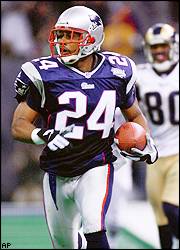
In 2000, the first year under Head Coach Bill Belichick, the Patriots finished at the bottom of the AFC East with a 5-11 tally, and not much more was anticipated in ’01. It certainly didn’t appear that the team was anything special when it fell to 5-5 following a loss to the Rams in November. But from that point, New England didn’t lose again, winning the last six regular season games. They barely defeated the Raiders in a snowy Divisional round contest and got past Pittsburgh for the AFC Championship. Coaching, starting with Belichick, certainly played a role, as did the coming together of a defense that didn’t allow more than 17 points in any of those eight wins. But the emergence of QB Tom Brady (pictured above), who took over for injured veteran QB Drew Bledsoe in September, paid huge dividends as he displayed outstanding game-management skills and great ability in clutch situations. Still, the Patriots came into the Super Bowl as two-touchdown underdogs.

There was a crowd of 72,922 at the Louisiana Superdome in New Orleans and the Patriots broke with tradition by eschewing the usual player introductions to be introduced en masse as a team, emphasizing the club’s cohesiveness. The clubs traded punts to start off the game. On their second possession, the Rams drove 48 yards in ten plays with Warner completing six of seven passes. Jeff Wilkins kicked a 50-yard field goal to give St. Louis the early lead.

After the Patriots went three-and-out, the Rams again drove into New England territory, the highlight being a 29-yard pass completion from Warner to WR Az-Zahir Hakim on the second play of the second quarter. But after penetrating to the 34 yard line, Wilkins was wide to the left on a 52-yard field goal attempt.

New England held onto the ball for seven plays but again had to punt. However, on the third play of the next St. Louis possession, CB Ty Law intercepted a Warner pass that was intended for Bruce and returned it 47 yards for a touchdown (pictured at right). In stunning fashion, the Patriots were in front at 7-3.

With under two minutes remaining in the first half, Warner threw to WR Ricky Proehl for a 15-yard gain to the New England 40, but safety Antwan Harris forced a fumble and CB Terrell Buckley recovered for the Patriots. Brady hit on passes to WR Troy Brown for 16 yards and eight yards to TE Jermaine Wiggins to get to the St. Louis 24. Following an eight-yard carry by RB Kevin Faulk, Brady threw to WR David Patten for an eight-yard TD and the Patriots went into halftime with an improbable 14-3 lead.

Coach Belichick had learned from the loss to St. Louis during the regular season, when he had tried to key on blitzing Warner. This time, he sought to keep Marshall Faulk in check and loaded up with as many as six or seven defensive backs on each play. The strategy was having the desired effect, as Warner’s rhythm was disrupted and the fleet wide receivers were kept in check.

The teams went back to trading punts in the third quarter, battling for field position. Late in the period, after the Rams had advanced to the New England 45, Warner was intercepted again, this time by CB Otis Smith, who returned the pickoff 30 yards to the St. Louis 33. Five plays later, Adam Vinatieri kicked a 37-yard field goal to make the score 17-3.

With the game moving into the fourth quarter, the Rams began to come alive as Warner hit on short passes, completing six in a row to reach the New England three. Following two incompletions and facing a fourth-and-three situation, Warner ran and fumbled when hit by LB Roman Phifer. Patriots FS Tebucky Jones picked up the ball and took off for an apparent 97-yard touchdown, but the play was nullified by a defensive holding penalty on DE Willie McGinest. Gaining a huge reprieve, Warner ran for a two-yard touchdown shortly thereafter and New England’s margin was cut to 17-10.

The teams again traded punts, and the Patriots had consecutive three-and-out possessions. After the second one, and with under two minutes remaining, the Rams took over at their 45 yard line. Warner threw to Hakim for 18 yards, WR Yo Murphy for 11, and then the slow-but-steady Proehl for a 26-yard touchdown. With the extra point, the game was tied at 17-17 and it appeared likely that the contest would go into overtime.

New England’s offense took over at its own 17 with 1:21 now on the clock and no timeouts remaining. Brady threw two passes to RB J.R. Redmond that covered 13 yards. After an incompletion, he went to Redmond again for another 11 yards to his own 41. A 23-yard pass to Brown took the ball into Rams territory at the 36 and a throw to Wiggins added another six yards. With seven seconds now remaining, Brady spiked the ball to stop the clock and Vinatieri, who was rapidly becoming recognized as an outstanding clutch kicker, booted a game-winning 48-yard field goal (pictured below). In an amazing upset, the Patriots won their first championship by a score of 20-17.


The Rams won the statistical battle, outdistancing New England in total yards (427 to 267), first downs (26 to 15), and time of possession (33:30 to 26:30). But the Patriots didn’t turn the ball over, while taking advantage of three St. Louis turnovers to score 17 points.

Tom Brady was the game’s MVP as he completed 16 of 27 passes for 145 yards and a touchdown and showed great poise in directing the game-winning drive. Troy Brown (pictured below) led New England’s receivers with 6 catches for 89 yards. RB Antowain Smith rushed for 92 yards on 18 carries.


The strategy of keying on Marshall Faulk held the Rams’ running game to 90 yards, with Faulk gaining 76 of that total on 17 attempts and catching four passes for 54 yards – ordinary by his standards. Kurt Warner was successful on 28 of 44 passes for 365 yards, but with just one TD against two interceptions. Az-Zahir Hakim, Isaac Bruce, and Torry Holt all caught five passes apiece, with Hakim gaining the most yards (90; Bruce and Holt gained 56 and 49 yards, respectively).

“When Adam hit it, it was so true,” said Bill Belichick of Vinatieri’s game-winning field goal. “It was so high and so far. If you want a guy to make a play at the end of the game, he's the one.”

Of the Rams, Ty Law said, “I don't think they looked past us, but at the same time, I don't think they were expecting this type of fight.”

“I don't think we were overconfident,” a disappointed Kurt Warner stated from the St. Louis perspective. “We played hard, but those few turnovers, those few mistakes we made, they turned them into points. Some days they don't turn into anything, but they turned them into 17 points and a world championship. That's what's so hard about this loss. It was the fact our mistakes did us in today.”

The championship for the Patriots proved to not be a fluke as the club won two more over the next three years and consistently contended beyond that. St. Louis, in the meantime, moved in the opposite direction. Warner suffered through two injury-marred seasons in 2002-03 and was let go – he would eventually revive his career in Arizona. The team dropped to 7-9 in ’02, and after rebounding to 12-4 in 2003, fell into mediocrity thereafter.

Thursday, December 2, 2010

2001: Cardinals Tie Raiders in Wild 4th Quarter, Win in OT


On the surface, the game between the Arizona Cardinals and host Oakland Raiders on December 2, 2001 at Network Associates Coliseum didn’t seem to be a promising matchup. Under Head Coach Dave McGinnis, in his first full season at the helm, the perennially underachieving Cardinals were 4-6, although they were riding a two-game winning streak. QB Jake Plummer (pictured at right), known for his inconsistency but also his late-game heroics, had come out of a midseason slump and was at his best throwing to WR David Boston.

The Raiders, coached by Jon Gruden, were 8-2 entering the contest. With QB Rich Gannon, whose career reached its pinnacle in Oakland, they ran a conservative, ball-control offense that proved highly effective. But the defense was beginning to show its age, although there was still plenty of talent.

Oakland got the first break of the game when LB Greg Biekert recovered a fumble by Plummer at the Arizona 23 yard line. Five plays later, Gannon passed to WR Tim Brown for a five-yard touchdown and 7-0 lead.

The Cardinals came back, driving 73 yards in seven plays. A four-yard run to the 50 by Plummer in a third-and-two situation kept the drive alive, and then RB Michael Pittman ran 42 yards to the Oakland eight. RB Thomas Jones scored on a five-yard run that tied the score.

The Raiders missed an opportunity to regain the lead early in the second quarter when a 41-yard field goal attempt by Sebastian Janikowski was blocked by DE Fred Wakefield. The Cardinals moved in front instead on an impressive drive in which Plummer completed a 21-yard pass to Boston on a third-and-ten play and Pittman contributed a 22-yard run down to the Oakland 15. Pittman capped the possession with a one-yard carry for a 14-7 lead.

Following a 55-yard punt return by WR Arnold Jackson to the Raiders’ 39, the Cardinals went 34 yards in nine plays capped by a 23-yard Bill Gramatica field goal to extend their margin to 17-7. It was 20-7 in favor of Arizona at halftime as Gramatica added another field goal, of 26 yards, in the last minute of the half.

Oakland scored the only points in the third quarter on a 12-play drive. RB Zack Crockett ran for seven yards in a fourth-and-one situation to the Arizona 24, and Crockett helped sustain the drive again with a four-yard run to the 12 on third-and-two. Fittingly, Crockett scored a TD from one yard out to narrow the Cards’ margin to 20-14.

Gannon, who had thrown only two interceptions in the first ten games, had tossed two in the first three quarters, and one was particularly costly deep in Arizona territory that CB Tom Knight returned for 43 yards. The Cardinals converted that turnover into a 33-yard field goal by Gramatica early in the fourth quarter. However, Gannon and the Raiders responded by driving 67 yards in five plays, capped by a 22-yard touchdown pass from Gannon to Brown.

The score remained 23-21 in favor of Arizona until the Raiders completed a 10-play drive with a 24-yard Janikowski field goal with 1:52 remaining on the clock. The Cardinals needed just 29 seconds to respond as Plummer completed a 20-yard pass to WR MarTay Jenkins to midfield and then Boston burned star Oakland CB Charles Woodson as he caught a 50-yard touchdown pass. Plummer successfully ran for a two-point conversion and Arizona was back in front at 31-24 with 1:10 now left.

It was plenty of time for Gannon and the Raiders to come back. The 14th-year veteran quarterback completed passes of 22 yards to venerable WR Jerry Rice on a third-and-ten play, 10 yards to RB Charlie Garner, and 36 yards to Rice down to the Cards’ 10 yard line. On a broken play, Gannon pump-faked and then ran for eight yards, getting out of bounds at the two with 15 seconds remaining. On fourth-and-goal, he then tossed a two-yard TD pass to Rice and, with the successful conversion, the game went into overtime tied at 31-31.

The game was decided in overtime when the Cardinals were forced to punt and Oakland WR David Dunn muffed the kick. Arizona LB LeVar Woods recovered at the Raiders’ 25 and three plays later, at 7:29 into the extra period, Gramatica won the game with a 36-yard field goal. The Cardinals came away with a 34-31 win.

Oakland outgained Arizona with 436 yards to 390, and also led in first downs, 26 to 24. However, they turned the ball over three times, to once by the Cardinals, and that ultimately proved costly.

Jake Plummer completed 22 of 38 passes for 249 yards with a touchdown and none intercepted. David Boston caught 6 passes for 106 yards and a TD, and MarTay Jenkins contributed 6 receptions for 90 yards. Michael Pittman was the team rushing leader with 78 yards on 18 carries and a score.


Rich Gannon (pictured at left) had 29 completions in 45 attempts for 302 yards with three TDs and two interceptions; he also ran the ball seven times for 30 yards. Jerry Rice had 7 pass receptions for 97 yards and a touchdown and Tim Brown added another 5 catches for 63 yards and two TDs. Charlie Garner was Oakland’s leading rusher with 59 yards on 15 attempts and added another 28 yards on 5 receptions out of the backfield.

Arizona lost three of its last five games to conclude with a 7-9 record, tied with the Giants for third in the NFC East. The Raiders won their next two contests but faltered with three losses to conclude the regular season. Still, their 10-6 tally was good enough to win the AFC West and they won in the Wild Card playoff round before losing a close decision to New England in the Divisional round.

Rich Gannon led the AFC in passing with a 95.5 rating and also in touchdown passes (27) and completion percentage (65.8). His 1.6 INT percentage was the lowest among NFL qualifiers and he was named to the Pro Bowl.

Jake Plummer threw for 3653 yards and had 18 touchdown passes to 14 interceptions – the only time in his six seasons with the Cardinals that he had fewer interceptions than TD passes.


David Boston (pictured at right) led the NFL with 1598 pass receiving yards; his 98 catches ranked seventh (third in the NFC). He was a consensus 1st-team All-Pro selection and was picked for the Pro Bowl.

The pass receiving combination of Tim Brown and Jerry Rice, with a combined total of 31 pro seasons, was highly productive. Each caught nine touchdown passes, while Brown pulled in 91 receptions for 1165 yards and Rice had 83 catches for 1139 yards. Brown was selected to the Pro Bowl.

Thursday, November 11, 2010

2001: Shaun Alexander Gains 266 Yards to Lead Seahawks Over Raiders


RB Shaun Alexander was chosen by the Seattle Seahawks in the first round of the 2000 draft out of Alabama, but spent his rookie season seeing limited action behind 31-year-old veteran Ricky Watters. To be sure, Watters had a typically solid year, rushing for 1242 yards and co-leading the team with 63 pass receptions, and was still the starting running back at the beginning of the 2001 season. However, Alexander got his chance when the veteran went down with a shoulder injury three games into the schedule, and made the most of it.

The 5’11”, 220-pound Alexander gained 176 yards in his first start, against Jacksonville, and after four games had 465 yards on 100 carries with five touchdowns. On November 11 against the Oakland Raiders, he had his biggest performance of all.

The Seahawks, under Mike Holmgren, who had led the Packers to a Super Bowl victory and was now in his third year in Seattle, were 3-4 coming into the Sunday night contest at Husky Stadium against a Raiders team that had beaten them handily in Oakland. Oakland, under Head Coach Jon Gruden, was 6-1. An aging club, they were the defending AFC West champions and coming off a big win over Denver the preceding Monday.

The first quarter started quietly, with Seattle’s Rian Lindell kicking field goals of 33 and 20 yards and, in between, Oakland’s Sebastian Janikowski booming a 52-yarder. QB Matt Hasselbeck, who was struggling with inconsistency in his first year as a starting quarterback after backing up Brett Favre in Green Bay for two seasons, threw timely passes to set up both field goals.

The Raiders scored the first touchdown of the game in the second quarter thanks to a 10-play, 89-yard drive that ended with QB Rich Gannon throwing a four-yard scoring pass to WR Tim Brown. But just before the end of the half, Hasselbeck directed the Seahawks on a 76-yard drive that ended with a nine-yard TD pass to WR Darrell Jackson. Seattle had a 13-10 lead at halftime.

That margin evaporated quickly when Oakland RB Terry Kirby returned the kickoff to open the second half 90 yards for a touchdown and 17-13 lead for the Raiders. Later, Oakland extended the margin in more methodical fashion, driving 61 yards on nine plays that included Gannon passes to Brown for 13 and 18 yards, and capped by a 37-yard Janikowski field goal.

Seattle came back, however, on a nine-play possession that covered 61 yards and was helped along by a 28-yard pass play from Hasselbeck to WR Bobby Engram in a third-and-five situation. With the ball at the Oakland 18, Alexander took off on a 12-yard carry and then ran the final six yards for a touchdown. With Lindell’s successful PAT, the score was tied at 20-20.

Late in the third quarter, Alexander made the most spectacular play of the game. With the ball on the Seattle 12 yard line, he took the handoff, ran to his left before cutting across the middle of the field and running nearly untouched for a touchdown (CB Tory James caught him at the one but couldn’t stop Alexander from falling into the end zone). The 88-yard run was the longest in Seahawks history. It also capped a third quarter in which Alexander ran for 120 yards and Seattle moved ahead by a 27-20 score.

The Seattle defense came up with a big play in the fourth quarter when LB Anthony Simmons forced a fumble by Raiders RB Zack Crockett and CB Willie Williams recovered at the Oakland 25. Alexander scored his third touchdown of the game from 10 yards out to extend Seattle’s lead to 34-20 with just over seven minutes remaining on the clock.

The Raiders came back with a 10-play, 64-yard drive that was highlighted by a 16-yard run by Gannon and a 13-yard pass completion to 17-year veteran WR Jerry Rice on a fourth-and-seven play. TE Roland Williams scored a touchdown on a five-yard pass from Gannon to narrow the margin. But Seattle ran the clock down on its next possession, helped along by a key first down run by Alexander, and the Raiders got the ball back for one last shot from their 22 yard line with 1:07 remaining and no time outs. Oakland got to the Seattle 48 as time expired, and the Seahawks came away with a 34-27 win.

Shaun Alexander was the star of the game, running for 266 yards on 35 carries with three touchdowns. The rushing total set a franchise record and was the fourth-highest in NFL history up to that time.

Overall, the Seahawks rolled up 497 total yards, with 319 of them coming on the ground against a Raiders defense that had entered the game ranked fourth against the run. Matt Hasselbeck passed for 181 yards, completing 15 of 23 throws with a TD and none intercepted. Darrell Jackson was the leading receiver by far, catching 7 of those passes for 102 yards and a touchdown.

Rich Gannon went to the air 38 times with 24 completions for 257 yards and two touchdowns against no interceptions. The savvy veteran wide receivers had very similar numbers as Tim Brown caught 7 passes for 86 yards and a TD and Jerry Rice added 6 receptions for 85 yards. RB Charlie Garner led Oakland in rushing with 57 yards on 13 carries.

”I don't know if that was Alexander or Jim Brown,” said Raiders Coach Gruden about Alexander’s performance. “If you're asking me if he's good, he ran for a franchise record. He's real good, man, real good.”

“Shaun Alexander had a marvelous game,” summed up Mike Holmgren. “The offensive line and (FB) Mack Strong did a great job. We challenged the offensive line and they came through big time, and Shaun had just a great game, but he has to do it game after game and year after year. But there is no reason to think he won't do that.”

The Seahawks went on to a 9-7 record to place second in the AFC West in their last season in the American Conference - with realignment in 2002, Seattle moved over to the NFC West. Oakland faltered in the second half of the season, losing its last three games, but still won the division at 10-6. The Raiders won in the Wild Card playoff round, but lost a close-fought Divisional playoff game to New England in a snowstorm.

Shaun Alexander ended up with 1318 yards on 309 carries (4.3 avg.) for a league-leading 14 rushing touchdowns. He briefly yielded the starting job back to Watters, and took some criticism for poor pass blocking, but by the next season Alexander was unquestionably the team’s number one running back. He would go on to string together five straight thousand-yard rushing seasons, leading the league once and setting a single-season record for touchdowns along the way. In eight years in Seattle, Alexander gained 9429 yards to become the franchise’s career rushing leader, as well as single-game and single-season record holder.

Thursday, October 28, 2010

2001: Saints Come From 18 Points Behind to Beat Rams


The New Orleans Saints were coming off of a 10-6 year in 2000 under first-year Head Coach Jim Haslett and were 3-2 in ’01 as they faced the St. Louis Rams, the team they had beaten out for the NFC West title and then defeated in the Wild Card playoff (the first playoff win in franchise history), at the Dome at America’s Center on October 28, 2001. The Rams, under second-year Head Coach Mike Martz, were a perfect 6-0 thus far and seemed almost invincible.

St. Louis, with its outstanding passing offense, struck quickly on the second play from scrimmage. WR Az-Zahir Hakim took the handoff on a reverse and the former high school quarterback proceeded to fire a pass to WR Isaac Bruce for a 51-yard touchdown. The Saints then fumbled the ball away on their first possession, as TE Cam Cleeland was stripped by St. Louis LB Don Davis after catching a short pass from QB Aaron Brooks. CB Aeneas Williams recovered for the Rams and five plays later, following pass completions by QB Kurt Warner of 25 yards to WR Torry Holt and 13 yards to TE Ernie Conwell, Conwell ran for a two-yard touchdown. St. Louis was ahead by 14-0 and the game was barely four minutes old.

New Orleans got on the board thanks to a 33-yard John Carney field goal, and the score was 14-3 after one quarter. But the Rams scored again early in the second quarter. A pass interference call on Saints CB Kevin Mathis gave St. Louis a 38-yard gain to the New Orleans 36 yard line, and then Warner connected on passes of 13 yards to RB Trung Canidate (filling in for injured star RB Marshall Faulk) and 19 to Bruce to set up Canidate’s one-yard touchdown run.

The Saints drove 66 yards in 12 plays for another field goal by Carney, this time of 44 yards. But Jeff Wilkins responded with a 54-yard field goal late in the period that gave the Rams a halftime lead of 24-6 (Wilkins had missed an attempt earlier that broke a string of 30 consecutive successful field goal attempts).

Down by 18 points, New Orleans came back in stunning fashion in the third quarter. First, rookie RB Deuce McAllister returned the opening kickoff of the second half 46 yards to the St. Louis 48. Two plays later, Brooks connected with WR Joe Horn for a 46-yard touchdown.

On the ensuing St. Louis possession, Saints safety Sammy Knight roared into the backfield on a safety blitz, batted Warner’s pass and intercepted it. His 13-yard return ended up at the Rams’ 16 yard line. New Orleans lost yardage on the possession, however, and settled for a 44-yard field goal by Carney.

St. Louis CB Dre’ Bly fumbled the kickoff and it was recovered for the Saints by RB Fred McAfee at the Rams 16. Five plays later Brooks rolled out and tossed a six-yard pass to Horn for a touchdown. An attempted two-point conversion failed when RB Ricky Williams was stopped short of the end zone, but the Saints were now only two points behind at 24-22.

The Rams went three-and-out on their next possession and had to punt. It took just two plays for New Orleans to take the lead when Brooks went deep down the sideline to WR Willie Jackson and connected for a 49-yard touchdown. Once again, the attempted two-point conversion failed, but the Saints were now ahead by 28-24.

The Saints onslaught continued when DE Darren Howard intercepted a short Warner pass and returned it 37 yards to the St. Louis 23. The resulting possession lasted five plays and ended with Carney hitting on a 23-yard field goal. The third quarter ended with the Saints in the lead at 31-24, having put up 25 points in the course of the period.

St. Louis finally got on the board again in the fourth quarter following a 12-play, 87-yard drive that ended with an eight-yard touchdown pass from Warner to Holt. With the score now tied at 31-31 and the clock winding down to under five minutes, it seemed as though the Rams would yet pull the game out. But at the New Orleans 23, Canidate, who had caught a screen pass, fumbled and safety Chris Oldham recovered for the Saints and ran 43 yards before being pushed out of bounds at the St. Louis 36.

A 14-yard run by Ricky Williams got the ball to the 22, but it seemed that the Rams had dodged a bullet four plays later when they blocked Carney’s 30-yard field goal attempt. However, Bly was penalized for being offsides, giving New Orleans a first down. They ran three times to run the clock down and Carney’s fifth field goal of the day, from 27 yards, gave the Saints a 34-31 win.


St. Louis outgained the Saints, 474 yards to 320, and had 25 first downs to New Orleans’ 15. But they also turned the ball over eight times, including the four that fueled the New Orleans third quarter comeback.

Aaron Brooks (pictured at top) completed 20 of 31 passes for 254 yards with three touchdowns and no interceptions. Joe Horn caught 8 passes for 121 yards and two of the TDs. Ricky Williams led the running game with 77 yards on 17 carries.

For the Rams, Kurt Warner went to the air 47 times with 29 completed for 385 yards; however, while he threw for one TD, he also surrendered four interceptions (two by Sammy Knight, pictured above left). Isaac Bruce was the most productive receiver, catching 7 passes for 179 yards and a touchdown, but while Trung Canidate caught 10 passes for 107 yards, he only gained 19 yards rushing on 12 carries in relief of Faulk, including the one short TD. Az-Zahir Hakim, who contributed a touchdown pass, was the team’s leading rusher with 20 yards on two runs.

“They're not robots, they can be beaten,” said Joe Horn afterward. “I think we proved that today and we look forward to meeting them again.” The result was very different when the clubs met for the rematch in New Orleans – the Rams won, 34-21. Indeed, St. Louis lost only once more the rest of the regular season in posting a 14-2 record and re-taking the NFC West. However, they were stunned by the underdog New England Patriots in the Super Bowl. New Orleans failed to generate any momentum from the come-from-behind win, going 3-7 and losing the last four games of the year. The Saints finished in third place in the division at 7-9.

Kurt Warner (pictured below) was the NFL’s leading passer (101.4 rating) and also led the league in completion percentage (68.7), passing yards (4830), touchdown passes (36), yards per attempt (8.8), yards per completion (12.9), and percentage of TD passes (6.6).

Aaron Brooks, in his first full season as the starting quarterback, ranked fourth in the NFL with a career-high 3832 yards and tossed 26 touchdown passes, although he was also among the league leaders with 22 interceptions.

Thursday, September 23, 2010

2001: Tom Brady Replaces Injured Drew Bledsoe at QB for Patriots


Since making it to the Super Bowl following the 1996 season (and immediately losing Head Coach Bill Parcells), the New England Patriots had steadily declined over the following four years. From 11-5 in the AFC championship season, they had gone 10-6 under Pete Carroll in ’97, and lost in the Divisional round of the playoffs; 9-7 in 1998 to just snag the last wild card spot and go out in the first postseason round; 8-8 and out of the running in 1999, Carroll’s last season; and 5-11 under first-year Head Coach Bill Belichick in 2000.

Through it all, Drew Bledsoe had been the team’s quarterback. The club’s first draft pick in 1993 (and first overall) out of Washington State, he had put up significant numbers, especially in his first few seasons. Big, at 6’5” and 240 pounds, with a strong arm, he was also immobile and prone to taking hits (he was sacked 45 times in 2000). Still, he was tough enough to keep coming back and the club had shown confidence in Bledsoe by signing him to a 10-year, $103 million contract. At 29, he was still in his prime.

New England lost its first game of the 2001 season at Cincinnati. Two days later, the terrorist strikes on New York City and the Pentagon caused football to take a back seat to far greater concerns and the following weekend’s games were postponed.

When play resumed, the Patriots hosted the New York Jets at Foxboro Stadium on September 23. The game was a low-scoring affair. New England’s Adam Vinatieri kicked a 24-yard field goal in the first quarter and New York’s John Hall responded with a 26-yarder at the end of the half.

In the third quarter, New York DT Steve Martin recovered a fumble by the Patriots deep in Jets territory and they responded by going 93 yards in 12 plays to score on an eight-yard touchdown run by RB Curtis Martin.

But the play that had huge consequences, if not for this game than for the season and beyond, occurred in the fourth quarter. Bledsoe took off in an attempt to run for a first down and was hit hard by Jets LB Mo Lewis. He suffered a chest injury that knocked him out of the game and, ultimately, out of the season and off the team.

In for Bledsoe came the unknown backup quarterback, Tom Brady. Brady was an unheralded sixth-round draft pick by the Patriots in 2000, having had an undistinguished college career at Michigan where he had difficulty competing for playing time against the likes of Brian Griese and Drew Henson. As a rookie, there were questions about his size (while he had good height at 6’4”, he was initially listed at 210 pounds) and arm strength. But Brady worked hard on the practice field and in the weight room.

By the 2001 preseason, Brady had improved to the point that Coach Belichick was suitably impressed with his development - even if Bledsoe had not gone down to injury, he might have gotten an opportunity to play. Brady had also added about 25 pounds to his frame and no longer looked too spindly for the NFL.

The young quarterback wasn’t able to salvage the game against the Jets; after completing five of his first six passes, he misfired the rest of the way and ended up successful on 5 of 10 attempts for 46 yards (Bledsoe had completed 18 of 28 passes for 159 yards with no TDs and two interceptions prior to his injury). New York held on to win, 10-3.

The Patriots won their next game against the Colts in what would be the first of many memorable showdowns between Brady and Peyton Manning. It was also the first of 11 wins in the remaining 14 contests as New England ended up with an 11-5 tally and won the AFC East. Carefully coached by offensive coordinator Charlie Weis, Brady showed tremendous composure and leadership skills. While he didn’t possess Bledsoe’s arm strength, he was more accurate. A come-from-behind 29-26 win over the Chargers was a defining performance for the young quarterback. Even after Bledsoe was cleared to play again, Brady continued to start.

The Patriots defeated Oakland in a snowy Divisional playoff game, the last at Foxboro Stadium, and won at Pittsburgh for the AFC Championship (a game in which Brady was knocked out of by injury and Bledsoe stepped in). They upset the heavily-favored St. Louis Rams in the Super Bowl to cap the stunning season.

Tom Brady ranked third in the AFC in passing (86.5) and second in completion percentage (63.9) as he threw for 2843 yards with 18 touchdowns and 12 interceptions. He was selected to the Pro Bowl. By the time another three seasons had gone by, he had also quarterbacked the Patriots to two more NFL titles.

Drew Bledsoe was traded to Buffalo following a season in which he displayed typical class after being relegated to the bench. He had a Pro Bowl year with an 8-8 club in ’02, but a porous line and declining skills made his last two years with the Bills far less successful. Bledsoe finished up with two years in Dallas, reunited with Head Coach Bill Parcells.

Tuesday, January 19, 2010

2002: Patriots Defeat Raiders in Snow With Help From Tuck Rule


It was a snowy day in Foxboro, Massachusetts on January 19, 2002 as the Patriots hosted the Oakland Raiders in an AFC Divisional playoff game at Foxboro Stadium. New England, under Head Coach Bill Belichick, had been the surprise team of the second half of the 2001 season. A 5-11 team in 2000, they had lost their first two games in ‘01 and as late as the tenth week were just 5-5 when they put together a six-game winning streak to finish the regular season at 11-5. It was good enough to win the AFC East over Miami, thanks to a better division record. More surprising had been the play of QB Tom Brady, an obscure second-year backup who had been thrust into the starting role after the established veteran, Drew Bledsoe, was injured in the second week. Showing great composure, Brady set a team record by completing 63.9 percent of his passes.

Their opponents, the Oakland Raiders, were coached by Jon Gruden and had won the AFC West with a 10-6 tally. 36-year-old QB Rich Gannon had continued to improve with age, passing for 3828 yards with 27 touchdowns and just 9 interceptions as he led the conference in overall passing. All-purpose RB Charlie Garner ran for 839 yards and caught 72 passes for another 578. Veteran wide receivers Tim Brown (91 catches, 1165 yards) and Jerry Rice (83 for 1139) combined skill and savvy. LB Greg Biekert and cornerbacks Charles Woodson and Eric Allen were prominent performers on the defense.

With the driving snowstorm hindering visibility and members of the grounds crew regularly clearing the snow at the yard lines, the defenses dominated the first half. Oakland finally got the first score of the game as Gannon passed to WR James Jett for a 13-yard TD early in the second quarter. The score remained 7-0 at the half.

It looked as though the veteran Raiders had finished off the upstart Patriots in the third quarter. Adam Vinatieri got New England on the board with a 23-yard field goal on the first possession of the second half, but Oakland came right back with a three-pointer from 38 yards by Sebastian Janikowski. Janikowski added another field goal, from 45 yards, later in the period and the Raiders led by a seemingly-comfortable 13-3 margin going into the fourth quarter.

With 12:29 to play, the Patriots offense came alive as Brady commenced a drive that included nine consecutive pass completions and ended with his running for a 9-yard touchdown on a quarterback draw. The teams exchanged punts after their next possessions, and with 2:24 left, the Raiders had the ball on their own 44 with a third-and-one situation. In a critical defensive play, RB Zack Crockett was stopped for no gain and Oakland had to punt.

New England got the ball back on their 46 with just over two minutes remaining and no timeouts. They reached the Oakland 42, but in the key play of the game, it appeared that the Patriots season was over when Brady was blindsided by the blitzing Woodson, who hit his arm and caused an apparent fumble that was recovered by Biekert. However, the ruling was overturned upon review by the replay official – it was determined that while Brady had pulled the ball down, it was part of a continuous forward motion and was thus an incomplete pass, not a fumble.

While still at the low end of a 13-10 score, the Patriots retained possession and managed a 42-yard, line-drive field goal by Vinatieri with 27 seconds left in regulation. All tied up at 13-13, the game proceeded into overtime.

Playing into the wind in the “sudden death” period, the Patriots took the kickoff and moved the ball down the field, with Brady completing all eight of his passes. The key play came on a fourth-and-four situation with the ball at the Oakland 28 as New England decided to go for a first down rather than attempt a field goal into the snow and wind at that distance. The gamble worked - Brady passed to WR David Patten for six yards, and shortly thereafter Vinatieri booted a 23-yard field goal (pictured at bottom) to win the game, 16-13.


While Tom Brady had his shaky moments, he rose to the occasion when necessary and completed 32 of 52 passes for 312 yards with an interception. Patten had 107 yards on 8 catches, while TE Jermaine Wiggins led with 10 receptions, for 68 yards (he caught just 14 passes during the season). RB Antowain Smith (pictured at left) had 65 hard-earned yards on 20 rushes.

Rich Gannon connected on 17 of 31 passes for 159 yards and a TD. Charlie Garner ran 17 times for 64 yards and gained another 32 yards on four pass receptions. It was a testament to both the weather and New England’s tenacious defense that Jerry Rice led the Oakland receivers with just 48 yards on 4 catches; Tim Brown had the most catches with 5, for 42 yards.

There was much comment about the reversal of the fumble call on Brady. The interpretation of the so-called tuck rule had saved New England’s season. Referee Walt Coleman, who viewed the replay and reversed the call, stated afterward that, “When I got over to the replay monitor and looked at it, [it] was obvious that his arm was coming forward. He was trying to tuck the ball and they just knocked it out of his hand. His hand was coming forward, which makes it an incomplete pass.”

Said Brady, “I knew I was throwing the ball…I’m glad they ruled it the way they did.” Oakland’s Coach Gruden stated, with obvious irritation, “It was obvious. I thought it was a fumble, but the officials ruled otherwise.” Rice summed up the feeling of the defeated Raiders when he said, “I feel like we had one taken away from us.”

In any event, the Patriots made the most of their opportunities with the game on the line. The young quarterback gained recognition for the first of what would be many outstanding clutch performances (as Jon Gruden also said, “Say what you want, (Brady) made some great plays when he had to.”). For Adam Vinatieri, it was the first of several games in which he made important kicks in key situations on his way to becoming the NFL’s all-time leader in postseason field goals. New England had made the final season – and last game – at Foxboro Stadium a memorable one.

The Patriots defeated Pittsburgh for the AFC Championship and won the Super Bowl over the highly-favored St. Louis Rams. Oakland went on to win the AFC title in ’02, losing decisively in the Super Bowl to Tampa Bay, the team Coach Gruden moved to following the loss at Foxboro. It was a last gasp for the veteran team - the Raiders fell into serious decline thereafter.