Showing posts with label Oakland Raiders. Show all posts

Friday, February 4, 2011

1969: John Madden Becomes Head Coach of Raiders


On February 4, 1969 the Oakland Raiders elevated John Madden, an assistant coach in charge of linebackers, to head coach. At 32 (he would turn 33 prior to the ’69 season), Madden, hardly the household name that he would later become, was the youngest head coach in either the AFL or NFL.

Madden succeeded John Rauch, who had compiled a 35-10-1 record over three seasons (including the playoffs) that included an AFL Championship in 1967. However, Rauch had clashed with Al Davis, the managing general partner, and resigned to take over as head coach in Buffalo (signed to a four-year contract, he lasted just two seasons as the Bills went 7-20-1). Davis had originally come to the Raiders as head coach (as well as general manager) and had served in that capacity for three seasons prior to a short stint as commissioner of the AFL, but made clear upon Rauch’s departure that he would not serve again in that capacity.

Davis chose to stay within the organization and elevated Madden instead of offensive line coach Ollie Spencer. The burly young coach had played tackle in college at California Polytechnic in San Luis Obispo and received all-conference honors. Drafted in the 21st round by the Philadelphia Eagles in 1958, a preseason knee injury brought a quick end to his pro career – although he did receive mentoring from Hall of Fame QB (and future pro head coach) Norm Van Brocklin. From there he went into college coaching and advanced through the ranks, with four years at Hancock Junior College in Santa Maria, California (two as head coach) and two years as defensive coach at San Diego State (on the staff of another future NFL head coach and mentor, Don Coryell). He joined the Raiders coaching staff under Rauch in 1967.

It was anticipated that going with a new coach who was already associated with the team would maintain stability, and with the club’s recent success, significant change was hardly in order. The Raiders had won the AFL Western Division for the second straight year in 1968 with a 12-2 record, defeating the Chiefs to break a tie at the top of the standings but then losing the league title game to the Jets.

There was no letdown under the new coach in 1969 as Oakland once again topped the division at 12-1-1. The offense was explosive, and QB Daryle Lamonica (pictured with Madden below) had an MVP season (UPI) as he led the AFL in its last pre-merger season in passing yards (3302), TD passes (34), pass attempts (426), and completions (221) – although also in interceptions, with 25. Deep-threat WR Warren Wells caught 47 passes for a league-leading 1260 yards and 14 touchdowns, while possession WR Fred Biletnikoff ranked second in pass receptions (54) and gained 837 yards while adding another 12 TDs.


Speedy HB Charlie Smith led the club with 600 yards rushing and also caught 30 passes and FB Hewritt Dixon, hindered by injuries but effective when healthy, added 398 yards on the ground and 33 receptions. The offensive line featured All-AFL performers in C Jim Otto, G Gene Upshaw, and OT Harry Schuh.

The defense was known for its aggressiveness and featured ends Ike Lassiter and Ben Davidson and tackles Carleton Oats and Tom Keating on the line. Gus Otto was an AFL All-Star for his play at right outside linebacker, while Dan Connors held down the middle. The backfield was outstanding and included cornerbacks Willie Brown and Nemiah Wilson plus FS Dave Grayson and SS George Atkinson. Oakland’s opponents completed just 38.9 percent of their passes. In addition, 42-year-old backup QB George Blanda was still one of the game’s most reliable placekickers and Mike Eischeid a good punter.

However, the ’69 season ended in disappointment. For the league’s last year, instead of the two division champions vying directly for the title, an extra layer was added to the postseason, with each first place team facing the second place finisher in the other division. The Raiders had no trouble disposing of the Houston Oilers, who finished second in the Eastern Division with a 6-6-2 record, bombarding them by a score of 56-7. The Jets, top finishers in the East and seeking a second consecutive title, lost to the Western Division’s second place team, the Chiefs, by a 13-6 tally. Oakland had beaten Kansas City in both meetings during the regular season, but in the final AFL Championship game, it was the Chiefs prevailing, 17-7, and then going on to defeat the champions of the NFL, the Minnesota Vikings, in the Super Bowl.

Success during the regular season followed by disappointment in the playoffs became a near-annual event, and the Raiders developed a reputation as a good team that couldn’t win the big games. In 1970, they won the division and advanced to the first AFC Championship game, but lost to the Colts. After going 8-4-2 and missing the postseason in ’71, the Raiders were back atop the AFC West at 10-3-1 in 1972 but lost in gut-wrenching fashion to the Steelers in the Divisional round as a result of the “Immaculate Reception” touchdown by RB Franco Harris. They were back in the conference title game in ’73 but lost to Miami. In 1974 and ’75 they also made it to the AFC Championship game, and lost to the Steelers both times.

Finally, Oakland went the distance in 1976, going 13-1 during the regular season and handily beating Pittsburgh for the conference title. In the Super Bowl, the Raiders defeated Minnesota in convincing fashion to finally achieve the elusive NFL Championship.


Madden coached for two more years but stepped down after the 1978 season. An animated and excitable coach, he had developed stomach ulcers and chose to leave the profession at age 42. He would, of course, transition into a long and prominent career broadcasting pro football games. He would also achieve recognition for his coaching achievements, gaining induction into the Pro Football Hall of Fame in 2006.

Madden’s coaching record was 103-32-7 in the regular season, for a gaudy .763 winning percentage (the highest in league history for a head coach with at least ten seasons), and his teams went 9-7 in the postseason, including the one NFL title.

Friday, January 14, 2011

1968: Packers Beat Raiders in Super Bowl II


Head Coach Vince Lombardi had guided the Green Bay Packers to five NFL championships in nine seasons, including three straight from 1965-67. Having beaten the Dallas Cowboys in a dramatic NFL Championship game on a frigid day at Lambeau Field, he now looked to cap his tenure with a second Super Bowl win over the AFL champions, the Oakland Raiders.

The Packers were a solid and seasoned club, having overcome a slow start in '67 by QB Bart Starr (pictured above) due to injuries at the beginning of the season, and the loss of HB Elijah Pitts and FB Jim Grabowski along the way. But Lombardi filled in with players like fullbacks Ben Wilson and Chuck Mercein, and there were familiar names throughout the roster, including Pro Bowlers in split end Boyd Dowler, G Jerry Kramer, OT Forrest Gregg, DE Willie Davis, LB Dave Robinson, FS Willie Wood, and cornerbacks Herb Adderley and Bob Jeter.

The team they would be facing on January 14, 1968 at the Orange Bowl in Miami, the Raiders, was in the postseason for the first time. Coached by John Rauch and operated by managing general partner Al Davis, Oakland profited from an offseason trade with Buffalo that brought QB Daryle Lamonica to the team. Lamonica, a highly-regarded backup with the Bills for four years, was outstanding as he led the league in passing and touchdown passes (30) while throwing for 3228 yards, and was named AFL Player of the Year by the Associated Press and UPI. He was not the only newcomer who made good – CB Willie Brown was obtained from the Broncos and had an All-AFL season, and 40-year-old George Blanda provided depth at quarterback and reliable placekicking. Rookie G Gene Upshaw joined young veterans having breakout years like flanker Fred Biletnikoff and FB Hewritt Dixon, and stalwarts such as center Jim Otto and G Wayne Hawkins.

The Raiders won the Western Division with a 13-1 record and decimated the Oilers in the league title game. The Packers were nevertheless 14-point favorites.

Attendance at the first Super Bowl in Los Angeles had been disappointing, but there were 75,546 fans filling the Orange Bowl for the second contest (still not officially called the Super Bowl). Oakland received the opening kickoff and proceeded to go three-and-out. The Packers responded by driving 34 yards in 11 plays on their first possession, capped by a 39-yard field goal by Don Chandler.

The Raiders nearly made it to midfield on their next possession, and Mike Eischeid’s punt traveled 45 yards before going out of bounds at the Green Bay three yard line. The Packers proceeded to methodically drive 84 yards in 16 plays, running 8:40 off the clock and highlighted by Starr’s 16-yard pass completion to flanker Carroll Dale and 14-yard run on a broken play. The long possession was capped in the second quarter by another Chandler field goal, this time from 20 yards, for a 6-0 lead.

Following another short Oakland possession, Starr fired a pass to Dowler who blew past CB Kent McCloughan and ran unencumbered the rest of the way for a 62-yard touchdown (pictured below). With the score now 13-0, Lamonica directed the Raiders on a nine-play drive that covered 78 yards and ended with a 23-yard touchdown pass to split end Bill Miller.


Green Bay took over at its own 15 yard line following the ensuing kickoff and DT Tom Keating’s sack of Starr drove the Packers backward. Donny Anderson’s 45-yard punt was returned 12 yards by safety Rodger Bird to give Oakland good field position at the Green Bay 40. However, the Raiders offense went three-and-out and George Blanda’s 47-yard field goal attempt was short.

Following another short Green Bay possession, Anderson punted again but this time Bird fumbled after signaling a fair catch and TE/LB Dick Capp recovered for the Packers at the Oakland 45. Chandler kicked a 43-yard field goal in the final seconds of the half and the Packers took a 16-7 lead into the intermission.

The Packers pulled away in the third quarter, much as they had done against the Chiefs in the first Super Bowl. Following a trade of punts to start the half, Green Bay drove 82 yards in 11 plays, highlighted by Ben Wilson’s 13-yard opening run on a draw play, a pass from Starr to split end Max McGee that covered 35 yards, an 11-yard Starr completion to Dale on a third-and-nine play, and a 12-yard pass completion to HB Donny Anderson. Anderson capped it all with a two-yard touchdown run and the Packers held a 23-7 lead.

Following another three-and-out possession by the Raiders, Green Bay put together another long drive that ended in Chandler’s fourth field goal, from 31 yards, with two seconds remaining in the period. The Packers now had a commanding lead of 26-7 with just a quarter to play.

The fourth quarter began with HB Pete Banaszak fumbling after catching a pass from Lamonica and Dave Robinson recovering for Green Bay. After a short possession by the Packers, the Raiders got the ball back and this time another turnover added the final nail to Oakland’s coffin as Lamonica was intercepted by Adderley (pictured below), who returned it 60 yards for a touchdown.


The Raiders came back to score on the next possession, again on a Lamonica pass to Miller that covered 23 yards, but it was too little, too late. Starr had to leave the game due to a jammed thumb, with veteran backup QB Zeke Bratkowski taking over to mop up, but the outcome was a foregone conclusion. Green Bay won its second Super Bowl by a score of 33-14.

The Packers outgained Oakland (322 yards to 293), including 160 yards on the ground, and led in first downs by 19 to 16. The efficient NFL champions didn’t beat themselves, suffering no turnovers and being penalized just once. The Raiders turned the ball over three times.

Bart Starr completed 13 of 24 passes for 202 yards with a touchdown and was again named MVP of the game. Ben Wilson ran for 62 yards on 17 carries, followed by Donny Anderson with 48 yards on 14 attempts and HB Travis Williams, who contributed 36 yards on 8 runs. Carroll Dale caught four passes for 43 yards and TE Marv Fleming also caught four, for 35 yards, while Boyd Dowler led the Packers in receiving yards, thanks to his long touchdown reception, with 71 on two catches.

For the Raiders, Daryle Lamonica completed 15 of 34 passes for 208 yards with two TDs and one picked off. Bill Miller (pictured below) caught 5 passes for 84 yards and scored both of the club’s touchdowns. Hewritt Dixon was the leading ground gainer with 54 yards on 12 carries.


“We're a young team,” John Rauch said. “I was happy with the fact that at no point in the game did we give up. It's characteristic of our team. We hope to continue with our program and get better.”

The game was the last for Max McGee, hero of the first Super Bowl and 12-year veteran who caught one 35-yard pass against the Raiders, and Don Chandler, who booted the four field goals to end his 12-season career as a placekicker/punter (with the Giants as well as Green Bay) on a high note. But another departure for the Packers was the most significant of all.

A few days after the game, Vince Lombardi confirmed what was widely rumored and stepped down as head coach, although he remained the general manager for another year. It marked the end of a remarkable coaching tenure for the man whose name became attached to the trophy presented each season to the Super Bowl-winning team.

Sunday, January 9, 2011

1977: Raiders Dominate Vikings in Super Bowl XI


Super Bowl XI on January 9, 1977 featured two teams that had a history of contending but coming up short in the postseason. The Oakland Raiders had been to the Super Bowl once before, as champions of the AFL following the 1967 season, and had made it to the playoffs in seven of the eight years following without winning a title. The Minnesota Vikings had also been in the postseason in seven of the previous eight campaigns, but had made it to the Super Bowl on three occasions - once having won the NFL title in 1969 and twice after the merger as representatives of the NFC. However, they had come up empty each time.

Oakland, coached by John Madden, easily won the AFC West for the fifth straight year with an NFL-best 13-1 record. QB Ken “The Snake” Stabler (pictured above) had an outstanding season, leading the league in passing (103.4 rating), touchdown passes (27), completion percentage (66.7), and yards per attempt (9.4). Deep-threat WR Cliff Branch caught 46 passes and ranked second in the league in yards (1111) and first in TD receptions (12). 33-year-old WR Fred Biletnikoff contributed 43 catches, while All-Pro TE Dave Casper led the team with 53 receptions, 10 of which were for scores. FB Mark van Eeghen ran for 1012 yards. Defensively, the team successfully converted to a 3-4 alignment and had a key acquisition in DE John Matuszak to go along with veteran linebackers Phil Villapiano and Ted Hendricks, CB Willie Brown, and safeties Jack Tatum and George Atkinson.

The Vikings were coached for the tenth season by Bud Grant and compiled an 11-2-1 tally to top the NFC Central. 36-year-old QB Fran Tarkenton put together a typically strong showing, throwing for an NFC-leading 2961 yards and 17 touchdowns while posting the league’s lowest interception percentage (1.9). He was helped by the performance of two new wide receivers, veteran Ahmad Rashad and rookie Sammy White. RB Chuck Foreman ran for 1155 yards and pulled in 55 passes for 567 more. The aging defense was still effective and contained such stalwarts as ends Carl Eller and Jim Marshall, DT Alan Page, MLB Jeff Siemon, and FS Paul Krause.

The Raiders defeated the Patriots in the Divisional round and Pittsburgh for the AFC title while Minnesota handily beat the Redskins and Rams, respectively, for the NFC Championship.

There were 100,421 fans present at the Rose Bowl in Pasadena, California. Oakland’s opening drive covered 55 yards to the Minnesota 11, but the Raiders came up empty when Errol Mann’s 29-yard field goal attempt hit the left upright and was no good.

With about five minutes left in the first period, Minnesota LB Fred McNeill blocked a punt by Ray Guy (the first time in Guy’s pro career that he had a kick blocked) and recovered the ball at the Oakland three yard line. Following a one-yard run by Foreman, RB Brent McClanahan fumbled when hit by LB Phil Villapiano and NT Dave Rowe; LB Willie Hall recovered for the Raiders.


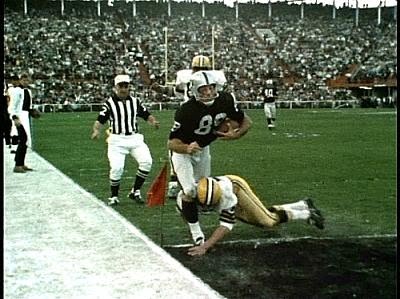
The Vikings defense seemed to have Oakland contained, but on third-and-seven at the six yard line HB Clarence Davis (pictured at left) took off around left end on a 35-yard run. Stabler threw to HB Carl Garrett for 11 yards and then to Casper for 25. The possession culminated in a 24-yard field goal by Mann early in the second quarter. From a situation in which it appeared Minnesota would score the game’s first points, the advantage instead shifted to the Raiders.

The Vikings had to punt on their next possession, and Oakland took over at its 36. After a couple of short passes and runs by van Eeghen and Davis, Stabler threw to Casper for 19 yards. Garrett ran for 13 yards and Biletnikoff caught a pass at the one. Stabler then threw to a wide-open Casper in the end zone for a touchdown. Oakland was ahead by 10-0.

With seven minutes left in the half, the Vikings got the ball back but once more had to punt and DB Neil Colzie returned it 25 yards to the Minnesota 35. Two running plays gained 17 yards and then Stabler passed to Biletnikoff for 17, again to the one yard line. The Raiders kept it on the ground this time as RB Pete Banaszak plunged over right tackle for a touchdown. Mann missed the extra point attempt that nicked the right upright, but the score was 16-0 at halftime.

Oakland had clearly dominated, controlling the ball for 21 minutes during the first half and outgaining the Vikings by 288 yards to 86 while leading in first downs by 16 to 4. By contrast, Tarkenton completed just 5 of 12 passes for 59 yards.

Ten minutes into the third quarter, Mann kicked a 40-yard field goal to extend the Oakland lead to 19-0. It appeared that the Minnesota offense would remain stymied, especially when they had to punt following the next possession. However, Oakland’s Hendricks roughed punter Neil Clabo and the Vikings kept the ball. Reinvigorated, Minnesota finally began to move as Tarkenton completed passes of 15 yards to TE Stu Voigt, 21 yards to Rashad, 10 to Foreman, and eight to Sammy White for a touchdown. The Vikings were finally on the board with 47 seconds left in the third quarter.

On the next Minnesota possession, Tarkenton threw while being pressured by Hendricks and was intercepted by Willie Hall, who returned it 16 yards to the Oakland 46. Three plays later, Stabler threw to Biletnikoff, who caught the pass at the Minnesota 35 and took it all the way down to the two yard line for a 48-yard gain. On the next play, Banaszak ran for the two-yard TD. For all intents and purposes, at 26-7 midway through the fourth quarter, the game was over.

A desperation pass by Tarkenton was intercepted by CB Willie Brown, who returned it 75 yards for a touchdown and 32-7 lead (the erratic Mann missed another PAT). That was all for Tarkenton, who was replaced by Bob Lee. Lee led the Vikings on a meaningless 86-yard drive that ended with his 13-yard touchdown pass to Voigt and provided the final score of 32-14.

The Raiders rolled up 429 yards, setting a then-Super Bowl record, to 353 for Minnesota. They also outrushed the Vikings by a whopping 266 yards to 71, which was as much a tribute to OT Art Shell and G Gene Upshaw as it was to the running backs. Minnesota turned the ball over three times, to none suffered by the Raiders.


Clarence Davis rushed for 137 yards on 16 carries and Mark van Eeghen added 73 more yards on 18 attempts. Ken Stabler had a solid performance, completing 12 of 19 passes for 180 yards with a touchdown and no interceptions. Fred Biletnikoff (pictured at right) caught 4 passes for 79 yards and was voted the game’s MVP while Dave Casper was right behind with 4 receptions for 70 yards and a TD.

As for the Vikings, Fran Tarkenton was successful on just 17 of 35 passes for 205 yards with a touchdown and two interceptions. In relief, Bob Lee completed 7 of 9 for 81 yards and a TD. Sammy White caught 5 passes for 77 yards with a score. Chuck Foreman had 5 receptions for 62 yards and led the club in rushing with 44 yards on 17 attempts.

“I had my own personal drive out there because of that stuff about us not winning the big ones,” said Oakland’s John Madden. “This was a pretty big one, wasn't it?”

“We have the best offensive line in the league,” said Ken Stabler. “When you have All-Pros like Upshaw and Shell, you use them. When you have the horses, you ride them.”

“They totally dominated us,” said a disappointed Fran Tarkenton. “They played extremely well, and we played badly. That was it.”

It was a fourth loss for the Vikings in the Super Bowl – and last under Bud Grant. They made it to the postseason four more times under the Hall of Fame coach, but didn’t advance beyond the conference title game. As for the Raiders, they just missed returning to the Super Bowl following the ’77 season with a loss to the division-rival Broncos in the AFC Championship game – they would next make it to the playoffs, and win another championship, in 1980 with Tom Flores at the helm.

Wednesday, January 5, 2011

1986: Patriots Take Advantage of Raider Turnovers, Win Divisional Playoff Game


The odds of the New England Patriots making it to the Super Bowl following the 1985 season were not good. They had finished 11-5 for third place in the AFC East, qualifying for the playoffs but needing to go on the road to advance. In the Wild Card round, the Patriots beat the team that had finished with the same record as theirs in the division, the New York Jets (awarded second place - and the higher wild card seeding - due to the conference record tiebreaker), but next had to take on the Los Angeles Raiders at the Memorial Coliseum on January 5, 1986.

The Patriots, guided by Head Coach Raymond Berry, had an opportunistic defense that led the AFC by generating 47 turnovers. LB Andre Tippett was the UPI Defensive Player of the Year in the AFC and LB Steve Nelson, CB Raymond Clayborn, and FS Fred Marion all were selected to the Pro Bowl. The offense ran the ball well, led by RB Craig James (pictured above; gained 1227 yards), and behind an offensive line anchored by G John Hannah and OT Brian Holloway. Quarterback was a question mark, however, as third-year QB Tony Eason, the club’s first draft choice in 1983, had gone down with a separated shoulder six games into the season and was replaced by 32-year-old veteran Steve Grogan. Grogan led the club to five straight wins but suffered a broken leg that put Eason back in the lineup.

The Raiders, coached by Tom Flores, were in the postseason for the fourth straight year and had been NFL champions in ’83. The defense was top-ranked in the conference and included consensus first-team All-Pros in DE Howie Long and CB Mike Haynes. RB Marcus Allen ran for 1759 yards and was the consensus NFL MVP. Sixth-year QB Marc Wilson took over for injured 38-year-old veteran Jim Plunkett. LA had won six straight to close out the regular season and finished atop the AFC West with a 12-4 record; in addition, they had beaten the Patriots earlier in the year.

New England benefited from an early turnover by the Raiders. The Patriots were forced to punt following the first possession of the game, and LA safety Fulton Walker muffed the catch. Safety Jim Bowman recovered for New England at the Los Angeles 21 and two plays later, Eason completed a 13-yard touchdown pass to TE Lin Dawson.


On LA’s ensuing possession, Wilson was intercepted by CB Ronnie Lippett (pictured at right), but after driving to the Raiders’ 41 the Patriots had to punt. The Raiders manufactured a break of their own as DE Greg Townsend blocked Rich Camarillo’s kick, giving them the ball at the New England 16. After a four-yard run by Allen, Wilson threw two incompletions and Chris Bahr kicked a 29-yard field goal. The score was 7-3 after one quarter of play.

Bahr missed a 44-yard field goal attempt early in the second quarter, but the Patriots were unable to move against LA’s defense. Following another New England punt and a 16-yard return by Walker, the Raiders drove 52 yards in six plays that culminated in Wilson tossing a 16-yard touchdown pass to WR Jessie Hester. The Raiders had a 10-7 lead, and they built upon it when, on the Patriots’ next play from scrimmage, RB Mosi Tatupu fumbled and Howie Long recovered for Los Angeles at the New England 19. Allen ran for an 11-yard touchdown and the score was now 17-7.

The Patriots responded with an 80-yard drive highlighted by Craig James running the ball for 27 yards and catching a pass for another 24 while Tatupu, making up for the earlier fumble, had a 22-yard run to the Los Angeles 15. James finished off the drive with a two-yard scoring run on third down out of the shotgun formation, and LA’s lead was cut to 17-14.

New England got the ball back as Lippett intercepted a Wilson pass at the Los Angeles 28 yard line. Four plays later, Tony Franklin kicked a 45-yard field goal to tie the score. However, with 1:40 left in the half, the Raiders commenced a 10-play drive to the New England 14, highlighted by a 17-yard run by Allen and 31-yard pass from Wilson to TE Todd Christensen. Bahr booted a 32-yard field goal with six seconds remaining on the clock, and the Raiders took a 20-17 lead into halftime.

Following an Allen fumble midway through the third quarter, the Patriots drove to the LA 14, where Franklin’s 32-yard field goal again tied the game at 20-20. In the biggest play of the game, Raiders CB Sam Seale fumbled the ensuing kickoff and Bowman recovered in the end zone for a New England touchdown.

There was still a quarter to play, but the Raiders were unable to advance beyond the New England 41 in their final three possessions of the game. The first ended in a punt, the second lasted just three plays as Wilson was intercepted by Marion, and the last drive fizzled out when Wilson threw incomplete on a fourth-and-17 play from his own 13 with a minute left to play. The Patriots held on to win, 27-20.

The Raiders outgained New England (287 yards to 254) and had the edge in first downs (17 to 15), but also gave up six turnovers, to two by the Patriots. New England turned those turnovers into 17 points, and that was the difference in the game.

Craig James was the star on offense for the Patriots, gaining 104 yards on 23 carries with a touchdown and also leading the receivers with three catches for 48 yards. Tony Eason completed just 7 of 14 passes for 117 yards and a TD, but threw no interceptions.


For the Raiders, Marcus Allen (pictured at left) ran for 121 yards on 22 attempts, including a score. But Marc Wilson was successful on only 11 of 27 passes for 135 yards and threw for one TD against three interceptions. Todd Christensen led the club’s receivers with 4 catches for 78 yards.

“It's unbelievable to come out here into Raider territory and come out with a win,” said Coach Raymond Berry. “It's a tribute to this club. It has true staying power and it never quits.”

“I'm not taking anything away from the Patriots, because they are a good football team,” said a disappointed Tom Flores, “but you just can't play in a game of this magnitude and make the mistakes we made today. We fumbled the ball, we threw interceptions, and those are the types of things that kill you.”

The Patriots went on to upset Miami for the AFC Championship, capping a dramatic run to the Super Bowl in which they won three playoff games on the road. But there was no storybook ending as they were demolished by the Chicago Bears for the league title.

Friday, December 24, 2010

1977: Raiders Overcome Colts in OT of AFC Divisional Playoff


The AFC Divisional playoff game on December 24, 1977 featured the Oakland Raiders, defending NFL champions, against the Baltimore Colts, three-time AFC East title-winners who had not been able to make it past the first round in the previous two postseasons.

The Raiders, coached by John Madden, finished second in the AFC West with an 11-3 record that, while it put them behind the upstart Denver Broncos, still qualified for the playoffs as a wild card entry. While there was a gnawing feeling that Oakland was beginning to slip, the club was still formidable. The offense was more run-oriented, and FB Mark van Eeghen placed at the top of the AFC with 1273 yards while the team as a whole also led the conference in ground-gaining. With QB Ken “The Snake” Stabler (pictured above), wide receivers Cliff Branch and Fred Biletnikoff, and TE Dave Casper, the Raiders could still pass effectively.

Baltimore, under Head Coach Ted Marchibroda, had won nine of the first ten games before a late three-game losing streak nearly cost the club the division title. But the Colts finished 10-4 (beating out Miami, also 10-4 and out of the playoffs, due to a better record in the conference) and featured an explosive offense directed by QB Bert Jones, who ranked second in the NFL with 2686 passing yards, and all-purpose HB Lydell Mitchell, who ran for 1159 yards and caught a league-leading 71 passes. The defense featured a good line that recorded 47 sacks and included DT Mike Barnes and DE John Dutton.

There was a sellout crowd of 59,925 fans at Baltimore’s Memorial Stadium for the Christmas Eve contest. Both teams played cautiously in the first half. Oakland HB Clarence Davis ran for a 30-yard touchdown in the first quarter on the team’s fourth possession. Colts SS Bruce Laird tied the game in the second quarter with a 61-yard interception return. Just prior to the end of the half and following a Jones pass to WR Freddie Scott for 27 yards, Toni Linhart kicked a 36-yard field goal to give Baltimore a 10-7 advantage at the intermission.

The Raiders regained the lead on their first possession of the third quarter as Stabler, following a 40-yard pass play to Branch, followed up with an eight-yard touchdown throw to Casper to cap a five-play, 70-yard drive. But the Colts came right back as WR Marshall Johnson returned the ensuing kickoff 87 yards for a TD and 17-14 lead for the home team.

Laird intercepted Stabler for the second time, but the Colts couldn’t mount anything and were forced to punt. Raiders LB Ted Hendricks blocked David Lee’s kick, which was recovered by LB Jeff Barnes, and Oakland turned it to immediate advantage as Stabler again threw to Casper for a touchdown, this time covering 10 yards. The score was 21-17 in favor of the Raiders after three quarters.


Early in the fourth quarter, the Colts drove 79 yards to the Oakland one, helped along by Jones passes of 20 yards to WR Glenn Doughty and 21 yards to Mitchell, plus a pass interference call on rookie CB Lester Hayes in the end zone. The Raiders defense stiffened and stopped three straight running attempts, but on fourth down RB Ron Lee finally plunged in for a touchdown (the first of the game by the Colts offense; pictured at left) and, with the successful PAT, Baltimore was back in front at 24-21.

Oakland came back again, starting with HB Carl Garrett’s 44-yard kickoff return to midfield. Stabler threw to van Eeghen for 23 yards and then a pass interference call in the end zone moved the ball to the one yard line. From there, RB Pete Banaszak plunged over for the TD. But less than two minutes later, the Colts again took the lead in the back-and-forth game as Jones threw passes of 16 yards to Lee and 30 to ex-Raiders TE Raymond Chester. Lee, following a 14-yard carry, ran 13 yards for his second touchdown of the game and a 31-28 score.

Coming down to the last two minutes in regulation, Stabler threw a pass that Casper had to adjust his route to get to and, making an outstanding basket catch, gained 42 yards to the Baltimore 14. Three running plays failed to net a first down, and with 29 seconds remaining Errol Mann booted a 22-yard field goal to tie the score at 31-31.

The game went into overtime, and neither team was able to score in the first OT period, although Mann attempted a 48-yard field goal that was blocked. Oakland’s defense reasserted itself and, in three possessions in overtime, the Colts never advanced beyond their own 40.

Finally, the Raiders put together a 58-yard drive in which they converted two third downs along the way. One of them came on a diving catch by Branch in a third-and-19 situation following a sack as Stabler completed five of six throws. Stabler, facing a second-and-seven situation, connected with Casper for the third time with a game-winning 10-yard touchdown pass at 43 seconds into the second period of sudden death. Oakland came out the winner by a score of 37-31. It was the third-longest game in NFL history up to that time.

The Raiders outgained the Colts, 491 yards to 301, but also turned the ball over four times, to none suffered by Baltimore. But while the Colts rushed for 187 yards (to 167 for Oakland), the Raiders defense held Baltimore’s potent passing attack to just 114 yards, sacking Bert Jones six times.


Ken Stabler completed 21 of 40 passes for 345 yards with three touchdowns against two interceptions (both by Bruce Laird). The 34-year-old veteran Fred Biletnikoff led the Raiders with 7 catches for 88 yards while Cliff Branch gained 113 yards on his 6 receptions. Of course, all four of Dave Casper’s catches were big ones, with the three TDs and the long reception that set up the game-tying field goal in the fourth quarter; he gained 70 yards (Casper pictured at right). Mark van Eeghen paced the running attack with 76 yards on 19 attempts.

Bert Jones (pictured at bottom) had a rough day against the rugged Raider defense as he completed just 12 of 26 passes for 164 yards with no touchdowns, although he also had none intercepted. Lydell Mitchell led the Colts with 67 rushing yards on 23 carries and also caught three passes for 39 yards. Freddie Scott gained 45 yards on his two receptions.

“My line gave me plenty of time," Jones said afterward. "But so often there was nobody to get the ball to. They covered us perfectly.”

“I don't know if it was the toughest game I've ever been in but it was a frustrating one,” Dave Casper summed up. “We'd go ahead and then they'd go ahead. It seemed like it would go on that way forever.”

As for playing for the touchdown in overtime rather than a field goal, John Madden said, “It was second down and I figured we'd go for the touchdown. If that failed, I was going to put Pete Banaszak in for the third down, and if we didn't score or get the first down on that, we'd kick a field goal.”

Oakland went on to lose the AFC Championship game to Denver by a 20-17 score. With significant injuries striking down Bert Jones, who had played so well during the three-year stretch from 1975-77, the Colts collapsed in 1978. The loss to the Raiders proved to be the franchise’s last postseason appearance in Baltimore – by the time the Colts next appeared in a playoff game ten years later, following the 1987 season, they were located in Indianapolis.

Thursday, December 2, 2010

2001: Cardinals Tie Raiders in Wild 4th Quarter, Win in OT


On the surface, the game between the Arizona Cardinals and host Oakland Raiders on December 2, 2001 at Network Associates Coliseum didn’t seem to be a promising matchup. Under Head Coach Dave McGinnis, in his first full season at the helm, the perennially underachieving Cardinals were 4-6, although they were riding a two-game winning streak. QB Jake Plummer (pictured at right), known for his inconsistency but also his late-game heroics, had come out of a midseason slump and was at his best throwing to WR David Boston.

The Raiders, coached by Jon Gruden, were 8-2 entering the contest. With QB Rich Gannon, whose career reached its pinnacle in Oakland, they ran a conservative, ball-control offense that proved highly effective. But the defense was beginning to show its age, although there was still plenty of talent.

Oakland got the first break of the game when LB Greg Biekert recovered a fumble by Plummer at the Arizona 23 yard line. Five plays later, Gannon passed to WR Tim Brown for a five-yard touchdown and 7-0 lead.

The Cardinals came back, driving 73 yards in seven plays. A four-yard run to the 50 by Plummer in a third-and-two situation kept the drive alive, and then RB Michael Pittman ran 42 yards to the Oakland eight. RB Thomas Jones scored on a five-yard run that tied the score.

The Raiders missed an opportunity to regain the lead early in the second quarter when a 41-yard field goal attempt by Sebastian Janikowski was blocked by DE Fred Wakefield. The Cardinals moved in front instead on an impressive drive in which Plummer completed a 21-yard pass to Boston on a third-and-ten play and Pittman contributed a 22-yard run down to the Oakland 15. Pittman capped the possession with a one-yard carry for a 14-7 lead.

Following a 55-yard punt return by WR Arnold Jackson to the Raiders’ 39, the Cardinals went 34 yards in nine plays capped by a 23-yard Bill Gramatica field goal to extend their margin to 17-7. It was 20-7 in favor of Arizona at halftime as Gramatica added another field goal, of 26 yards, in the last minute of the half.

Oakland scored the only points in the third quarter on a 12-play drive. RB Zack Crockett ran for seven yards in a fourth-and-one situation to the Arizona 24, and Crockett helped sustain the drive again with a four-yard run to the 12 on third-and-two. Fittingly, Crockett scored a TD from one yard out to narrow the Cards’ margin to 20-14.

Gannon, who had thrown only two interceptions in the first ten games, had tossed two in the first three quarters, and one was particularly costly deep in Arizona territory that CB Tom Knight returned for 43 yards. The Cardinals converted that turnover into a 33-yard field goal by Gramatica early in the fourth quarter. However, Gannon and the Raiders responded by driving 67 yards in five plays, capped by a 22-yard touchdown pass from Gannon to Brown.

The score remained 23-21 in favor of Arizona until the Raiders completed a 10-play drive with a 24-yard Janikowski field goal with 1:52 remaining on the clock. The Cardinals needed just 29 seconds to respond as Plummer completed a 20-yard pass to WR MarTay Jenkins to midfield and then Boston burned star Oakland CB Charles Woodson as he caught a 50-yard touchdown pass. Plummer successfully ran for a two-point conversion and Arizona was back in front at 31-24 with 1:10 now left.

It was plenty of time for Gannon and the Raiders to come back. The 14th-year veteran quarterback completed passes of 22 yards to venerable WR Jerry Rice on a third-and-ten play, 10 yards to RB Charlie Garner, and 36 yards to Rice down to the Cards’ 10 yard line. On a broken play, Gannon pump-faked and then ran for eight yards, getting out of bounds at the two with 15 seconds remaining. On fourth-and-goal, he then tossed a two-yard TD pass to Rice and, with the successful conversion, the game went into overtime tied at 31-31.

The game was decided in overtime when the Cardinals were forced to punt and Oakland WR David Dunn muffed the kick. Arizona LB LeVar Woods recovered at the Raiders’ 25 and three plays later, at 7:29 into the extra period, Gramatica won the game with a 36-yard field goal. The Cardinals came away with a 34-31 win.

Oakland outgained Arizona with 436 yards to 390, and also led in first downs, 26 to 24. However, they turned the ball over three times, to once by the Cardinals, and that ultimately proved costly.

Jake Plummer completed 22 of 38 passes for 249 yards with a touchdown and none intercepted. David Boston caught 6 passes for 106 yards and a TD, and MarTay Jenkins contributed 6 receptions for 90 yards. Michael Pittman was the team rushing leader with 78 yards on 18 carries and a score.


Rich Gannon (pictured at left) had 29 completions in 45 attempts for 302 yards with three TDs and two interceptions; he also ran the ball seven times for 30 yards. Jerry Rice had 7 pass receptions for 97 yards and a touchdown and Tim Brown added another 5 catches for 63 yards and two TDs. Charlie Garner was Oakland’s leading rusher with 59 yards on 15 attempts and added another 28 yards on 5 receptions out of the backfield.

Arizona lost three of its last five games to conclude with a 7-9 record, tied with the Giants for third in the NFC East. The Raiders won their next two contests but faltered with three losses to conclude the regular season. Still, their 10-6 tally was good enough to win the AFC West and they won in the Wild Card playoff round before losing a close decision to New England in the Divisional round.

Rich Gannon led the AFC in passing with a 95.5 rating and also in touchdown passes (27) and completion percentage (65.8). His 1.6 INT percentage was the lowest among NFL qualifiers and he was named to the Pro Bowl.

Jake Plummer threw for 3653 yards and had 18 touchdown passes to 14 interceptions – the only time in his six seasons with the Cardinals that he had fewer interceptions than TD passes.


David Boston (pictured at right) led the NFL with 1598 pass receiving yards; his 98 catches ranked seventh (third in the NFC). He was a consensus 1st-team All-Pro selection and was picked for the Pro Bowl.

The pass receiving combination of Tim Brown and Jerry Rice, with a combined total of 31 pro seasons, was highly productive. Each caught nine touchdown passes, while Brown pulled in 91 receptions for 1165 yards and Rice had 83 catches for 1139 yards. Brown was selected to the Pro Bowl.

Tuesday, November 30, 2010

1987: Bo Jackson Runs for 221 Yards as Raiders Beat Seahawks


After a Heisman Trophy-winning career at Auburn, RB Bo Jackson followed a different path than usual in proceeding into the pro ranks. He was drafted first overall by the Tampa Bay Buccaneers in 1986, but opted to sign with major league baseball’s Kansas City Royals instead. After playing minor league baseball and getting a brief call-up by the Royals in ’86, he played for KC in 1987. He also was eligible for the NFL draft again, having never signed with the Bucs, and the Los Angeles Raiders took him in the seventh round.

Unlike the Buccaneers, who insisted on his making a choice between football and baseball, the Raiders offered a unique arrangement in which Jackson could play football once his baseball season was concluded. The 6’1”, 225-pound outfielder/running back agreed, and seven games into the 1987 NFL season, Jackson debuted with the Raiders.

Los Angeles had won its first three games and then lost three by the time Jackson joined the team (due to a players’ strike, three of the contests were played with replacement players – those wearing Raiders uniforms went 1-2). The club had plenty of problems, but it already had an outstanding running back in Marcus Allen. The rookie split time in his first few games, and after four games he had gained 254 yards on 41 carries for a healthy 6.2-yard average gain and two touchdowns. On November 30, 1987, Jackson’s 25th birthday, he broke out in a big way.

The Raiders had continued to lose, although the last two had been by close scores, and were now at seven straight defeats by the time they took on the Seattle Seahawks at the Kingdome in the Week 11 Monday night contest. The Seahawks were 7-3 under Head Coach Chuck Knox and still had a solid core on offense with QB Dave Krieg, WR Steve Largent, and RB Curt Warner behind an aging but effective line. However, the defense was vulnerable against the run, and that would prove to be a significant factor against the Raiders.

Things didn’t start auspiciously for Jackson when he lost a yard on his first carry and then fumbled the ball away on his second. Following the fumble, the Seahawks drove 64 yards on nine plays that concluded with Kreig throwing to WR Daryl Turner for a 19-yard touchdown.

The Raiders came back in short order as QB Marc Wilson completed passes of 21 yards to TE Todd Christensen, 17 yards to WR Dokie Williams, and 46 yards and a TD to WR James Lofton. Jackson didn’t play much of a role in this drive, carrying once for four yards, but after LA took over again near the end of the opening period following a Seattle punt, he took off for a 15-yard gain to start the possession. The Raiders drove to another touchdown early in the second quarter, with Jackson catching a 14-yard pass from Wilson in the corner of the end zone for a 14-7 lead.

On the third play following another punt by the Seahawks, Jackson took a handoff at his own nine yard line and sprinted 91 yards down the left sideline for a touchdown – the longest run in Raiders history. That was it for the rookie in the first half, as Marcus Allen handled the running in the last two series of the half. Los Angeles added two field goals by Chris Bahr, of 23 and 47 yards, to take a stunning 27-7 lead at halftime (Seattle’s Norm Johnson missed a 54-yard attempt on the final play of the half). Bo Jackson had gained 122 yards on seven carries and a score and had the one catch for the 14-yard TD.

The Raiders took the second half kickoff and drove 75 yards in seven plays, highlighted by two Jackson carries – the first, a 42-yard run to the Seattle 22 and then, taking a pitchout at the two yard line, a touchdown in which he ran over the Seahawks’ highly-touted rookie linebacker, Brian Bosworth.

LA scored once more, on a possession that started with safety Vann McElroy intercepting a Krieg pass, as Bahr booted a 23-yard field goal to extend the lead to 37-7. Seattle finally scored again, on a three-yard touchdown pass from Krieg to TE Mike Tice near the end of the third quarter, but the outcome had long been decided. The final score was 37-14 in favor of the Raiders.

The statistics reflected LA’s domination of the Seahawks as the Raiders accumulated 507 total yards to 167 for Seattle. Of the Los Angeles total, 356 came on the ground, and Bo Jackson accounted for 221 yards on 18 carries with two TDs – while his 12.3-yard average gain was impressive enough, he had actually rolled up 202 on his first 11 attempts, before the Raiders turned conservative in the fourth quarter while running out the clock, an 18.4-yard average. The yardage total was a single-game franchise record that was eventually exceeded by Napoleon Kaufman in 1997.

Marcus Allen also carried the ball 18 times, for 76 yards - in addition, he threw a key block from the fullback position that launched Jackson on his 91-yard run. Marc Wilson completed 11 of 18 passes for 159 yards with two TDs and no interceptions. Dokie Williams was the leading receiver with 4 catches for 47 yards (James Lofton’s 46-yard TD reception was his only catch of the night).

The Seahawks were far less successful running the ball, gaining just 37 yards on 16 carries. Curt Warner led the way with 26 yards on 11 attempts. Dave Krieg went to the air 31 times and completed 17 for 170 yards with two touchdowns and two intercepted. WR Paul Skansi caught 4 passes for 54 yards.

“He’s awesome…he’s just awesome,” said veteran Raiders LB Rod Martin of Jackson afterward. “I mean, with the talent he has, I don’t know why he’d be looking for a curveball to hit.”

Bo Jackson would keep making it look easy, and would impress both football and baseball observers with his talent before a devastating hip injury curtailed both careers. In 1987, over the course of seven games he ended up running for 554 yards on just 81 carries for a 6.8-yard average and four touchdowns; Jackson added a career-high 16 catches for 136 yards and two scores.

As for the Raiders, it was a highlight in an otherwise gloomy year. In the 15-game season (the players’ strike resulted in the loss of one week of play), they finished with a 5-10 record, their worst since 1962, for fourth place in the AFC West. Seattle went 9-6 to place second in the division and secure a wild card spot in the postseason. The Seahawks lost to Houston in the first round.

Friday, November 26, 2010

1961: Abner Haynes Scores 5 TDs as Texans Defeat Raiders


The Dallas Texans were in the midst of a disappointing season in the American Football League’s second year as they hosted the Oakland Raiders at the Cotton Bowl on November 26, 1961. The club had gone 8-6 in the inaugural ’60 season and had plenty of talent and an able head coach in Hank Stram. The Texans had hoped to challenge the Chargers for supremacy in the Western Division, but after a promising 3-1 start, they had lost six straight games coming into the contest against Oakland.

QB Cotton Davidson lacked accuracy and consistency, and the loss of FB Jack Spikes in the sixth game had hurt the inside running game. It was one of several injuries that had exposed issues with the club’s depth. Still, the team had HB Abner Haynes, an exciting multi-purpose talent who could run, catch, and return kicks equally well. Haynes had been suffering from a shoulder injury at the beginning of the season, but was now healthy – as Oakland would find out.

The Raiders were a 2-8 basket case. After losing their first two games by a combined score of 99-0, Eddie Erdelatz was fired as head coach and replaced by assistant Marty Feldman. It didn’t help much, but Oakland had given the Texans a tough contest in their earlier meeting (Feldman’s first game). The offense, led by capable QB Tom Flores, lacked enough punch and the defense had too many holes. It didn’t help that the situation with the front office was chaotic and the club played its home games across the bay from Oakland in San Francisco. The first meeting had been a back-and-forth struggle, but not this one.

There were 14,500 fans present at the Cotton Bowl as the Texans scored on their first possession. Davidson threw a pass to HB Johnny Robinson for a 30-yard touchdown and quick 7-0 lead. They never looked back.

Later in the first quarter, Haynes caught a pass from Davidson and went 66 yards for his first touchdown. In the second quarter, following a 65-yard run by FB Bo Dickinson, Haynes ran for a five-yard TD and Dallas was up by 21-0.

Meanwhile, Oakland’s offense reached the Dallas seven in the first quarter and came up empty, and a drive to the 11 in the second quarter also ended up without a score. George Fleming finally kicked a 45-yard field goal just before halftime, making it 21-3, but missed on three other attempts.

In the third quarter, Haynes accounted for all but seven of 61 yards in a drive that ended with the fleet halfback scoring from the one. He scored twice more in the same period, first on a 33-yard run over right tackle (followed by a successful two-point conversion) and then a 26-yard carry to the left side.

With the game well in hand at 43-3, Haynes sat out most of the fourth quarter, but did have a 25-yard run to finish off his day. Most of his successful runs came on pitchouts, giving him room to fake out defenders on the flanks.

Flores was relieved in the third quarter. Backup QB Nick Papac finally got the Raiders into the end zone in the fourth quarter with a quarterback sneak and they successfully converted for two points, providing the final score of 43-11.

The Texans piled up 495 yards, to 254 for the Raiders, with 284 on the ground and 228 through the air (147 by Davidson and 81 by backup Randy Duncan). Bo Dickinson, thanks to the long run in the second quarter, gained 79 yards on six carries and split end Chris Burford had a good performance with four catches for 68 yards. But the star of the game was Abner Haynes, who rushed for 158 yards on 14 carries with four touchdowns and caught two passes for 84 yards and a TD, thus accounting for 242 yards from scrimmage.

The touchdown and rushing yardage totals set new records for the young AFL. Haynes broke his old mark of 157, set against the New York Titans in ’60. He had also shared the old record for touchdowns in a game with three.

The 6’0”, 185-pound Haynes had been an unknown coming out of North Texas State in 1960, passing up offers from the NFL’s Pittsburgh Steelers and CFL’s Winnipeg Blue Bombers to sign with the new team in his native state of Texas. He made a huge impact in the AFL’s first season, leading the league in rushing with 875 yards on 156 carries (5.6 avg.) and punt returning with a 15.4 average on 14 returns. He also caught 55 passes for 576 yards and scored a total of 12 touchdowns while piling up 2100 all-purpose yards. For his efforts, he was named AFL Player of the Year by the Associated Press and UPI.

Haynes, considered the new league’s first home-grown star, had a distinctive running style, with deceiving speed and shiftiness – and a habit of carrying the football in his hand like a loaf of bread (he led the league with 11 fumbles).

The Texans ended the season on a high note, winning their last two games, for a 6-8 record that placed them second in the Western Division – well behind the Chargers. Oakland had the league’s worst record at 2-12.

Abner Haynes, despite missing three games, still finished third among the AFL’s rushers with 841 yards; his nine TDs on the ground tied for first (with San Diego’s Paul Lowe). He caught 34 passes for 558 yards and three more scores and ranked fourth with a 10.3 punt returning average. Haynes returned a kickoff for a TD, one of 13 on the year. His 1399 yards from scrimmage ranked third in the AFL and 1865 all-purpose yards ranked second.

Thursday, November 11, 2010

2001: Shaun Alexander Gains 266 Yards to Lead Seahawks Over Raiders


RB Shaun Alexander was chosen by the Seattle Seahawks in the first round of the 2000 draft out of Alabama, but spent his rookie season seeing limited action behind 31-year-old veteran Ricky Watters. To be sure, Watters had a typically solid year, rushing for 1242 yards and co-leading the team with 63 pass receptions, and was still the starting running back at the beginning of the 2001 season. However, Alexander got his chance when the veteran went down with a shoulder injury three games into the schedule, and made the most of it.

The 5’11”, 220-pound Alexander gained 176 yards in his first start, against Jacksonville, and after four games had 465 yards on 100 carries with five touchdowns. On November 11 against the Oakland Raiders, he had his biggest performance of all.

The Seahawks, under Mike Holmgren, who had led the Packers to a Super Bowl victory and was now in his third year in Seattle, were 3-4 coming into the Sunday night contest at Husky Stadium against a Raiders team that had beaten them handily in Oakland. Oakland, under Head Coach Jon Gruden, was 6-1. An aging club, they were the defending AFC West champions and coming off a big win over Denver the preceding Monday.

The first quarter started quietly, with Seattle’s Rian Lindell kicking field goals of 33 and 20 yards and, in between, Oakland’s Sebastian Janikowski booming a 52-yarder. QB Matt Hasselbeck, who was struggling with inconsistency in his first year as a starting quarterback after backing up Brett Favre in Green Bay for two seasons, threw timely passes to set up both field goals.

The Raiders scored the first touchdown of the game in the second quarter thanks to a 10-play, 89-yard drive that ended with QB Rich Gannon throwing a four-yard scoring pass to WR Tim Brown. But just before the end of the half, Hasselbeck directed the Seahawks on a 76-yard drive that ended with a nine-yard TD pass to WR Darrell Jackson. Seattle had a 13-10 lead at halftime.

That margin evaporated quickly when Oakland RB Terry Kirby returned the kickoff to open the second half 90 yards for a touchdown and 17-13 lead for the Raiders. Later, Oakland extended the margin in more methodical fashion, driving 61 yards on nine plays that included Gannon passes to Brown for 13 and 18 yards, and capped by a 37-yard Janikowski field goal.

Seattle came back, however, on a nine-play possession that covered 61 yards and was helped along by a 28-yard pass play from Hasselbeck to WR Bobby Engram in a third-and-five situation. With the ball at the Oakland 18, Alexander took off on a 12-yard carry and then ran the final six yards for a touchdown. With Lindell’s successful PAT, the score was tied at 20-20.

Late in the third quarter, Alexander made the most spectacular play of the game. With the ball on the Seattle 12 yard line, he took the handoff, ran to his left before cutting across the middle of the field and running nearly untouched for a touchdown (CB Tory James caught him at the one but couldn’t stop Alexander from falling into the end zone). The 88-yard run was the longest in Seahawks history. It also capped a third quarter in which Alexander ran for 120 yards and Seattle moved ahead by a 27-20 score.

The Seattle defense came up with a big play in the fourth quarter when LB Anthony Simmons forced a fumble by Raiders RB Zack Crockett and CB Willie Williams recovered at the Oakland 25. Alexander scored his third touchdown of the game from 10 yards out to extend Seattle’s lead to 34-20 with just over seven minutes remaining on the clock.

The Raiders came back with a 10-play, 64-yard drive that was highlighted by a 16-yard run by Gannon and a 13-yard pass completion to 17-year veteran WR Jerry Rice on a fourth-and-seven play. TE Roland Williams scored a touchdown on a five-yard pass from Gannon to narrow the margin. But Seattle ran the clock down on its next possession, helped along by a key first down run by Alexander, and the Raiders got the ball back for one last shot from their 22 yard line with 1:07 remaining and no time outs. Oakland got to the Seattle 48 as time expired, and the Seahawks came away with a 34-27 win.

Shaun Alexander was the star of the game, running for 266 yards on 35 carries with three touchdowns. The rushing total set a franchise record and was the fourth-highest in NFL history up to that time.

Overall, the Seahawks rolled up 497 total yards, with 319 of them coming on the ground against a Raiders defense that had entered the game ranked fourth against the run. Matt Hasselbeck passed for 181 yards, completing 15 of 23 throws with a TD and none intercepted. Darrell Jackson was the leading receiver by far, catching 7 of those passes for 102 yards and a touchdown.

Rich Gannon went to the air 38 times with 24 completions for 257 yards and two touchdowns against no interceptions. The savvy veteran wide receivers had very similar numbers as Tim Brown caught 7 passes for 86 yards and a TD and Jerry Rice added 6 receptions for 85 yards. RB Charlie Garner led Oakland in rushing with 57 yards on 13 carries.

”I don't know if that was Alexander or Jim Brown,” said Raiders Coach Gruden about Alexander’s performance. “If you're asking me if he's good, he ran for a franchise record. He's real good, man, real good.”

“Shaun Alexander had a marvelous game,” summed up Mike Holmgren. “The offensive line and (FB) Mack Strong did a great job. We challenged the offensive line and they came through big time, and Shaun had just a great game, but he has to do it game after game and year after year. But there is no reason to think he won't do that.”

The Seahawks went on to a 9-7 record to place second in the AFC West in their last season in the American Conference - with realignment in 2002, Seattle moved over to the NFC West. Oakland faltered in the second half of the season, losing its last three games, but still won the division at 10-6. The Raiders won in the Wild Card playoff round, but lost a close-fought Divisional playoff game to New England in a snowstorm.

Shaun Alexander ended up with 1318 yards on 309 carries (4.3 avg.) for a league-leading 14 rushing touchdowns. He briefly yielded the starting job back to Watters, and took some criticism for poor pass blocking, but by the next season Alexander was unquestionably the team’s number one running back. He would go on to string together five straight thousand-yard rushing seasons, leading the league once and setting a single-season record for touchdowns along the way. In eight years in Seattle, Alexander gained 9429 yards to become the franchise’s career rushing leader, as well as single-game and single-season record holder.

Monday, October 25, 2010

1970: Blanda Comes Off Bench for First of Five Straight Clutch Performances


Entering the 1970 NFL season, Oakland’s 43-year-old George Blanda was typically viewed as an over-the-hill backup quarterback who was still able to play pro football because of his placekicking ability. He had thrown just 13 passes in 1969 in relief of Daryle Lamonica, who had been selected Player of the Year by UPI in the American Football League’s last season and was still in his prime at age 29. Moreover, Ken Stabler had been drafted out of Alabama in the second round in ’68, and while injuries had kept him sidelined, he was expected to be ready for a more active role in ’70.

Blanda had been around for 20 years after being taken in the 12th round of the 1949 NFL draft out of Kentucky by the Chicago Bears. In 10 years with the Bears (he was briefly dealt to the Colts in 1950 but was brought back after just a week), he had a contentious relationship with owner/Head Coach George Halas and battled for playing time at quarterback. He handled the placekicking competently and even had occasion to play at linebacker and in the defensive backfield.

Blanda retired from the Bears following the 1958 season but returned to pro football in ’60 with the Houston Oilers of the new American Football League. The Oilers won the first two league championships with Blanda at the helm, and he set a then-record with 36 touchdown passes in 1961 (he set a more dubious record by tossing 42 interceptions in ’62). The Oilers released him after the 1966 season and he signed with the Raiders as a placekicker/backup QB. Behind Lamonica, he started one game in three years.

The Raiders were off to a slow start in ’70 and were 2-2-1 as they hosted the Pittsburgh Steelers at the Oakland-Alameda County Coliseum on October 25. In the second quarter, with the score tied at 7-7, Lamonica was sidelined with a bad back. Head Coach John Madden, who at 34 was nine years younger than the 21st-year veteran, sent Blanda into the game. An apparent scoring pass to TE Raymond Chester was called back due to a penalty, but on the next series a 44-yard pass to WR Warren Wells counted for a touchdown and put the Raiders ahead at 14-7. Before the half was over, Blanda kicked a 27-yard field goal and tossed another TD pass, of 19 yards to Chester.

In the third quarter, Blanda tossed a second touchdown pass to Chester that covered 43 yards and Oakland cruised to a 31-14 win. Blanda had come off the bench to complete 7 of 12 passes for 148 yards with three touchdowns against one interception. But the heroics were only just beginning.

The following week at Kansas City’s Municipal Stadium, Lamonica was back behind center as the Raiders were locked in a tight struggle against the defending-champion Chiefs. With eight seconds left to play, Kansas City was ahead by a 17-14 score, but Blanda was successful on a 48-yard field goal into the wind that salvaged a 17-17 tie.

The Raiders were now in first place as they hosted the Cleveland Browns on November 8. Early on, it seemed as though Oakland had the contest in hand as they took a 13-0 lead in the second quarter, thanks to two Blanda field goals of nine and 42 yards with a 27-yard touchdown pass from Lamonica to HB Charlie Smith in between. But Cleveland scored on a 10-yard pass from QB Bill Nelsen to HB Leroy Kelly and then Don Cockroft booted a 42-yard field goal to narrow the Raiders’ lead to 13-10 at halftime.

On the last play of the third quarter, Browns FB Bo Scott took off on a 63-yard touchdown run that put Cleveland in the lead by 17-13. On the next Oakland series, Browns DE Ron Snidow blind-sided Lamonica, causing him to leave the game with an injured shoulder. The Raiders punted, but CB Nemiah Wilson intercepted a pass deep in his own territory. However, it seemed as though the Blanda luck had run out when the old pro immediately tossed an interception in return.

Four plays after Blanda was picked off, Cockroft kicked a 32-yard field goal to extend the Cleveland lead to 20-13. Oakland’s offense took over with 4:11 remaining on the clock. Blanda completed three passes, and on a key fourth-and-16 play at the Browns’ 31 yard line threw an off-balance pass that WR Fred Biletnikoff caught for 17 yards and a first down. On the next play, Blanda threw for the end zone and connected with Wells for a 14-yard touchdown. Blanda kicked the extra point, and the game was tied at 20-20 with only a little over a minute remaining.

It looked as though the Raiders might end up with a tie for the second straight week (regular season overtime in the NFL was still four years away), but CB Kent McCloughan intercepted a Nelsen pass and returned it to the Oakland 46. Now down to 34 seconds and no time outs left, Blanda threw two incomplete passes – and was hit hard by DE Jack Gregory after each. A pass to FB Hewritt Dixon gained nine yards to the Cleveland 45 and with three seconds remaining, Blanda attempted a 52-yard field goal – his longest as a Raider. The kick was good, to the wild delirium of the crowd at the Oakland-Alameda County Coliseum, and Oakland came away with a stunning 23-20 win.

The heroics continued for a fourth straight week at Denver’s Mile High Stadium. Once again, Lamonica threw two TD passes and Blanda kicked a field goal to stake the Raiders to a 17-6 lead after three quarters. The Broncos rallied, with QB Pete Liske throwing a 10-yard TD pass to TE Jim Whalen and then running the ball over on a quarterback sneak to take a 19-17 advantage. And once more, Blanda rallied the Raiders in the last minute on a drive that culminated in a 20-yard touchdown pass to Biletnikoff and 24-19 win.

Finally, while Lamonica went the distance in a home game against the San Diego Chargers, it was Blanda breaking a 17-17 tie in the fourth quarter with a 16-yard field goal that produced a 20-17 victory for the Raiders. Over the course of five consecutive weeks, the 43-year-old veteran had made the game-saving plays that allowed Oakland to go 4-0-1 in that span. The streak caught the imagination of football fans across the country, making the gruff veteran something of a modern folk hero.

It all ended with a loss at Detroit, and the Raiders split their remaining games to end up topping the AFC West with a record of 8-4-2. They defeated Miami in the Divisional round but lost to the Baltimore Colts in the first AFC Championship game – even Blanda’s relief efforts couldn’t overcome the tough Baltimore defense.


George Blanda appeared as a quarterback in six games and completed 29 of 55 passes (52.7 %) for 461 yards (8.4 yards per attempt) with six touchdowns and five interceptions. He was, of course, the placekicker in all 14 contests and was successful on 16 of 29 field goals and all 36 extra point attempts for a total of 84 points. Even with his limited play at quarterback in addition to the kicking, Blanda received the Bert Bell trophy as NFL MVP from the Maxwell Club.

Blanda went on to play another five years, even seeing brief action at quarterback in his final season at the age of 48. At the end of his career in 1975, he was the NFL’s all-time scoring leader (counting his AFL seasons as well) with 2002 points. He also held the career record for field goals (335) and extra points (943), as well as passes intercepted (277). Except for the career extra points, all of those have since been eclipsed (he lived to see Brett Favre break the record for career interception passes, one he was glad to no longer hold) but perhaps most significantly, his record for most seasons played (26) remains. Blanda was inducted into the Pro Football Hall of Fame in 1981.

Friday, October 22, 2010

1972: Johnson & Little Lead Broncos to First Win Over Raiders in 10 Years


The Denver Broncos had posted losing records since the early days as an original American Football League franchise in 1960. Lou Saban, who led Buffalo to back-to-back AFL titles in 1964 and ’65, had been the latest coaching casualty after he arrived amid high hopes in 1967 - he left Denver with a 20-42-3 overall record and failed to make it through the ’71 season.

John Ralston, who had led Stanford to back-to-back Rose Bowl wins, took over the head coaching duties in 1972. While he had an outstanding running back on hand in Floyd Little, the NFL’s leading rusher in ’71, the situation at quarterback was far less settled. Holdover Steve Ramsey started the first five games, and the Broncos were 1-4.

For the Week 6 contest on October 22 against the Raiders at the Oakland-Alameda County Coliseum, Ralston decided to start Charley Johnson at quarterback. The 33-year-old Johnson (pictured above), in his 12th season out of New Mexico State, had once been a highly regarded signal caller. A smart (he had a doctorate in chemical engineering) and accurate passer, he had been considered a rising star with the St. Louis Cardinals in the mid-60s. But injuries and then a military commitment put him in competition with the younger Jim Hart, and Johnson was dealt to the Houston Oilers following the ’69 season.

Johnson spent two injury-plagued years in Houston before being dealt to the quarterback-desperate Broncos on the eve of the 1972 season. After some appearances in relief of Ramsey, he was getting a chance – and he made the most of it.

Oakland, under Head Coach John Madden, was as strong over the past few years as the Broncos had been weak, and entered the game with a 3-1-1 record. Moreover, the Raiders had not lost to the Broncos since 1962 – a string of 18 straight games (there was one tie, back in 1964).

Denver scored on its first possession as Johnson tossed a 21-yard touchdown pass to TE Billy Masters, who beat star safety George Atkinson. The play was set up by a 40-yard completion to Little out of the backfield.

Early in the second quarter, George Blanda got the Raiders on the board with a 32-yard field goal. Denver’s lead was now cut to 7-3, but Johnson again passed effectively to widen the margin. Following completions of 21 and 8 yards to WR Jerry Simmons, Johnson threw to Little, who had lined up in the slot and beat Oakland LB Phil Villapiano to score a 37-yard TD.

On the next Denver possession, the Broncos surprised the Raiders as Little took a handoff from Johnson and fired a pass to Simmons that resulted in a 35-yard TD. It was the first pass completion of Little’s pro career, in his sixth season.


As had been the case in most of Oakland’s games thus far, they had gotten off to a slow start. The situation appeared grave when QB Daryle Lamonica was forced to leave the game in the second quarter due to back spasms. Lamonica had just thrown a pass intended for rookie WR Cliff Branch that was broken up by CB Randy Montgomery when, on the next play, he was hit in the back by DE Lyle Alzado’s helmet. Backup George Blanda came in initially and delivered a first down, but then fumbled at the Denver 28 when hit by DT Paul Smith. Alzado recovered for Denver (Alzado pictured at left; he would go on to play for the Raiders ten years later).

Johnson completed three passes, including a 22-yard completion to ex-Raiders WR Rod Sherman, to set up a 44-yard field goal by Jim Turner on the last play of the half. The Broncos held a 24-3 lead at the intermission.

On the first play of the second half, Denver FB Bobby Anderson fumbled and LB Dan Conners recovered for Oakland at the Denver 20, setting up a 35-yard field goal by Blanda. The Raiders’ inexperienced third quarterback, Ken Stabler, had come into the game for Lamonica and showed over-anxiousness as he misfired on three passes.

However, Stabler began to find the range on his passes as the game progressed, although an apparent scoring pass to WR Fred Biletnikoff was nullified by a clipping call on Branch. But HB Charlie Smith ran 20 yards on a sweep to the Denver two and he scored three plays later to narrow the Broncos’ lead to 24-13.

Denver responded with a drive highlighted by Johnson connecting with Simmons for 28 yards on a third-and-15 play that culminated in an eight-yard Turner field goal early in the fourth quarter.

On Oakland’s next series, Stabler was sacked twice and the Raiders were penalized for holding twice as the young quarterback completed 8 of 10 passes and Oakland drove 67 yards. WR Mike Siani scored on a four-yard pass play in which he pulled the ball away from Montgomery in the left corner of the end zone.

However, Montgomery responded with an 88-yard kickoff return to the Oakland 15 yard line before being caught by Atkinson. Turner kicked a 27-yard field goal to extend Denver’s lead to 30-20 with 3:28 left to play.

The Raiders made it into scoring position once more, and Blanda kicked a 40-yard field goal with 1:36 remaining. They got one last chance, but in the final seconds, a pass to TE Raymond Chester on a fly pattern was deflected and he couldn’t pull it in. Denver came away with the 30-23 upset win.

There was a wild celebration in the Denver locker room afterward, in what Little referred to as the franchise’s “greatest victory ever.”

All the more astonishing, the Broncos managed only 13 yards rushing on 24 attempts, for an average of less than a yard per carry. But they made up for it with 396 passing yards as they gained 409 total yards to Oakland’s 316. It was a stunning performance against what was considered to be the best pass defense in the AFC. Charley Johnson completed 20 of 28 passes for 361 yards and two touchdowns with no interceptions; Little, of course, added a 35-yard TD completion.


Jerry Simmons led the Denver receivers with 6 catches for 118 yards and a TD. Tight ends Billy Masters (6’5”, 240) and Riley Odoms (6’4”, 230) matched up well size-wise against safety George Atkinson (5’10”, 180) and were effective (Masters caught three passes for 66 yards and a touchdown and the rookie Odoms had two for 46 yards). Floyd Little (pictured at right) had three catches for 92 yards and a touchdown, although he missed the second half due to a foot injury and was held to just 15 yards rushing on nine carries.

Ken Stabler had a notable performance in relief of Daryle Lamonica, completing 13 of 22 passes for 165 yards with a TD and no interceptions and nearly pulling off a major comeback. Fred Biletnikoff and Raymond Chester both caught five passes apiece, with Biletnikoff gaining the most yards (74, to Chester’s 56). RB Marv Hubbard led the Raiders in rushing with 61 yards on 15 carries.

Coach Ralston said afterward, “Johnson’s accuracy was just incredible. Charley did a magnificent job of putting the ball on the money.”

Said Charley Johnson, “It was just one of those days when the timing between the
passer and the receivers was there.” He added, “I had real good vision - I could see all the
coverages. But there are days when you can't see anything.”

The loss to the Broncos was only a speed bump on the way to the AFC West title for Oakland. They recovered to win seven of their remaining eight games to finish at 10-3-1, but lost in the Divisional playoff in stunning fashion to the Pittsburgh Steelers as a result of RB Franco Harris and the “Immaculate Reception”. Denver ended up in third place in the division with yet another losing record, 5-9. But with Johnson at the helm, they would post winning records in each of the following two seasons.

Charley Johnson continued to play well in his comeback year, throwing for 1783 yards with 14 touchdowns and 14 interceptions. He ranked third among the AFC’s passers (74.6 rating) as well as in completion percentage (55.5) and second in yards per attempt (7.5) and percentage of TD passes (5.9, tied with Joe Namath of the Jets).

Floyd Little ran for 859 yards on 216 carries (4.0 avg.) and nine touchdowns and caught 28 passes for 367 yards and four more TDs. He also completed another pass.

Monday, October 18, 2010

1981: Hendricks Blocked FG Preserves Oakland Two-Point Win Over Bucs


The Oakland Raiders had won the Super Bowl following the 1980 season, but were slumping badly as they hosted the Tampa Bay Buccaneers at the Oakland-Alameda County Coliseum on October 18, 1981. The Raiders had a 2-4 record and, moreover, had not scored in three straight games – the first NFL team to suffer such a slump since the 1943 Brooklyn Dodgers.

QB Jim Plunkett, who had been the comeback hero of Oakland’s championship season, was benched by Head Coach Tom Flores in favor of second-year QB Marc Wilson, making his first start for the Raiders.

Tampa Bay, under Head Coach John McKay, was off to a 4-2 start and had won their last three games thanks to the fine play of QB Doug Williams and a tough defense.

The Raiders finally ended the scoring drought in the first quarter as Chris Bahr kicked a 51-yard field goal. Less than two minutes later, Oakland scored on a safety for a 5-0 lead when TE Todd Christensen blocked a punt in the end zone. Before the period was over, the Raiders drove 51 yards, capped by a 12-yard touchdown run by FB Derrick Jensen.

There was no more scoring until late in the second quarter, when Bahr connected on a 20-yard field goal to extend the Oakland lead to 15-0 going into halftime.

However, Tampa Bay rallied in the second half. QB Doug Williams started things off with a 77-yard touchdown pass to WR Kevin House in the third quarter. In the fourth quarter, Williams struck again, this time on a 13-yard TD pass to TE Jimmie Giles that narrowed Oakland’s margin to 15-13, although the extra point attempt failed. But Tampa Bay took the lead at 16-15 with 5:01 remaining when Bill Capece kicked a 26-yard field goal.

Now behind, Oakland’s offense came alive. Wilson, whose performance had been uneven at best, made clutch passes to set up a 44-yard field goal by Bahr with 2:21 left to play.

The Bucs still had time, and following Bahr’s field goal they drove to the Oakland 13 yard line, with a 40-yard pass play from Williams to Giles the biggest play. With eight seconds left, Capece came in to attempt the potential game-winning field goal from 30 yards out. But for the second time in the contest, LB Ted Hendricks got a hand on the kick and it fell short, preserving the 18-16 win for the Raiders.

Total yardage reflected the closeness of the score, with Oakland edging Tampa Bay, 370 yards to 356. How they accumulated their yards was very different, as the Raiders far outrushed the Buccaneers, 194 yards to 29, but Tampa Bay had much higher net passing yardage, 327 to 176. Both clubs suffered three turnovers, Oakland’s all through interceptions and Tampa Bay’s all by fumbles.

Marc Wilson completed 17 of 34 passes for 176 yards with no TDs and the three interceptions. RB Kenny King led the running game with 87 yards on 17 carries while Derrick Jensen added 56 yards on 16 attempts with a TD. TE Derrick Ramsey was Oakland’s top receiver with 6 catches for 49 yards.


Doug Williams did well in leading the Bucs from behind, completing 16 of 30 passes for 335 yards with two TDs and none intercepted. Kevin House had 178 of the yards on four catches, including the one long touchdown. Jimmie Giles also caught four passes, for 76 yards and a TD. Reflecting the poor overall running performance, RB Jerry Eckwood led the team with just 14 yards on 9 carries.

While gratifying, the win did not mark a turning point for the Raiders, who went 4-5 the rest of the way and finished fourth in the AFC West with a 7-9 record. Tampa Bay went on to win the NFC Central, albeit with a mediocre 9-7 tally, and lost badly to Dallas in the NFC Divisional playoff.

Marc Wilson, a 6’6” product of Brigham Young University, had a so-so season in what would ultimately be a mediocre career. He completed just 47.3 % of his passes for 2311 yards with 14 touchdowns against 19 interceptions, and was sacked 30 times. While he lasted in Oakland through the 1987 season, he battled Plunkett for the starting job most of the time, and when the Raiders recovered to win another championship following the ’83 season, it was Plunkett guiding the team in the Super Bowl.

Doug Williams ranked fifth in the NFC with 3563 yards passing and tossed 19 touchdown passes to 14 interceptions (mirroring Wilson’s ratio in a more positive way). Kevin House caught 56 passes for a career-high 1176 yards; his 21.0 yards per catch ranked third in the NFL and nine of his receptions resulted in touchdowns. Jimmie Giles went to the Pro Bowl for the second of three consecutive years (four overall) as he hauled in 45 passes for 786 yards (17.5 average) with six TDs.

For Ted Hendricks (pictured at top), aka The Mad Stork, it was just another highlight in a 15-year career with three teams that earned him numerous honors. He was a four-time consensus first-team All-Pro, was selected to the Pro Bowl eight times (including the 1981 season), and eventually gained induction into the Pro Football Hall of Fame.