
Head Coach Vince Lombardi had guided the Green Bay Packers to five NFL championships in nine seasons, including three straight from 1965-67. Having beaten the Dallas Cowboys in a dramatic NFL Championship game on a frigid day at Lambeau Field, he now looked to cap his tenure with a second Super Bowl win over the AFL champions, the Oakland Raiders.
The Packers were a solid and seasoned club, having overcome a slow start in '67 by QB Bart Starr (pictured above) due to injuries at the beginning of the season, and the loss of HB Elijah Pitts and FB Jim Grabowski along the way. But Lombardi filled in with players like fullbacks Ben Wilson and Chuck Mercein, and there were familiar names throughout the roster, including Pro Bowlers in split end Boyd Dowler, G Jerry Kramer, OT Forrest Gregg, DE Willie Davis, LB Dave Robinson, FS Willie Wood, and cornerbacks Herb Adderley and Bob Jeter.
The team they would be facing on January 14, 1968 at the Orange Bowl in Miami, the Raiders, was in the postseason for the first time. Coached by John Rauch and operated by managing general partner Al Davis, Oakland profited from an offseason trade with Buffalo that brought QB Daryle Lamonica to the team. Lamonica, a highly-regarded backup with the Bills for four years, was outstanding as he led the league in passing and touchdown passes (30) while throwing for 3228 yards, and was named AFL Player of the Year by the Associated Press and UPI. He was not the only newcomer who made good – CB Willie Brown was obtained from the Broncos and had an All-AFL season, and 40-year-old George Blanda provided depth at quarterback and reliable placekicking. Rookie G Gene Upshaw joined young veterans having breakout years like flanker Fred Biletnikoff and FB Hewritt Dixon, and stalwarts such as center Jim Otto and G Wayne Hawkins.
The Raiders won the Western Division with a 13-1 record and decimated the Oilers in the league title game. The Packers were nevertheless 14-point favorites.
Attendance at the first Super Bowl in Los Angeles had been disappointing, but there were 75,546 fans filling the Orange Bowl for the second contest (still not officially called the Super Bowl). Oakland received the opening kickoff and proceeded to go three-and-out. The Packers responded by driving 34 yards in 11 plays on their first possession, capped by a 39-yard field goal by Don Chandler.
The Raiders nearly made it to midfield on their next possession, and Mike Eischeid’s punt traveled 45 yards before going out of bounds at the Green Bay three yard line. The Packers proceeded to methodically drive 84 yards in 16 plays, running 8:40 off the clock and highlighted by Starr’s 16-yard pass completion to flanker Carroll Dale and 14-yard run on a broken play. The long possession was capped in the second quarter by another Chandler field goal, this time from 20 yards, for a 6-0 lead.
Following another short Oakland possession, Starr fired a pass to Dowler who blew past CB Kent McCloughan and ran unencumbered the rest of the way for a 62-yard touchdown (pictured below). With the score now 13-0, Lamonica directed the Raiders on a nine-play drive that covered 78 yards and ended with a 23-yard touchdown pass to split end Bill Miller.

Green Bay took over at its own 15 yard line following the ensuing kickoff and DT Tom Keating’s sack of Starr drove the Packers backward. Donny Anderson’s 45-yard punt was returned 12 yards by safety Rodger Bird to give Oakland good field position at the Green Bay 40. However, the Raiders offense went three-and-out and George Blanda’s 47-yard field goal attempt was short.
Following another short Green Bay possession, Anderson punted again but this time Bird fumbled after signaling a fair catch and TE/LB Dick Capp recovered for the Packers at the Oakland 45. Chandler kicked a 43-yard field goal in the final seconds of the half and the Packers took a 16-7 lead into the intermission.
The Packers pulled away in the third quarter, much as they had done against the Chiefs in the first Super Bowl. Following a trade of punts to start the half, Green Bay drove 82 yards in 11 plays, highlighted by Ben Wilson’s 13-yard opening run on a draw play, a pass from Starr to split end Max McGee that covered 35 yards, an 11-yard Starr completion to Dale on a third-and-nine play, and a 12-yard pass completion to HB Donny Anderson. Anderson capped it all with a two-yard touchdown run and the Packers held a 23-7 lead.
Following another three-and-out possession by the Raiders, Green Bay put together another long drive that ended in Chandler’s fourth field goal, from 31 yards, with two seconds remaining in the period. The Packers now had a commanding lead of 26-7 with just a quarter to play.
The fourth quarter began with HB Pete Banaszak fumbling after catching a pass from Lamonica and Dave Robinson recovering for Green Bay. After a short possession by the Packers, the Raiders got the ball back and this time another turnover added the final nail to Oakland’s coffin as Lamonica was intercepted by Adderley (pictured below), who returned it 60 yards for a touchdown.

The Raiders came back to score on the next possession, again on a Lamonica pass to Miller that covered 23 yards, but it was too little, too late. Starr had to leave the game due to a jammed thumb, with veteran backup QB Zeke Bratkowski taking over to mop up, but the outcome was a foregone conclusion. Green Bay won its second Super Bowl by a score of 33-14.
The Packers outgained Oakland (322 yards to 293), including 160 yards on the ground, and led in first downs by 19 to 16. The efficient NFL champions didn’t beat themselves, suffering no turnovers and being penalized just once. The Raiders turned the ball over three times.
Bart Starr completed 13 of 24 passes for 202 yards with a touchdown and was again named MVP of the game. Ben Wilson ran for 62 yards on 17 carries, followed by Donny Anderson with 48 yards on 14 attempts and HB Travis Williams, who contributed 36 yards on 8 runs. Carroll Dale caught four passes for 43 yards and TE Marv Fleming also caught four, for 35 yards, while Boyd Dowler led the Packers in receiving yards, thanks to his long touchdown reception, with 71 on two catches.
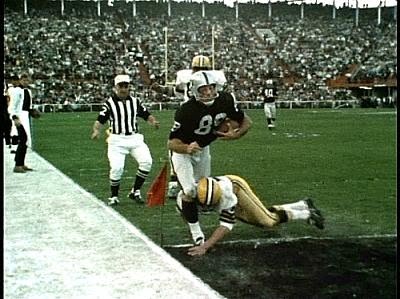
For the Raiders, Daryle Lamonica completed 15 of 34 passes for 208 yards with two TDs and one picked off. Bill Miller (pictured below) caught 5 passes for 84 yards and scored both of the club’s touchdowns. Hewritt Dixon was the leading ground gainer with 54 yards on 12 carries.
“We're a young team,” John Rauch said. “I was happy with the fact that at no point in the game did we give up. It's characteristic of our team. We hope to continue with our program and get better.”
The game was the last for Max McGee, hero of the first Super Bowl and 12-year veteran who caught one 35-yard pass against the Raiders, and Don Chandler, who booted the four field goals to end his 12-season career as a placekicker/punter (with the Giants as well as Green Bay) on a high note. But another departure for the Packers was the most significant of all.
A few days after the game, Vince Lombardi confirmed what was widely rumored and stepped down as head coach, although he remained the general manager for another year. It marked the end of a remarkable coaching tenure for the man whose name became attached to the trophy presented each season to the Super Bowl-winning team.


