Showing posts with label Otto Graham. Show all posts

Wednesday, December 22, 2010

1946: Browns Defeat Yankees for First AAFC Championship


The first season of the All-America Football Conference (AAFC) culminated in the Championship game at Cleveland’s Municipal Stadium on December 22, 1946. There were 41,181 fans in attendance on a cold and windy day to see if the Browns could cap their outstanding initial year with a title.

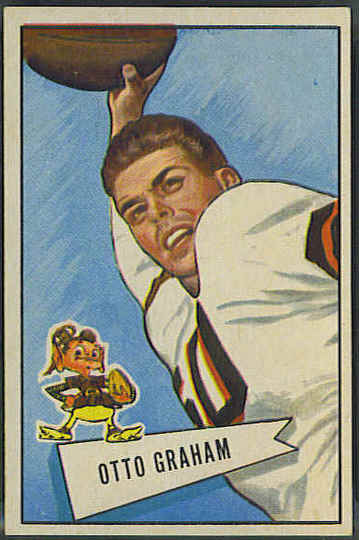
Under Head Coach Paul Brown, Cleveland had roared through the Western Division for a 12-2 record. QB Otto Graham (pictured above), a rookie ex-single wing tailback out of Northwestern, had proven adept at operating in the T-formation. Ends Mac Speedie and Dante Lavelli were outstanding, as was the running game led by FB Marion Motley and HB Edgar “Special Delivery” Jones. The Browns were every bit as sound defensively and did not allow an opponent to score in double digits in the first six games of the season (eight overall). In short, they scored the most points (423) and gave up the fewest (137).

The New York Yankees won the Eastern Division with a 10-3-1 tally under Head Coach Ray Flaherty, who had twice led the NFL’s Redskins to titles. Operating a single-wing offense, they had former Brooklyn star Ace Parker as the passing tailback and rookie Orban “Spec” Sanders, the AAFC’s leading rusher (709 yards). Other ex-NFL veterans who contributed heavily were G Bruiser Kinard and FB/LB Pug Manders. End Jack Russell led the receiving corps.

The Browns had not lost to an Eastern Division team during the course of the 14-game season, including the Yankees, a club they defeated twice (once by shutout). They were heavy favorites coming into the game – which proved to be a motivating factor for New York.


It was the Yankees scoring first in the opening period. Following FB/DB Eddie Prokop’s interception of a Graham pass that he returned to the Browns’ 34 yard line, Parker threw a 16-yard pass to Russell and Sanders ran 14 yards to the four. The Cleveland defense held and New York came away with a 21-yard field goal by Harvey Johnson (pictured at left).

A Cleveland drive to the Yankees’ three yard line came up empty, but the Browns came back in the second quarter with a 70-yard possession that was capped by a two-yard run by Motley. Graham completed five passes for 55 yards along the way. The score was 7-3 at the half.

Following a missed field goal attempt by Cleveland’s Lou Groza, the Yankees regained the lead in the third quarter thanks to an 80-yard possession that ended with Sanders plowing in for a touchdown, also from two yards out. The extra point attempt was missed, holding New York to a lead of 9-7.

It seemed as though the two-point margin might be enough for the upset, but the Browns put together a drive in the fourth quarter that culminated in a Graham pass to Lavelli for a 16-yard touchdown. Along the way, “Special Delivery” Jones made a shoestring catch to keep the drive alive at the New York 42. After missing on a pass intended for Speedie at the goal line, Graham threw to Lavelli who lateraled to HB Don Greenwood for an eight-yard gain. Following a seven-yard run by Jones and an 11-yard gain on a lateral to HB Tom Colella, Graham threw the TD pass.

New York wasn’t done yet, and Sanders returned the ensuing kickoff to the Cleveland 45. Tackle Lou Rymkus threw Prokop for a 12-yard loss, but Parker regained the yardage on a pass to end Perry Schwartz. However, Parker’s next throw was intercepted by Graham to snuff out the threat. The Browns won by a score of 14-9.

Cleveland outgained the Yankees (325 yards to 146) and had the edge in first downs (18 to 10). The vaunted New York rushing attack was held to just 65 yards on 29 attempts. The Yankees turned the ball over twice, while the Browns did so once on the early interception.

One of Cleveland’s problems was that Lou Groza, suffering from an ankle injury in the season finale against Brooklyn, had an uncharacteristically bad day kicking the ball, missing field goal attempts from 20, 42, and 48 yards. Chet Adams also was wide on a 37-yard try.


Otto Graham completed 16 of 27 passes for 213 yards with a touchdown and an interception. Dante Lavelli and Mac Speedie each caught six passes, with Lavelli gaining 87 yards and scoring a TD while Speedie had 71 yards. Marion Motley (pictured at right) ran for 98 yards on 13 attempts that included a 51-yard carry in the third quarter and a score.

Ace Parker, who came under a strong pass rush throughout the game, was successful on 8 of 18 passes for 81 yards and had the one late interception. Spec Sanders was the leading rusher for the Yankees with 55 yards on 14 carries and a TD. Jack Russell caught 5 passes for 58 yards.

The championship season was just the beginning for the Browns, who would dominate the AAFC in its four years of existence before moving on to the NFL.

The game was the last for Ace Parker, who had starred for six years in the NFL before coming to the AAFC. He was inducted into the Pro Football Hall of Fame in 1972.

Saturday, October 9, 2010

1949: Albert & Perry Star as 49ers Hand Browns Only Defeat of Season


Throughout the four seasons of the All-America Football Conference’s existence, the Cleveland Browns were clearly the best team, going 47-4-3 and winning the championship every year, and the San Francisco 49ers were second best at 38-14-2. Games between the two clubs were among the most highly attended in pro football history up to that time. While the 49ers were the first team to beat the Browns in 1946, they had lost the next five encounters, mostly by close scores, and missed out on postseason opportunities because both teams were in the Western Division.

On October 9, 1949 the 49ers hosted Cleveland at Kezar Stadium before 59,770 enthusiastic fans in their first encounter of the year. With the AAFC having dropped from eight teams to seven, division play had been done away with. The Browns, under Head Coach Paul Brown, came into the contest with a 4-0-1 record and had not lost since the sixth week of the 1947 season – including the postseason, a total of 29 straight games (they had been tied twice). San Francisco, coached by Buck Shaw, was 4-1 and had scored over 40 points in three of the wins.

The 49ers jumped off to a quick start with 21 points in the first 10 minutes of the game. QB Frankie Albert (pictured above) started off the scoring with a 16-yard touchdown pass to HB Johnny Strzykalski. Strzykalski scored a second TD a few minutes later on the next San Francisco possession with a short carry from inside the one.

Next, Albert threw his second touchdown pass, of 28 yards to FB Joe Perry, who made an outstanding one-handed catch. Before the first quarter ended, the Browns finally got on the board thanks to a 39-yard touchdown pass from QB Otto Graham to end Mac Speedie. It was followed in the second quarter by a Graham TD pass to end Dante Lavelli that covered 26 yards and Cleveland was down by just a touchdown at 21-14.

San Francisco came back as end Alyn Beals scored the 40th touchdown of his AAFC career on a 15-yard pass into the end zone from Albert. The Browns again closed the gap to seven points at 28-21 on a 13-yard Graham-to-Speedie pass. However, the 49ers scored once more before halftime as Albert tossed an eight-yard TD pass to end Nick Susoeff for a 35-21 lead.

After the high-scoring first half, there was only one score in the third quarter, but it padded the San Francisco margin as Albert threw his fifth touchdown pass of the game to HB Ed Carr.

Early in the fourth quarter, FB Marion Motley scored for the Browns on a 12-yard run down the center of the field, but the Niners responded with Perry scoring on a 49-yard run of his own. Carr iced the cake with a five-yard carry that finished off a 56-yard drive and the 49ers came away with a convincing 56-28 win.

The game was exceedingly physical, although no fights erupted. Both quarterbacks passed well, but the 49ers defense dominated the line of scrimmage and Graham was hit hard and sacked often. San Francisco ran up a season-high 507 total yards, to 367 for the Browns.

Key performers for San Francisco were Frankie Albert, who completed 16 of 24 passes for 249 yards with five touchdowns and three interceptions, and Joe Perry, who ran for 155 yards on 16 carries with two touchdowns. Cleveland’s Otto Graham was successful on 13 of 26 throws for 281 yards.

The win put the 49ers (5-1) in front of Cleveland (4-1-1) in the AAFC standings. However, the Browns recovered, not losing again the rest of the way, and finished with a 9-1-2 record. One of the wins came in the rematch with the 49ers in Cleveland, and San Francisco had also lost the week before to the New York Yankees. They once again came in second to the Browns at 9-3. However, in the single-division format of 1949, the top four clubs made it into the postseason. The Browns and 49ers each won their opening playoff game and the teams met for a third time in Cleveland, with the Browns prevailing 21-7 for the last AAFC title.


Joe Perry (pictured at left) was the AAFC’s leading rusher with 783 yards and also had the highest average gain per carry (6.8) on his 115 attempts with a league-leading eight touchdowns (tied with Cleveland’s Motley).

Frankie Albert, a mobile left-handed passer reminiscent of later 49ers star Steve Young, led the league in touchdown passes for the second straight year with 27 (his 88 TD passes were the most in the four-year history of the AAFC). His TD pass percentage of 10.4 was more than three yards higher than his nearest competitor, Otto Graham (6.7). However, he ranked second (behind Graham) in passer rating (82.2) and third in passing yards (1862), yards per attempt (7.2), and yards per completion (14.4). He also tossed 16 interceptions, which tied him for second in the AAFC with New York’s Don Panciera.

The demise of the AAFC after the ’49 season didn’t mean the demise of the Browns and 49ers. Along with the original version of the Baltimore Colts, they were absorbed into the NFL for 1950. The rivalry between the two teams diminished, however, as they played in different divisions and, from 1970 on, different conferences.

Friday, October 1, 2010

1950: Giants “Umbrella” Defense Shuts Down the Browns


After dominating the All-America Football Conference (AAFC) for four seasons, winning all four league title games, the Cleveland Browns took up residence in the NFL in 1950 and continued to win there as well. The Browns opened at Philadelphia, against the defending NFL champion Eagles, and beat them handily, 35-10. The following week they rolled over the Baltimore Colts, who also came over from the AAFC, by a 31-0 score.

Under innovative Head Coach Paul Brown, Cleveland had been utilizing a precision passing attack that NFL teams had not seen before (a prototype of the modern West Coast offense). QB Otto Graham threw to ends running sideline routes and backs on flare-out passes that the predominant defenses of the time – the 5-3-3 and 5-2-4 (Eagle) devised by Eagles Head Coach Greasy Neale – were unable to stop. Not only were the passes difficult to defend against, but by forcing the defensive linemen and linebackers to spread out, they became vulnerable to trap and draw plays up the middle.

On October 1 the Browns hosted the New York Giants at Municipal Stadium. However, the Giants came prepared. Head Coach Steve Owen (pictured above) devised a new defensive scheme in response to Cleveland’s passing attack. In addition to four defensive backs, as in the Eagle defense, he put six players on the line, but the ends often dropped back into pass coverage (like modern outside linebackers) and the middle guard was frequently backed off the line, creating a new position – middle linebacker.

The new scheme came to be called the “Umbrella” defense as, when diagramed, the defensive backs were fanned out behind the middle linebacker, who appeared to be the stem of the defensive umbrella. Essentially a 6-1-4 alignment, when the ends dropped back into coverage it became like a modern 4-3-4 defense.

The defensive backfield was made up of solid performers that included halfbacks Emlen Tunnell and Harmon Rowe and safeties Tom Landry and Otto Schnellbacher. John Cannady was the pioneering middle linebacker, behind a line anchored by All-Pro tackles Arnie Weinmeister and Al DeRogatis. The new defense proved more than adequate to the task against the Browns.

There were 37,647 fans in attendance on a humid but dry day as the Giants scored in the first quarter. Capping a 51-yard drive in which HB Gene Roberts rushed for 34 yards, FB Eddie Price bulled over for a touchdown from three yards out, but the extra point attempt was missed due to a fumbled snap (Roberts, pictured below, proved to be the key player on the Giants offense, rushing for 77 yards on 12 carries).


That was all that the Giants could muster, playing conservatively against the equally tough Cleveland defense, but the Browns were unable to advance into New York territory at all during the first half. Graham failed to complete any of his first seven passes.

Cleveland finally made it across the 50 yard line on three occasions during the second half, but twice gave up the ball on downs, at the New York 38 and 12 yard lines, to end long drives. On the last advance, late in the fourth quarter, the Browns were at the Giants’ eight when Graham and FB Marion Motley collided in the backfield when attempting a hand off on a trap play and fumbled; LB Dick Woodard recovered for the Giants to end the threat. New York held on to win by a 6-0 score.

It was the first time the powerful Browns had ever been shut out. They also had not lost a home game since three seasons before, in 1947 to the Los Angeles Dons.


Safeties Schnellbacher and Landry (pictured at left), who had both faced the Browns in the AAFC, played especially well in thwarting the vaunted Cleveland passing attack. Otto Graham completed just 12 of 30 passes for 127 yards and was intercepted three times.

Afterward, a philosophical Paul Brown said “At least we weren’t beaten by a big score. We just lost to a better team. New York was ready for us.”

The Giants proved to be ready when the teams met again in New York three weeks later, winning 17-13. No other club was able to beat Cleveland and the Giants lost games to the Steelers and Cardinals along the way; as a result, both clubs ended up tied atop the American Conference with 10-2 records at the end of the regular season. However, in the tiebreaking playoff, the Browns finally beat the Giants in another defensive struggle, 8-3, and went on to win the NFL Championship game against the Rams.

The new defense didn’t take hold right away, but the 4-3-4 became the predominant alignment by the end of the decade and, along with the 3-4-4 that was adopted by some teams starting in the 1970s, continues to be used.

The mastermind of the “Umbrella” defense, Steve Owen, was dismissed as head coach of the Giants following the 1953 season after 23 years. His innovative defensive coaching, combined with a preference for conservative, run-oriented offenses produced a 151-100-17 record (2-8 in the postseason).

Monday, September 6, 2010

1946: Browns Dominate Miami in First AAFC Contest


There were 60,135 fans at Cleveland’s Municipal Stadium on September 6, 1946 to witness the debut of a new pro football league, the All-America Football Conference (AAFC). The size of the crowd was notable in itself, for it was the larger than any that had assembled to watch a regular season NFL game to date.

The AAFC had been organized by Arch Ward, sports editor of The Chicago Tribune, who had previously brought major league baseball’s All-Star Game and football’s College All-Star Game into being. The league was determined to be truly national in scope, with teams on the west coast (San Francisco and Los Angeles) and southeast (Miami) as well as the major centers of New York City and Chicago (the NFL’s Rams moved from Cleveland to Los Angeles in 1946 to extend the older league’s reach as well). By and large, the AAFC franchise owners were wealthier than their NFL counterparts and prepared to spend money in the competition for talent.

One of the new AAFC owners was Arthur “Mickey” McBride in Cleveland, who had made his money in real estate and taxi services. He hired Paul Brown (pictured above) as head coach and general manager, a smart public relations – as well as football – move. Brown was already a semi-legendary figure in Ohio football from his coaching stints at Massillon High School and Ohio State. He had most recently coached during World War II at the Great Lakes Naval Training Station and, everywhere he had been, he had produced winning teams. Likely in tribute, when a fan contest to name the new club was held, “Browns” was the winner.

Brown signed players that he was familiar with from his college and service coaching, including Otto Graham, who had been a single-wing tailback at Northwestern; end Mac Speedie, from Utah but who Brown knew from service football; and end Dante Lavelli and tackle/placekicker Lou Groza, from Ohio State. There were also Bill Willis, a guard from Ohio State, and 230-pound fullback Marion Motley, who was familiar to Brown from high school and service teams, who were not only talented players but the first two African-Americans in the AAFC (the NFL’s Rams broke that league’s color barrier in ’46 also).

All of those players were making their pro debuts in the opening game along with the new franchise and league. Other significant Browns players who had at least some prior pro experience included HB Edgar “Special Delivery” Jones, who briefly played for the Chicago Bears in 1945; tackle Lou Rymkus, formerly of the Washington Redskins; and Gaylon Smith, an all-purpose back who had spent four seasons with the Cleveland Rams.

The Browns’ opponents in the season-opening game were the Miami Seahawks, coached by Jack Meagher. They fell quickly behind in the first quarter as QB Cliff Lewis threw a 19-yard touchdown pass to Speedie for the first score in Browns history. Groza followed with a 22-yard field goal for a 10-0 lead at the end of the first quarter.

It was 27-0 by halftime as the Browns broke the game open in the second quarter. Otto Graham threw the first TD pass of his illustrious career, of 39 yards to Lavelli, HB Tom Colella ran for a 50-yard touchdown, and Groza booted another field goal, from 27 yards out.

The defense added two more touchdowns in the fourth quarter, as HB Don Greenwood scored on a three-yard fumble return and HB Ray Terrell intercepted a pass and ran 76 yards. In between, Groza kicked his third field goal, of 21 yards.

The final score was 44-0 and demonstrated both the dominance of the Browns and the weakness of the Seahawks. “I couldn’t believe we beat a pro team 44-0”, said Lavelli afterward.

Cleveland won its first seven games and didn’t allow another club to score in double figures until the seventh contest. After losing for the first time to the team that would be their chief nemesis in the AAFC, the San Francisco 49ers, the Browns lost once more to the Los Angeles Dons before completing the regular season with a 12-2 record. Finishing at the top of the Western Division, they went on to defeat the New York Yankees for the league title.

As outstanding as the Browns were, the Miami Seahawks proved to be the biggest failure of the AAFC’s first season. Two of the club’s games were postponed by hurricanes and the team never drew more than 9700 fans at home (they scheduled their games on Monday nights). The Seahawks weren’t helped by the fact that seven of their first eight games were played on the road and they were already 1-7 by that point. They finished at the bottom of the Eastern Division with a 3-11 tally.

Coach Meagher resigned after six games and was replaced by player/coach Hamp Pool. Owner Harvey Hester went broke and the other teams were forced to pay off the club’s debts at the end of the season. The franchise was expelled and replaced by the first incarnation of the Baltimore Colts for 1947.

Tuesday, August 17, 2010

1951: Browns Dominate College All-Stars


After four seasons of dominance in the All-America Football Conference (AAFC), the Cleveland Browns joined the NFL in 1950 and won that league’s championship as well. As a result, on August 17, 1951 they faced off against a team of college football’s best players in the 18th annual College All-Star Game, sponsored by The Chicago Tribune on behalf of Chicago Charities.

There were 92,180 fans on hand at Chicago’s Soldier Field. The All-Stars were coached by Yale’s Herman Hickman and included future pro stars Kyle Rote, halfback from SMU; Northwestern end Don Stonesifer; tackles Bob Gain from Kentucky and Mike McCormack of Kansas (both of whom would go on to play for the Browns); and guard Bud McFadin of Texas.

Both teams started off slowly in the first quarter, with the lone score occurring when Rote fumbled a handoff in the end zone that was recovered by Notre Dame QB Bob Williams, who was promptly downed by Cleveland DE Len Ford for a safety. The Browns began to gain momentum, however, and early in the second quarter drove 56 yards in a series that ended with HB Dub Jones running for a two-yard touchdown.

Shortly before halftime Cleveland again put together a scoring drive highlighted by runs of 22 yards by FB Marion Motley and 20 yards by Jones. Lou Groza kicked a 17-yard field goal and the Browns had a 12-0 lead at the intermission.

In the third quarter, the Browns methodically moved the ball 62 yards on 10 plays, ending up with Dub Jones again scoring a touchdown on a short (three-yard) run. QB Otto Graham’s passing highlighted the next Browns drive, in the fourth quarter, and Graham connected with end Dante Lavelli on a 14-yard TD pass. The final TD came on a second Graham touchdown pass, this one of eight yards to FB Emerson Cole. When the onslaught was over, the Browns had won by a final score of 33-0.


Just as the All-Stars couldn’t stop the Cleveland offense, they couldn’t generate any offense of their own. They gained only five first downs and never penetrated beyond the Browns’ 45 yard line. Kyle Rote, who rushed eight times for 45 yards, had the longest gain of the day for the All-Stars with a run of 23 yards. Bud McFadin was named MVP for the collegians – the second time a guard had received the honor.

Dub Jones and Otto Graham were the stars for the Browns, with Jones gaining 105 yards rushing and scoring two touchdowns and Graham completing 16 of 30 passes for 263 yards and two TDs. Overall, Cleveland outgained the All-Stars 425 yards to 126.

It was the worst defeat the All-Stars had suffered up to that time, when most of the games had been competitive and the pro teams held only a nine to six advantage in wins, with two ties, coming into the 1951 game. More and more, as the series wore on until its conclusion in 1976, the pro teams dominated – the final tally would be 31 wins for the defending pro champions, 9 wins for the All-Stars, and the two ties.