Showing posts with label Birmingham Americans. Show all posts

Saturday, July 24, 2010

1974: Alfred Jenkins Gains 200 Receiving Yards as Birmingham Overwhelms Memphis


The Birmingham Americans and Memphis Southmen (or Grizzlies, as they were popularly referred to by the local fans) had won their first two World Football League games in 1974 and had already established themselves as among the better franchises in the league’s short history. The clubs met for the first time before 61,319 fans at Birmingham’s Legion Field on the night of July 24 in what proved to be a high-scoring affair.

The Americans, under Head Coach Jack Gotta, split the quarterback duties between veteran George Mira and Matthew Reed. The stable of running backs was led by former Bengal and Oiler Paul Robinson and included Jimmy Edwards, Carl Bartles, Charlie Harraway, and Art Cantrelle. WR Dennis Homan, a local favorite who had a modest NFL career after coming out of Alabama, had been drawing the primary coverage by opposing defenses, and this opened the door for fast rookie WR Alfred Jenkins.

Memphis was coached by John McVay and had created a sensation earlier in the year by signing three key members of the NFL champion Miami Dolphins (FB Larry Csonka, HB Jim Kiick, and WR Paul Warfield) to contracts for the ’75 season. However, those players were not available for 1974 and so the offense was led by RB J.J. Jennings, a former Rutgers standout; QB John Huarte, a former Heisman Trophy winner at Notre Dame who had been a career backup in the AFL and NFL; TE Gary Shirk, from Morehead State; and tall (6’5”) WR Ed Marshall.

The tone of the game was set on the Memphis offense’s first play when Huarte fumbled the snap and DE Dick Trower recovered at the Southmen nine yard line. Bartles ran three yards for the touchdown, and while the action point was no good, Birmingham had an early 7-0 lead.

After a Bob Etter field goal for Memphis cut the lead to 7-3, Mira threw to Jenkins for a 38-yard touchdown; once again the action point failed. Again, Mira connected with Jenkins for a long touchdown pass play that covered 74 yards for a 21-3 advantage (once more, the action point attempt was unsuccessful).

The Southmen came back as Huarte passed to Shirk for a 35-yard TD and, with a successful action point, the Birmingham margin was narrowed to 21-11. However, the Americans scored once more prior to the half as Mira connected on four passes in a 59-yard drive that culminated in a 12-yard touchdown throw to Homan. With yet another failed action point, the tally stood at 28-11 in favor of Birmingham at halftime.

Memphis scored quickly in the third quarter thanks to a five-play drive that featured a 46-yard run by RB John Harvey. Harvey completed the drive with a two-yard TD run and, after a successful Huarte-to-WR Roger Wallace pass for the action point, the Southmen were back in the contest at 28-19.

Mira suffered a sprained ankle while scrambling during the next possession, but that didn’t slow the Birmingham offense as Reed threw to Jenkins for a 52-yard touchdown on his first play. The Americans finally converted an action point and led by 36-19.

The Southmen didn’t give up as they responded with an 80-yard drive that ended with a one-yard TD run by Harvey, although they failed to make the action point. Again, Birmingham responded with a touchdown as Reed connected with TE Jim Bishop on a four-yard scoring pass. With a failed action point, the Americans now led by a 43-26 margin.

Aided by a pass interference call in the end zone, the Southmen came back once more to score on a one-yard TD run by Jennings, but a failed action point attempt kept the margin at ten points (43-33). Once more the Americans drove right back down the field with Robinson scoring on a two-yard touchdown carry and a successful action point. The back-and-forth nature of the second half finally ended when LB Steve Conley intercepted a Huarte pass and gave Birmingham good field position at its own 49. After a 31-yard carry by Robinson, Jimmy Edwards swerved his way to an 18-yard touchdown run. The action point was missed, but the margin proved decisive as the Americans defeated the Southmen, 58-33.

The Birmingham quarterbacks, Mira and Reed, combined for 367 yards and five touchdowns. Paul Robinson led the runners with 93 yards on 18 carries with a TD. The defense had forced six turnovers, including two fumbles and four interceptions. But the most spectacular performance was turned in by Alfred Jenkins as he caught 5 passes for 200 yards and three touchdowns (it could have been more, but an apparent long scoring play was called back due to a penalty – one of 14 the Americans committed). The 200 yards would remain the single-game record for pass receiving yards in the WFL’s short history.

For Memphis, John Huarte passed for 224 yards with a TD, but had four passes picked off. John Harvey rushed for 126 yards and two touchdowns on 16 carries, while Ed Marshall caught 6 passes for 114 yards.

Birmingham went on to finish at 15-5, putting them in second place in the Central Division behind the Southmen, who survived the high-scoring loss to post the league’s best record at 17-3. However, in the postseason Memphis was upset in the semifinal round by the Florida Blazers, who ended up losing the league championship game to the Americans.

Alfred Jenkins was a consensus All-League pick after catching 60 passes for a WFL-best 1326 yards with 12 touchdowns. He would parlay his notable WFL showing into an outstanding nine-year career with the NFL’s Atlanta Falcons.

Saturday, July 10, 2010

1974: WFL Debuts with Five Games


The World Football League kicked off its inaugural 20-week season with five games on July 10, 1974. The new league started off with 12 teams, along with great ambitions and several novelties. Most games were scheduled on Wednesday nights in order to avoid conflict with high school, college, and NFL games (a weekly nationally-televised game would be played on Thursdays). The July start (the league played no preseason games, although there were some intersquad scrimmages) gave the WFL a head start on the NFL, which was beset by a player’s strike during the preseason that kept veterans out of the training camps until late August.

The WFL instituted several rules changes, some of which the NFL had adopted for the ’74 season as well - they included moving the goal posts to the back of the end zone, allowing for an overtime period in case of ties, and bringing the ball back to the line of scrimmage if a field goal was missed outside the 20 yard line. While kickoffs in the NFL would now be from the 35 rather than 40 yard line, the WFL chose to kick off from the 30. Additionally, the new league banned fair catches of punts, allowed for forward motion by backs prior to the snap, required receivers to have just one foot in bounds for a catch to be legal, and prohibited the bumping of receivers beyond three yards of the line of scrimmage. Touchdowns would be seven, rather than six points, to be followed by an “action point” that could not be kicked. An invention called a “Dickerrod” was used instead of the traditional chains for measuring first down yardage.

There were 55,534 fans in JFK Stadium as the Philadelphia Bell hosted the Portland Storm, winning 33-8 behind QB Jim “King” Corcoran (pictured below left), who had the best passing night in the WFL’s first week. Corcoran, a semi-legendary figure in the world of minor league football, completed 21 of 38 passes for 227 yards and two touchdowns. The running tandem of Claude Watts (94 yards on 16 carries) and John Land (73 yards on 14 attempts) also had an impressive debut. WR Vince Papale, later to become celebrated as a walk-on free agent and special teams standout for the NFL’s Eagles, caught three passes for 39 yards.


Attendance at Orlando’s Tangerine Bowl was far less (18,625) as the Florida Blazers defeated The Hawaiians in a low-scoring 8-7 contest. RB Jim Strong was the star for the Blazers, catching a three-yard touchdown pass and then scoring the decisive action point. RB Derrick Williams gained 94 yards on 18 carries for The Hawaiians while Strong and fellow running backs Tommy Reamon and A.D. Whitfield combined for 104 yards for Florida. Blazers QB Bob Davis passed for only 55 yards and Norris Weese and Bill Donckers combined for just 106 yards for the Honolulu-based club.

A crowd of over 36,000 at Soldier Field saw the Chicago Fire record a 17-0 shutout of the visiting Houston Texans. QB Virgil Carter (pictured below right) threw two touchdown passes, although he also had three picked off. WR James Scott had 10 catches for 84 yards and one of the TDs. Houston ground out 116 yards rushing but veteran quarterbacks Don Trull and Mike Taliaferro passed for just 58 yards.


Legion Field in Birmingham was filled with 53,231 fans who saw the Birmingham Americans defeat the Southern California Sun by an 11-7 tally thanks to a 50-yard interception return for a touchdown by CB Steve Williams. RB Paul Robinson spurred the ground game with 79 of Birmingham’s 144 rushing yards although rookie RB Kermit Johnson of the Sun led all rushers with 88 yards on 24 attempts.

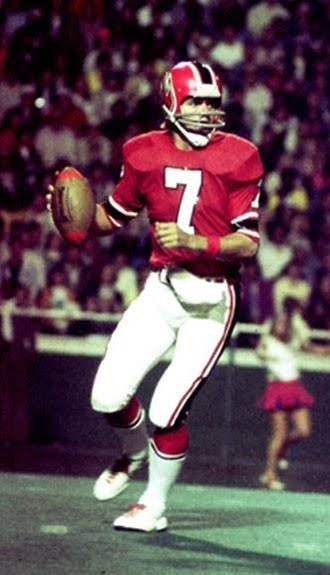
Elvis Presley was among 30,122 in attendance at the Liberty Bowl where the Memphis Southmen were winners over the Detroit Wheels, 34-15. Memphis RB J.J. Jennings (pictured at top) had the most rushing yards in the first week with 99, including a touchdown, and also caught four passes for 83 yards and another TD. Detroit WR Hubie Bryant had the best receiving game of the first week in defeat with 7 catches for 153 yards and a touchdown.

The following night, in the first nationally-televised contest with Commissioner Gary Davidson in attendance, the largest crowd of all, 59,112, was present at Jacksonville’s Gator Bowl as the Sharks defeated the New York Stars, 14-7. However, the game suffered a delay when a blown generator caused a blackout – it was perhaps a portent of bad things to come.

While the crowds were certainly encouraging, the scarcity of points was a disappointment. The league averaged just 13.8 points per game for the six contests. Scoring would improve as the season progressed, but other factors would cast a shadow over the WFL.

Several weeks into the season, it was divulged that attendance, particularly in Philadelphia and Jacksonville, had been considerably aided by the handing out of huge numbers of free tickets. Of the 55,534 fans at JFK Stadium, only 13,800 had actually paid; a crowd of 64,719 for the second home game, against New York, contained only 6200 paid attendees. The big opening night crowd at the Gator Bowl was padded by some 44,000 free passes.

League credibility never recovered from the disclosure, and the fact that the WFL was floating in a sea of red ink became clearer as the season progressed. By the end, 10 teams remained and two of those had relocated (Detroit and Jacksonville folded; the Houston Texans became the Shreveport Steamer and the Stars moved from New York to Charlotte, NC).